US Immigration on the Easiest Setting
pluralistic.net77 points by headalgorithm 4 hours ago
77 points by headalgorithm 4 hours ago
I want to share a couple of stories of immigration.
1. Personal. In the aftermath of 9/11, a simple switch from F1 Student Visa to H1 work visa became a perfect Kafkaesque nightmare. The consulate denied the visa without giving a reason. After two months of non-response, my company reached out to the congressman's office. Apparently, the consulate wanted a copy of my transcript and they reached out to my university, but did not tell me that. The university would not release my transcript without my permission, but did not tell me that DHS was asking for it. It was an infinite loop that left me out.
2. In 2006-2007, I was consulting for Hormel Foods (this time with a legit green card). There was a raid at one of their plants, and I was talking to a couple of middle managers who commented how difficult the jobs are, and people only last for a short time. Only migrants are willing to do the job. I would later learn that meat packing jobs used to be unionized, and that put limits on the number of animals processed per shift. The deregulation of the eighties did away with unions and regulations, and created an untenable work situation. This can ONLY be done by disposable labor, which happens to be immigrants.
A simple solution to the immigration problem would be to arrest the CEO of the company employing illegals. Perhaps that will percolate down to the line level to make the jobs humane.
Cato maintains this fun flowchart for legal immigration : https://www.cato.org/sites/cato.org/files/styles/pubs_2x/pub....
I don't see VAWA derived visas on there. That's probably one of the most straightforward ones. Those who can credibly claim or frame sex trafficking, or in some cases domestic violence, against a US citizen can go straight to a visa. Obviously this has severe moral hazard.
My family came to the US via Ellis Island. Compared to what people have to do today, their legal path to US citizenship was relatively easy. I see no reason that becoming a citizen today should be any more difficult today than it was in the early 20th century. Open a 21st century equivalent of Ellis Island, and let people become citizens.
The growth of a welfare system seems like the major change. How does that plan interact with the welfare system? If someone is impoverished in Asia can they get a plane ticket to the US and expect to eventually be entitled to a state-sponsored minimum standard of living? Maybe healthcare if the left's plans for that get through eventually?
The welfare system requires a stable population pyramid and currently the US is under-reproducing for that to happen. Without some immigration, the existing welfare system will become impossible to maintain.
The reality is that many rich industries are built on the backs of illegal workers. If countries would punish those who hire illegal workers more than they do the illegal workers themselves, the resulting collapse of the agricultural and food industries alone should prove that the current systems are already being held up by people who do not participate in the welfare system.
The people who would've come through Ellis Island are still coming in, they're just not getting registered anymore, and the people and government have turned a blind eye so they can cheaply dismiss them when they're no longer necessary/when they need to act as a scapegoat.
The experience in Europe is that immigrants from most of the world are not net contributors to government finances: https://www.economist.com/europe/2021/12/18/why-have-danes-t...
> Many fear that refugees are a drain on their welfare state
At least the excerpt of the article you linked say that people fear that, but does not provide any numbers to say that this fear makes sense or not.
> should prove that the current systems are already being held up by people who do not participate in the welfare system.
Well, yes. If there is a pool of workers who aren't covered by the welfare system then it would work out fine to just let them migrate. Big wins for everyone. Probably works great every time it is tried. And if you're arguing that in practice there is an underclass in the US that isn't getting welfare and that works then sure, easy to see.
But, and I'm just going by vague rumours from reading US political news, there seems to be a significant number of people who would want US citizens covered by a welfare system. Phrases like "Universal" and "Basic Human Right" turn up from time to time. The people arguing against offering everyone in a country general support have lost a lot of arguments in parliaments around the world since ... around the late 1800s with Bismark as I vaguely recall. It comes off as unfair and unreasonable.
Frankly I imagine the US political process will start asking why undocumented migrants aren't getting welfare of some sort fairly soon if it isn't already resolved that they get something. That seems like it'd be in line with the general trends. If they are there to stay they're locals.
How does all this square up with easy, formal migration? In a practical sense? Rough numbers?
I've heard this argument going back to Milton Friedman, but the immigration discourse these days is quite detached from any economic concerns. Forget impoverished people; there is rabid opposition to pretty much all immigration including, for example, investor or employment categories. It's a lot more tribal than rational.
Yes but people face censure, ostracism, witch hunts and unemployment if we openly advocate for an ethnic homeland for our people. With recent legislation here in Australia, I potentially face 5 years in prison for voicing such an opinion. So we generally stick to "safe" arguments like the economic ones.
> With recent legislation here in Australia
Are you of Aboriginal extraction? Otherwise, I'm not sure an ethnic homeland for you would be Australia, right?
This stuff is so weird, as basically all humans migrated to wherever they are now. Like, I'm pretty sure that I have Celtic, Norman, Viking and other ancestors, despite my official ancestry being Irish (and all of my last 3-4 generations being born in Ireland).
Is it culture? That would seem to be what people are actually looking for, and I can definitely see the appeal, but culture is something that is generated from interaction with other members of a culture, and isn't dependent on genetics (consider how you or I might behave in OpenAI vs Anthropic vs Goldman Sachs).
Sure. But hypothetically, if we pretend people are rational for a few minutes here, how does the Ellis Island idea interact with a functional welfare system?
Friedman's argument was more so to just keep them as illegals but not deport them. That way they can support the welfare system but not use it. Friedman didn't want to make them legal until the welfare system has been crushed.
Of course that might require some changes to make it actually true illegals don't use state benefits. You need to cut off WIC for illegals, public schooling for illegals for instance before they will actually not be using public benefit. Also their children become legal via jus soli.
The obvious down-side is that those citizens / legal residents who have the skill level of illegal immigrants (sad, but commonly true) will see their real wages depressed and more competition for the job.
High skill immigration still brings cultural change. My parents came here from Bangladesh, and while they superficially assimilated, they’re still culturally Bangladeshi. They, like virtually all the Bangladeshis and Indians I know, still overvalue formal education, undervalue risk taking, elevate familial over civic obligation, don’t value economic modesty, believe elites should rule over “the common people,” etc. And this was despite spending 35 years almost completely isolated from other Bangladeshis. Culture is very deep and not easily changed.
Libertarians assign culture zero substantive value, viewing people as fungible economic actors. Like many libertarian assumptions, that one isn’t grounded in empirical observation.
> Culture is very deep and not easily changed.
This seems somewhat incorrect to me, as people change jobs and with it, culture, basically all of the time.
The cultural differences between companies in a country are superficial compared to the cultural differences between countries.
We have strong evidence that deeper cultural, everything from attitudes towards saving, government, and social trust, persists for generations after immigration: https://www.nas.org/academic-questions/36/2/rethinking-immig... (“The authors found that forty-six percent of home-country attitudes toward trust persist in second- and fourth-generation immigrants—in the adults whose parents, grandparents, and great-grandparents were immigrants. People from high-trust societies, like Sørensen, transmit about half of their high-trust attitudes to their descendants, and people from low-trust societies do the same with their low-trust attitudes.”).
You can see this just by going around the country. Scandinavia has much higher social trust than Italy. The upper midwest, where Scandinavian immigration dominated, has higher social trust than NJ/NY, which saw mass immigration from southern Italy.
Think about your own life. How important is food to your family and friends as a way of social bonding? Do you think you’d be able to change that easily?
Ellis Island opened in 1892. You don’t see any salient differences between then and now? How about the fact that the U.S. was vastly less populated?
Also, what makes us think that the Ellis Island experiment was successful? I can’t help but notice that New Jersey doesn’t resemble orderly Puritan New England. Assimilation didn’t really work!
Your family had to leave everything behind, risking a weeks-long journey at sea costing them everything they ever had, going into the unknown - at a time where nobody could travel. The US was not as rich, or built, or anything.
People today get a 50$ plane ticket and move straight to the Bay Area.
You don't see why things need to change?
Where can I buy a international plane ticket for $50 ?
With Ryanair, Easyjet and other similar carriers. Not to the Bay area though, at least not yet.
Buddy, what are you on about? This sounds just like all those welfare queens in Cadillacs GHW Bush was telling us about.
It is counter-intuitive that the more accomplished you are, the more evidence you need to provide. The part about the child not getting a naturalization certificate even though they are naturalized is very weird -- that should be fixed administratively.
Anyway, I don't think the O-1 / EB-1A is the easiest setting. An even easier setting is to become a tenure-track professor at a reasonable university in a technical field, e.g., computer science. That gives you an H1-B without any drama. An EB-1B green card requires a lot of evidence, but maybe a few pages less than an EB-1A green card.
Finally, getting citizenship is trivial. It's the green card that is hard to get.
He is a US citizen? Three nationalities?
His reasons for leaving the UK make interesting reading in current circumstances:
> The USA is putting curbs on surveillance, expanding its national healthcare, and there are mass parental boycotts of standardised testing in its public schools. The UK just elected a Tory majority government that's going to continue to slash and burn the welfare state, attack schools, health, legal aid and teachers, and impose mandatory cryptographic backdoors in the technology we use to talk to each other. They've even announced that merely not breaking the law is no reason to expect that you won't be arrested.
https://boingboing.net/2015/06/29/why-im-leaving-london.html
Edit: improved wording below and added quote
A lot of his other problems are London specific. Why do people forget the rest of the UK exists?
> London is a city whose two priorities are being a playground for corrupt global elites who turn neighbourhoods into soulless collections of empty safe-deposit boxes in the sky, and encouraging the feckless criminality of the finance industry. These two facts are not unrelated.
> My office rent has doubled this decade. We live in 600 square feet, up six flights of stairs, and can't possibly afford anything even remotely larger.
> We've seen the writing on the wall: this is not a city for families. It's not a city for people running small firms. It's not a city for people who earn their living in the arts. We've given it the best we have, and we're getting out because we can.
>Its all very London specific.
Your comment is a bit confusing. Did you mean everything except the part you quoted only applies to London? The part you quoted is about the UK not London and seems to contain all that is necessary for someone to understand why a person like Doctorow would have considered leaving at that point in time.
Good point. I have edited my comment to replace the "all".
You are right, its pretty much everything except what I quoted.
At first, I couldn’t believe it, but Cory Doctorow did write that terrible blog post. (Un)Surprisingly, everything turned out quite differently than expected. London outshines LA in many ways, except for the weather.
The difficulties of the US immigration system is one of the reasons that made me give up of the US. I (unfortunately) moved to the US when I was younger on a tourist visa and had an overstay. After realizing I didn't have many options to become a legal resident, I gave up. Too hard to navigate it. Nowadays I live in the Netherlands, with my second citizenship (from another EU country). A lot easier. It feels quite contradictory that a country that has its history tied to immigration has a worst immigration system than countries that historically are not so tied to immigration.
Strong opinion loosely held, but the U.S. immigration (not refugee) policy should be:
   1. You are going to school? Great! Go to the DMV with reasonable documentation (student ID and registration paperwork?) and you get a year-long visa. Renew each year, welcome to America!
   2. You have a job? Great! Go to the DMV with reasonable documentation (a couple pay stubs?) and you get a year-long visa. Renew each year, welcome to America!
   3. You don't have a job yet? Great! Go to the DMV with reasonable documentation of self-sufficiency (bank statement?) and you get a 3-month visa while you look for work. Renew each 3 months for as long as you can prove self-sufficiency, welcome to America!
   4. You have none of the above, but you are the spouse/dependent on someone who does? Great! Go to the DMV with them, with proof of the relationship (marriage/birth certificate or the person signing an attestation) and you get a visa to match theirs, welcome to America!
   5. You have none of the above but you are a refugee? Not great for you, but: go to the DMV to register yourself and get a date for review. With the money we save on enforcement, that review should be within weeks if not days. Welcome to America! (for now, subject to review)
   6. You have none of the above and run out of money? I'm sorry about that, please return to your home country.
   7. You're on the national list of Certified Bad People? You're going back to your home country, No America For You. And we have biometric information on you to ensure you never come back. Did I mention the DMV gets FaceID and DNA swabs?
Generally a sensible list, except I'm sure you have seen how the national list of "Certified Bad People" is used these days. A majority of people that ICE rounds up have no convictions or traffic type issues (https://www.cato.org/blog/5-ice-detainees-have-violent-convi...).
Literally just walked out of a language test for UK path on this.
Even though they can technically use your uni degree as proof of English speaking ability that process seems designed to be unworkable. So off we go to do a grade 5 language test…
And yeah also need years of travel history which is a pain in Europe where a cross border weekend getaway is a thing. Or worse via bus and ship. I don’t fuckin know what bus I was on years ago
This is not the easiest setting.
I became American as a previously British citizen. I had been employed in the UK, by a company in California who wanted to relocate me to the US and did (I was an early H1-B).
I then moved to another company after 18 months. Both my first and second companies were applying for my green card and renewing my paperwork as needed for me.
Later I stopped working for a US company but still had a VISA and married a US citizen. I then handled my green card application, and citizenship, myself without lawyers.
As a highly qualified individual who had already been screened multiple times to get H1-Bs I knew I would pass further screening. I also knew I had no criminal records or adverse history globally.
In short I got my green card and my citizenship without any further professional legal help. I paid nothing but my own costs.
It took a couple of years but it is possible.
The process is torturous and repetitive. You have to resubmit the same information multiple times, and some of the requirements are extremely expensive.
To whit, I was required to produce a “Police letter” from every country I had lived in, signed by the local police, attesting to the fact I hadn’t broken any laws overseas.
I had lived in 4 continents at that point. Thus I had to arrange to send my ID to multiple countries and to pay, in some cases, for letters to be written, delivered as originals on paper and then (hilariously) pay to have them translated for a US government who only wants to work in English and apparently trusts whatever translation you send (this was pre LLM).
So though I could do all this, in one case paying an ex colleague to manage the police in Eastern Europe on my behalf, for many others this would be impossible and require lawyers and the huge markups they would charge for these services. I would guess them hiring another team of lawyers in another country with each stage doubling the costs of the ones beneath them meaning a single police letter ends up costing many thousands.
The system is thus absolutely limited to those with connections, deep pockets or sponsorship.
Also for those who think this is good insurance, I also know Central Europeans who bribed their local authorities to facilitate their green cards, covering adverse information and putting them at the tops of lists. Ie for $50k or so they got essentially instant residency status.
Also the need for people to leave the US before re entering when processing paperwork (so that if rejected you have already self deported) means you need to be able to stop working, or work remotely, and to be able to fund living in your old home country for an indefinite period.
I moved in with my parents but had they not been an option I would have had to rent a place in London - a vast expense - just to comply.
The system is incredibly broken.
What year was this? I also did everything on my own after marrying an American citizen (2010-15) and I didn't have to do anything so extreme!
I don't understand the premise of this. The author goes on and on (and on) about how "Americans have no idea how weird and tortuous their immigration system is" but doesn't really give any evidence. I wonder if they ever have spoken to an American? They must have some extremely out of touch social circles.
Here in the real world, every American I know knows that the only way for "normal" (non-rich, non-connected, non-extraordinary) person to legally immigrate is to marry an American citizen and have them sponsor you. Literally everyone knows the average "illegal immigrant" living in the US isn't eligible for citizenship and couldn't obtain citizenship legally. Exactly zero people think that any (let alone most) "illegal immigrants" could have just "followed the rules" and been able to live here legally. The reason they are "illegal immigrants" is because there's no legal way, other than marrying an American.
A lot of people would prefer if even family sponsorships didn't exist. Many people think of that as "gaming the system" because they allow "average" people to be immigrants. I assume Republicans want to get rid of this.
> A lot of people would prefer if even family sponsorships didn't exist. Many people think of that as "gaming the system" because they allow "average" people to be immigrants. I assume Republicans want to get rid of this.
I think Republicans didn’t really understand that this existed until recently. And yes, many want to get rid of it, because it’s a loophole in the skilled immigration system. We apply aggressive filters to 65,000 H1Bs or whatever, and hundreds of thousands of low skill people come over because they’re someone’s cousin.
The author is mostly correct. A lot of discourse in America revolves around, "Why don't they get come in legally?"
>A lot of discourse in America revolves around, "Why don't get come in legally?"
Do you honestly believe that people who say "Why don't [they] come in legally?" are complaining about a lack of administrative process? Do you really, honestly believe that? Because if you do I have a bridge in Brooklyn I can give you a great deal on.
"Why don't [they] come in legally?" is just conservative doublespeak for for "they don't belong here." It's begging the question and everyone knows that, even the person saying it. They know there's no legal avenue for the vast majority of "illegal immigrants."
You’re attacking a strawman. The administrative process is not the end in itself. It’s the process we use to control the number and type of immigrants. The fact that most people wouldn’t be able to get through the legal system is exactly the point! It’s like any other administrative system for controlling access to a fixed number of slots.
It's a bit of both. I would wager that most Americans believe that there are reasonable pathways, either through education, work, family ties, or even asylum, to "legally" immigrate to the US. They have never dealt with the Kafkaesque nightmare that is USCIS or the State Dept.
I have always thought of it like this: U.S. citizens have the right to marry and bring home anyone they want. It is not about the immigrant. For example, if you're stationed on a military base on Japan or Germany, you can meet a local girl, fall in love, and bring her back home.
"Chain migration" however is more questionable.
I'm familiar with immigration in a few countries - in my experience, whatever the background of the country (Western, Eastern, Middle Eastern...) it's all "torturous".
If I was an acolyte of Freud or Jung I would say that this dichotomy between "easygration" and "immigration" (im is for impossible, right?) is because easygration is the result of sex and being born in a country (yes yes pedants, that's changing now and not universal, but swallow your pedantry presently and persist with this a moment), and the "STATE" in its everquest to control all aspects of human existence, necessarily seeks to control and intermediate sex and all its analogs (as sex is the intimacy of individuals it seeks to control, it must get between there, too). So if sex-migration (by being born) is easy (as some concessions must be made), then the corresponding path must be a gauntlet gated by the difficulty proportional to how much the state wants to intermediate the individual's intimate affairs. The hard path of immigration, is then a mirror of the control the state ultimately seeks to exercise over every aspect of existence, but which for now, it is constrained by the modesty and norms of its people to resist.
TL;DR - immigration is hard because states can't control yet sex and intimacy as much as they want, so they control the next best thing, that thing which is accepted to arise from the result of sex and intimacy - citizenship or right of abode by birth.
Also one can make the obvious metaphors with borders, porosity, and penetration. One might be inclined to say: the state must currently tolerate the annoying promiscuity of its individuals, so it, in spite and compensation, becomes ultrachaste in turn, wrt its own intimate borders.
But I am not an acolyte of Freud or Jung. Tho sometimes I think as above.
Like the author, I have a lot of personal experience with this. Going through it basically forces you to become an expert in things don't really want to know anything about.
What stuck out to me is that despite obviously being a smart and educated person and having the help of immigration lawyers, the author has made a mistake. Sepcifically this:
> I checked in with our lawyers and was told that the kid couldn't get her certificate of citizenship until she turned 18
When you apply to be naturalized (N400) then your children become US citizens by operation of law as long as they are in your physical custody and are under 18. The "certificate of citizenship" the author is talking about is called Form N600 and it specifically doesn't require the child to be over 18. Go and read the instructions for it [1].
If you know nothing about this, you might be confused because the author says his daughter has a US passport. Isn't that the same thing? No.
This comes up a lot when US citizens adopt children from outside the US. This essentially causes them to become US citizens (there's a whole process) but some parents fail to go through the application and formally recognize their child as a US citizen.
But how does the child travel internationally before any of this happens? There's an allowance for them to get a US passport even though they may not be US citizens. Weird, huh? Some people mistakenly think just having a US passport is proof of US citizenship but it isn't.
So here's my advice to anyone who has a child when they naturalize or adopts a child from overseas: IMMEDIATELY file an N600 for that child so they have proof they are a US citizen. This can be incredibly difficult and costly to reconstruct later when paperwork may have gone missing.
[1]: https://www.uscis.gov/sites/default/files/document/forms/n-6...
It must be said that immigration laws pretty much anywhere are rigid, and enforced equally seriously, so it's not just a US-exclusive thing. Very liberal European countries which the media portrays as "overrun" with immigrants will also throw (and ban) you out if you've done seemingly insignificant errors in your paperwork.
WITH THAT SAID, one side-effect of having such extensive laws is that it really depends on how much you enforce them. If you make laws so difficult and hard that anyone can fail them, but remain quite selective on how you enforce them, that means you have a green light to deport the people that are deemed undesirable, while also having the option to turn a blind eye to desirable people.
One small error can easily get some random Indian or Mexican worker deported, even if they've worked in the US for 20+ years, if the state feels so. Meanwhile I suspect they wouldn't do a damn thing if it turns out that some immigration billionaire outright lied on their paperwork.
Also, I hate to pull the fascism card, but one hallmark of fascism is to make laws so rigid (and punishment draconian) that everyone is potentially a criminal, but then very selectively enforce those laws.
I don't think US immigration laws are rooted in fascism, not at all - they're the product of decades / centuries of complex immigration...but how you enforce them, is a different thing.
>It must be said that immigration laws pretty much anywhere are rigid, and enforced equally seriously, so it's not just a US-exclusive thing
I'm puzzled how you came to this conclusion since its left completely unsubstantiated in your comment. It's not "enforced equally seriously" in the US itself let alone another country. European citizens for one had no fear of being sent to a detention camp or deported speedily prior to the latest Trump adminstration.
People in Europe are regularly deported for lying on their immigration application papers. Hell, even children of refugees are being deported for mistakes made by their parents. A quite common scenario is that someone applies for refugee status, but lie where they come from. Then years/decades later it is uncovered, and they are notified to leave the country within months.
I guess the big difference here is that we don't have immigration officers roaming the streets, snatching up people and shipping them to random holding centers. But you can *absolutely* expect to be apprehended if you've received notice, and don't do anything about it. Same goes for criminals that roam around (which is easy due to Schengen), get caught, and are ordered to leave.
From time to time you'll read stories here about people that came here as kids, their parents lied on the application (said the were from Afghanistan/Iraq or similar worn-torn countries back then, but in reality came from some neighboring countries), and now they too have been order to leave - even though they have zero connections with their birth countries.
In Norway, a country with population 5.6 million, around 2500 people were deported in 2024. Per capita that's around 3-4 times less than the US - but we don't necessarily have the same types of immigrants.
> Meanwhile I suspect they wouldn't do a damn thing if it turns out that some immigration billionaire outright lied on their paperwork.
We don't have to guess this. We have evidence. Elon Musk is worked illegally in the US [1] and then later obtained a green card then citizenship. He didn't acquire his green card through marriage to a US citizen (where unauthorized work is forgiven).
So if you look at his original I485 (adjustment of status) and N400 (naturalization), you would need to see how he answered the questions about unauthorized work. If he answered yes, he may have been ineligible. If he answered no, then that's a misrepresentation and the government could denaturalize him on the basis that his original green card was improperly granted.
Will any of that ever happen? No.
[1]: https://www.theguardian.com/technology/2024/oct/26/elon-musk...
[flagged]
> There also seems to be a common belief that just because the laws are unfair, stupid, counterproductive or destructive that they can be ignored and that isn't how laws work. If the law is terrible it is still the law. If it doesn't let you do what you want to do then that desired course of action is not a legal option.
Well then explain to me how the US Marijuana industry exists despite it being a schedule 1 controlled substance.
Laws are a social construct and their enforcement is based on what society thinks is ok. People don’t want to throw their community members is jail for marijuana. They do want to throw murderers in jail. They don’t want to throw upstanding community members who just don’t have the right immigration status in jail either.
Question is - why would anyone with cash immigrate to US? Doing business there does not require citizenship. What is it more than doing business that attracts people if one has a citizenship of just about any first world country? I mean, America is about making money, but those people already have money, what else? Citizenship for kids? Just give birth in US. Question again, is why. Top concern for the rich is taxes. US is unique by forcing people to pay taxes even if they live abroad full time as long as they hold citizenship. Why then?
If you're rich America is one of the safest places in the world: you can access the best hospitals in the world and well-armed private security. Citizenship means you can't suddenly be kicked out for expressing your political views.
Higher salary jobs and some very attractive nature. I have chosen _not_ to move there despite those.
I’ve also gone through the US immigration system - got a green card, then naturalized. I did everything myself. And then I did everything for a friend who asked for my help.
It’s not hard. It’s just time consuming and the wait times are very long. But it’s really not difficult to fill out the forms and I never used a lawyer.
Would it have remained as easy if you were scooped up off the street one day by masked men, and deported to a country you've never been to?
Your greencard or documentation may be of no consequence to these masked men, it's up to their mercy or their face scanning app to determine the status you actually have. They may accept your documents at face value OR just deport you no questions asked.
What about the N-600 form which the article highlights as an impossible barrier for many immigrants to attain their certificate of citizenship. That isn't hard?
Summary: legal immigration is very difficult to impossible.
The solution, IMO, isn't "just enter illegally". When you're not a citizen then, quite frankly, the fact that you want to immigrate doesn't matter. It's the country that says whether you should get in or not.
Not all immigration is created equal. There's the economic migration and asylum seekers. Those are 2 distinct groups of people with different motives.
For the true asylum seekers, that feat for their life wherever they're from for example, the laws of the country they're entering just don't matter. If it's a choice between life as an illegal or death I think we would all choose life.
For the economic cases, sure. That's where the legal immigration system applies. And I agree with what you said about rules and each country gets to decide.
What a novel, insightful conclusion. Thanks for sharing.
Funny, how the anti ICE crowd wants people to immigrate illegally. What about voting somebody to the office and changing the laws instead?
People have wanted to do the same with abortion and medicare for all as well (both of which poll very highly) and yet neither of these popular policies are law.
Are you stupid? Where does Doctorow's post advocate for illegal immigration?
The entire post reads like a justification to illegal immigration, no?
No, it reads like an explanation of the pain-in-the-ass called immigrating to the US.
The Europeans didn't refrain from creating colonies in the Americas after learning it was already inhabited.
Immigrants and their children account for 27% of the American population. Almost a quarter of people who either were born in a foreign country or raised by someone who was. Clearly immigration to America isn’t hard. Judging by the numbers, it’s too easy.
> Judging by the numbers, it’s too easy
I don't see how the numbers support that claim.
What percentage of the population would you like to see made up of immigrants? Would you make immigration harder if the immigrant populating was above 1%?
If it got too high, would you start deporting people or forcing native people to have more children?
You want the number to be small enough where the cultural and social impact of immigrants is controlled. We don't want America to become more like India or Bangladesh or places like that, so we need to keep immigration low enough where the native culture overwhelms that of the immigrants.
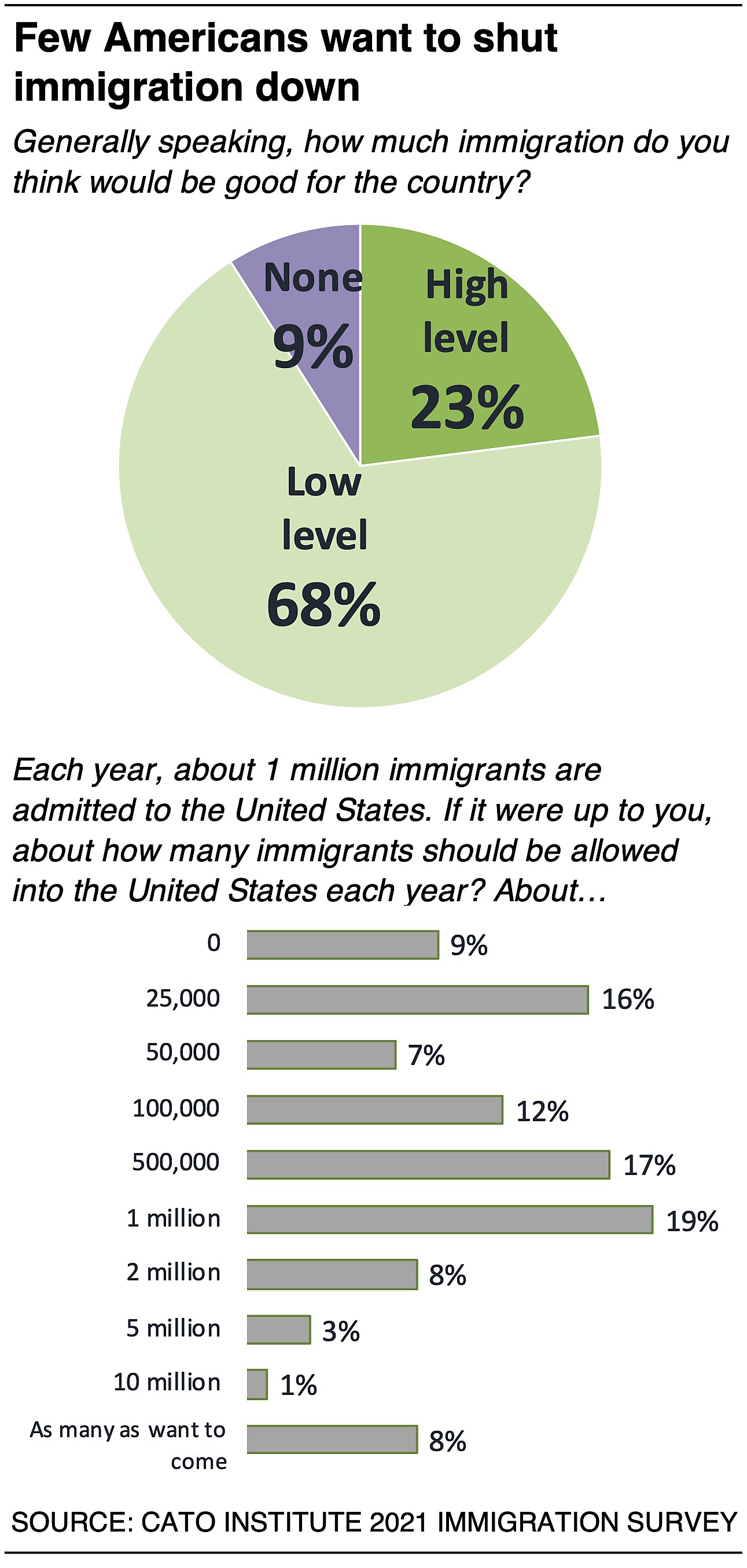
According to a 2021 Cato survey--which is a pro-immigration outfit--the median response to "how many immigrants should be allowed each year" was 500,000: https://www.cato.org/sites/cato.org/files/styles/aside_3x/pu.... If we enforced that number long term, we'd probably end up with a foreign-born population under 5%, as we had in 1970. That seems like an appropriate number to foster cultural homogeneity and a high level of social cohesion.
Immigrants account for ~98% of the American population.
There is a fundamental difference between settlers, who create a society, and immigrants, who move into a society that already exists. America was established by mostly British settlers. Folks on HN of all places should be able to understand the importance of founders.
It's self-evident that this difference between settlers and immigrants has a huge impact. Australia, Canada, and the United States are very similar to each other in terms of language, law, economics, etc. But the U.S. separated from the parent society, Britain, 250 years ago. Subsequently, those countries underwent completely different immigration patterns. So why are those countries so similar? It's because of the difference between settlers and immigrants.
America was pretty "settled" when Italian immigrants showed up in the 1910s-20s. Or the millions of Germans in the late 1800s. Or the millions of British and Irish a generation before that. Not every white American has ancestors who stepped off the Mayflower. The majority are - by your own definition - immigrants.
I agree that the majority of Americans are immigrants. But you said 98% above. Probably 40% of American are descended from settlers or African slaves, the people who constitute the founding population.
19th century Germans and Scandinavians are difficult to categorize. On one hand, the nation was well established by the time they came. On the other hand, they were the original settlers, creating greenfield cities, in large swaths of the country. Depending on how you count them, a majority of Americans may not have immigrant ancestry. But it’s surely a very large fraction.
100% if you go back a little further. Large hominids aren’t native to this continent.
BTW have you ever thought about what incredible bad asses people had to be to cross the Bering strait during the ice age with Stone Age tech? We could definitely settle space if we had the will. It’d probably be more comfortable, safer, and easier, even in the early days, than that.
100% of the population of everywhere other than parts of Africa if you go back far enough.
But Japan is clearly different from India, right? So how useful is that out-of-Africa factoid for analyzing modern societies?
That is my point.
The comment saying immigrants are 98% of the population of the US is not useful because they are people whose ancestors have been their for many generations.
Defining anyone who has immigrant ancestry as an immigrant is pointless. Sometimes it is useful to talk about, say, second generation immigrants, but not endlessly.
For one thing, after a generation or two the culture of people descended from immigrants diverges from that of their ancestors, even if their ancestry is limited to just one culture.
That was not even half as badass as taking slaves from Africa, stuffing them in ships and shipping them across the Atlantic. That must have taken some serious grit.
> Clearly immigration to America isn’t hard. Judging by the numbers, it’s too easy.
Just tell me, have you ever gone through it? My guess? You haven't as you would think a little different of how easy it is.
And yes, I have.
I didn't have a U.S. passport until I was in high school, despite living in the U.S. since I was five. Lots of my family has gone through the process; I have a cousin going through it right now.