New iPad mini
apple.com159 points by soheilpro 15 hours ago
159 points by soheilpro 15 hours ago
They should stop handicapping the non-Pro displays at 60hz refresh rate. The world moved on 5 years ago. It’s getting tiring now.
Has any non pro consumer ever noticed a display greater than 60 hz. I can barely get the regular people in my life to nice anything above 30 hz or turning off motion smoothing. I really don't see how any of this stuff matters for most people
Someone was complaining to me that Apple took a long time to add 120 Hz displays to phones. I didn't even know what my iPhone had, turns out it's 60 Hz cause it's a 12 mini. I've used 120 Hz displays before. Cannot tell the difference.
If you use a 120 Hz iPhone for 6 months and then switch back to your 12 mini, you'll notice immediately.
If something is not noticeable when it gets "better", but it leads people to notice other stuff is "worse" over time, then I'd argue it's not actually a good thing to get.
Imagine if someone said "this food won't really taste better to you when you first eat it, but after 6 months you'll find other food tastes worse". To me, this would not be a selling point.
I don't think that's a good comparison.
I've often had new phones that are 'faster' but I barely notice the fastness until I go back to my old phone and realise that my finger-memory needs adapting because things take just a bit longer to load.
I'd assume it's similar for screen refresh rates.
Some people are born with nervous systems which aren’t capable of noticing the difference, just like there are people who can’t see better than 20/20 no matter how good their optical acuity is.
Maybe I'd be able to tell in a blind test if I'm looking for it. Just meant it's not something I'd passively notice.
If you have any devices with a faster screen, you can see them side-by-side on https://testufo.com/
Not a blind test, but the smoothness when tracking a moving object is very obvious
Thanks for the link, checked it and well even side by side on my mbp, the difference is not that super obvious. 30 to 60 fps is very obvious and night and day. 60 fps and 120 fps, I only notice the difference side by side if I pay attention...
But maybe it's because I'm 40+ with relatively bad eye vision and 20 years earlier I'd be noticing the difference much more.. But I'd say going from 1080p to 4k was a lot more obvious than that...
I'm sure there is a point of diminishing returns for display refresh rates, but I can tell you from experience that it is definitely higher than 60hz. 90hz feels meaningfully smoother (on a Steam deck), and 120/144hz (on a desktop monitor in my case) feels smoother than that. Even mouse input latency is perceptibly lower. I've never used a display faster than 144hz but I honestly would not be surprised to discover that one can still tell the difference well past 144hz.
60fps is basically fine as long as you are unaware that it can be any better, but once you find out you are forever spoiled by the knowledge.
I'm sure mouse latency is a big issue for iPad Mini users.
I know there's a sizable contingent of people who just think a bigger number is better, but realistically this is a device for passively consuming text and video content that is typically around 30 fps anyway. Why waste the battery power on faster refresh?
I know you’re being sarcastic with that first line, but touch latency is even more noticeable than mouse latency.
Does the page look and feel glued to your finger as you scroll?
Not sure about iPads, but going from a pixel 3 to a pixel 5 made me feel like my pixel 3 was broken. Xr to 16 pro was similar, but that is because Xr was legit broken.
The ProMotion screens have variable refresh rate depending on the content displayed. 10Hz to 120Hz for iPhones and 24Hz to 120Hz for iPads. So in theory the power consumption should be even better than a regular screen for static content like reading text.
Having seen faster screens, I find 120 is where the diminishing returns ramp up for me. I wouldn’t bother with more.
Yup. For me up until 90/100ish it's a pretty significant improvement all the way up and after that I don't know if I could notice outside of a fast game or wiggling the cursor over a contrasting color
I'm sure a lot of people now would feel odd if you gave them a 60Hz phone after high refresh has become so common, even if they don't pay conscious attention to that kind of stuff
> I can barely get the regular people in my life to nice anything above 30 hz or turning off motion smoothing. I really don't see how any of this stuff matters for most people
"I don't have an issue with it, so most people also don't have an issue with it"
False Consensus Effect (or false consensus fallacy):
It happens when someone overestimates how much other people agree with them, assuming that their own personal beliefs, values, or experiences are the default for everyone else.
But in this case, most people really truly don't have an issue with it.
It's a very small minority who cares.
> It's a very small minority who cares.
Cite your sources, please or you're just echoing "trust me, bro".
I think Apple has held off 120 Hz for so long precisely because the average person gets a bit of a jolt of "this device is fast, it runs so smooth compared to..." they can't quite immediately place until someone explains it's the refresh rate.
Without this, it'd be very hard for an average user to "feel" a performance difference between an A18 Pro in the Neo and say as far as the M5 Max in a MacBook Pro unless they had a "special" use case which really needed the extra CPU/GPU cores.
Of course, they can't stay forever on that. E.g. with the iPhone 17 they finally flipped the non-Pro over. Probably because it was starting to make the iPhone seem sluggish/stuttery compared to other phones more than it was making the iPhone 18 seem fast. Tablets have never seemed to be as fierce a market in terms of your average Joe comparing them, but I'd expect the same switch to being a liability instead of a tool will happen there as well (if they aren't already late to the game).
I think they made iOS run slower for 60Hz devices. Like 2-3 version ago they changed all the animations and it makes it unbearable to use my iPHone 17 on 60Hz when I used to prefer running my old Samsungs on 60Hz several years ago.
I would be surprised if >10% of people didn't notice a difference between 60Hz and 120Hz.
Whether the hardware can keep up with Liquid Glass and push 120 frames a second is a different story, of course.
notice, maybe, but care, definitely not. there's a reason TV manufacturers get away with leaving on that awful AI smoothing by default.
That argument goes the other way though? The only reason TV manufacturers would leave frame interpolation on by default is that a decent chunk of people notice, those people care, and most of the people who notice are "normal people" who aren't repulsed by it.
If only "pro consumers" noticed or cared... well, those "pro consumers" are the ones who think it looks like shit and would rather have a TV without it.
You don't have to know what Hz is to see that scrolling on some devices is smooth and on other (coug..Apple) devices is choppy. 60Hz feels like a decade old phone.
If your phone is choppy when scrolling a list on a 60 Hz display, it's not going to scroll smoothly on a 120Hz display.
iOS at 60Hz is so much worse than Android at 60Hz, I don't know why. maybe Apple did it intentionally to sell more iphones
I just tried it on my iPhone right now, and yeah, something seems wrong. Switching from 120Hz to 60Hz on my Mac, I can barely tell. On the iPhone, 60Hz feels more like 30Hz.
Really, my case it's opposite. I was quite happy with the 60hz on my ip13mini, even if my main phone is Android 120hz phone.
I got a Pixel 7 Pro for work, and it's so laggy. Idk what a 120hz display is for when stock apps like Google Maps are running at like 30fps. I thought maybe some corp security stuff was slowing it down, but I showed it to people at work who have only ever used Android, and they thought it was normal.
Outdated comparison now that Liquid Glass is lagging my phone.
Phones today have plenty of power to generate 120 screens per seconds. Capping them with a screen is a terrible idea. Smooth form a decade ago isn't the same as smooth of today.
20 years ago I was gaming at 30fps and called it smooth. Now 120Hz feels like bare minimum.
I still game at 30 fps and don't really notice it, but scrolling at 30 fps gives me a headache.
Yeah I wanted to love the form factor of the Mini and thought the 60 he wouldn't be an issue but was reminded any time I used the device.
Actually surprised to learn Apple did the OLED swap and didn't use the opportunity to bump it up at least to 90 hz like the OLED Steam Deck.
As someone who occasionally browses Hacker News on a Kindle e-Reader, having a low refresh rate really doesn't matter.
I'd love to have eInk at 90-120Hz. But I agree that 60Hz or 5Hz is pretty much similar expeirience when it comes to scrolling.
I think it only really matters for gamers, but seriously, who's gaming on an iPad?! Use a PC or console!
Nobody ever wanted a >60Hz display, but once you've used one it's hard to go back. It's like having a higher-performance car. You're now stuck with paying more just for baseline happiness.
It's probably not actually as hard to go back as we think it is, but holding on to stuff is in our genes.
I keep hearing this all the time, and I think this is an absolutely massive overstatement that you cannot go back to 60 hz after experiencing high refresh rates.
My personal experience is that I do notice the difference - for like a minute - and then I adjust and never care anymore.
Yeah, we're talking more like reducing the amount of sugar in your tea hard, not quitting heroin hard.
As an experiment I put my phone into 60Hz after posting this comment. 5 hours later I've remembered. I didn't notice.
Came in to say exactly that. That’s what’s holding me back from upgrading my older Pro. I refuse to go back to 60hz.
If you give me a choice between buttery smooth >60Hz refresh rate animations, and better battery life, I'll choose the battery life 100% of the time. But that's just me. But then again, with the insides of a typical tablet being 90% battery these days (along with a little motherboard along one edge) maybe that's all a nonissue. Phones, on the other hand... my unambitious, cheap (from when you could still get half decent cheap phones) one goes two days on a charge easily, whereas a friend with an "advanced" phone struggles to get through one day with it, often running out during all-day outdoor adventures. Tradeoffs!
This tradeoff doesn’t exist.
Look at Apple’s own smartphone lineup. The Pro models with 120Hz screens get better battery life than the low end iPhone models.
You could make up for the difference in battery life with an almost undetectable amount of extra battery capacity from both a cost and size standpoint.
Phones use VRR displays, they don't always scale up all the way to 120Hz, only when justified by the content.
the irony is that 120hz screens are actually 1-120hz vs constant 60hz which makes it more battery efficient most of the time except for when you're scrolling
What's magical about 60 there? I'd naively think you'd just want VRR and some power saving render rate behavior rather than a fixed target framerate equal to the max framerate for all types of content all the time. The latter gives you neither good power saving nor good experience in most combinations.
I think you missed the point of their comment. The point is they are reducing features (marginal cost difference for them) to provide a worse experience for a cheaper model. I'm pretty sure it's less complicated to have a shared manufacturing process with fewer SKUs than to have two separate displays (if they're even different and not just software locked).
Do you think they couldn't add a refresh rate control to the device if you wanted to have lower battery? They already have variable refresh rate implemented, a much harder problem.
I remember the age of when Intel used to lock down hardware multipliers for overclocking behind the K versions, and GPUs did too. This is a well known practice, and Apple is not above it.
The base iPhone 17 has a 120 Hz display, I suspect they are going to drip feed it through their products as a cheap spec bump (vs adding extra RAM or storage).
> I suspect they are going to drip feed it through their products as a cheap spec bump (vs adding extra RAM or storage).
The iPhone sells way more units than the iPad, so it makes sense that it's not a feature for the iPad mini yet.
Or this will be an anomaly and they'll drop the base iPhone and keep the E model for the new base, the Air, the Pro and now the Duo.
The non-Pro iPhone 17 has ProMotion. I have to assume it's a matter of time before it'll make its way to the non-Pro iPads.
Sure, but the parent comment is saying the “matter of time” should be in the past. I wouldn’t buy a 60hz device today.
If you needed a mini tablet you would cause there's practically zero competition
I bought the new 8 inch Alexa tablet the other day, and the price was decent but it's a piece of shit. I only wanted it for putting on a video in bed while I fall asleep but it can't even do that because when you drop the brightness to minimum, the display randomly turns off (not actually locking the screen, it's still running the app and active, you can touch stuff you can't see, but the pixels are turned off)
While I agree 100%, I'm more interested in the variable refresh down to 1hz that comes with 'Promotion' to save on battery when viewing lots of static text.
To everyone over here stating the pro vs regular consumer argument:
- Apple introduces OLED and talks about deep blacks and 1200 bits
- Why do they think people care about the above and not 120hz as well?
To the average consumer, neither matters much. True. But the above did not make much sense to me.
Apple introduced Tandem OLED there is a difference most of the PC world is still using single OLED with all its shortcomings along with Thunderbolt 4.
120hz at 5k requires Thunderbolt 5 (ie better graphics card, more info down the pipeline.
Which is why most of the PC world is on cheap 4k monitors still.
To the average consumer, deep blacks will look great in the next Avengers movie.
To the average consumer, obsessing over scroll feeling not completely perfect is a distraction from watching the next Avengers movie, if not downright neurotic behavior.
To a prosumer, the value may be obvious but the price may not be worth it. Which can lead to a distaste for the company, for not being a more accommodating company.
To a professional, if you need it, you need it, and you begrudgingly pay for it. Because you need it.
I don’t even know what my phone screen has. Wasn’t why I bought the pro at the time. Wanted the additional ram. So I wouldn’t feel as pressed to upgrade now. (Prosumer, aka neurotic.)
High refresh rate displays are an interesting feature because most users do not notice the difference.
I can spot a 60Hz display from jiggling the mouse pointer for a second.
I’ve also done side-by-side comparisons of full screen scrolling on 60Hz and 120Hz screens for less technical people who could barely perceive a difference when I was pointing it out, but it took some time to get them to see it.
MKBHD (YouTube tech video and reviewer) talks about this a lot: It’s highly valuable to people like you and me who are attuned to the performance of our devices, but most people don’t notice. Or care!
I would appreciate high Hz displays everywhere, but I admit that Apple has probably made the right consumer choice tradeoff to compromise on refresh rate for these lower end devices where minimum cost and maximum battery life are the two most important features for those who buy them.
I think another thing to keep in mind is that there’s probably an element of sensory adaptation at play here. Like when you wear a watch: you notice it at first, and then you don’t notice it on your wrist anymore.
So if you’re actively moving between a high-refresh-rate device (like a lot of people here with their 144hz monitors) and then one with a lower refresh rate, you’re probably more sensitive (and potentially annoyed) by the discrepancy.
You will notice this as soon as you use a low dpi device again for any length of time. First 10 minutes you see the pixels. After that you stop seeing the pixels.
Viewing distance plays a factor too. I realized 4k tvs are useless to me because I can't perceive 1080p pixels unless I'm comparison shopping in a TV show room from 2 feet away (probably why they don't let you experience appropriate TV viewing distances in these spaces in the first place).
I'm one of those who can't spot a difference. I've tried to with the mouse trick or scrolling and I just can't see it. I can see the difference between 30fps and 60fps but anything north of 60fps is imperceptible to me. Maybe it's from a lifetime of gaming on toaster specs where I'd scarcely break 25fps.
A 40% price increase compared to pre June pricing, a 60Hz display (that’s likely just software locked), and still starting at 128GB of storage.
I was actually excited for this, but now I’m going to pass.
It's hard to even know what price to use to calculate the delta, since there are different processors with different memory capacities, different CPUs based on memory, and higher price for the nano-texture display.
But yeah, a top-of-the-line iPad mini costs well more than an MBA, which seems kind of nuts. Add on a keyboard case and Apple Pencil Pro and you're looking at $1,500.
Thanks AI.
I wanted to upgrade my air(gen4) but with these prices it's just not happening. Oh and no support for the perfectly fine apple pencil I already got with it is just....
I would not assume it is software-locked. Display controller on 120Hz ProMotion displays is more expensive. Also, the panel itself is likely cheaper LTPS vs. LTPO.
Value/$ in iPad basically has not changed since 2022. Inflation (general and AI/antitrust-driven component shortages) has cancelled out technical gains.
I doubt the display is hardware locked. Apple is too good at protecting its margin to do that.
Who can afford this shit?
I can, easily, wouldn’t feel the cost in any way.
The question you I think should ask is who finds this value reasonable?. To which, I can only answer my myself who can’t see any reason to upgrade from my iPhone 15.
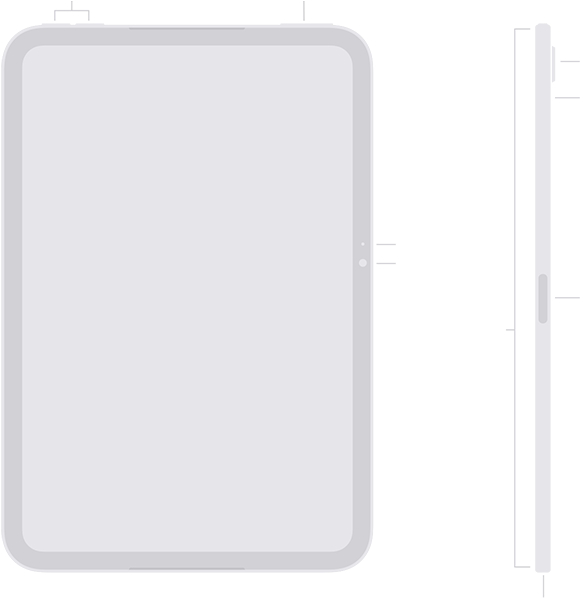
It makes no sense to make the devices so thin and then having a fat camera. This requires a cover to equalize the size with the camera for haptic reasons. Better use this space for other stuff like larger batteries and make the device the same thickness everywhere.
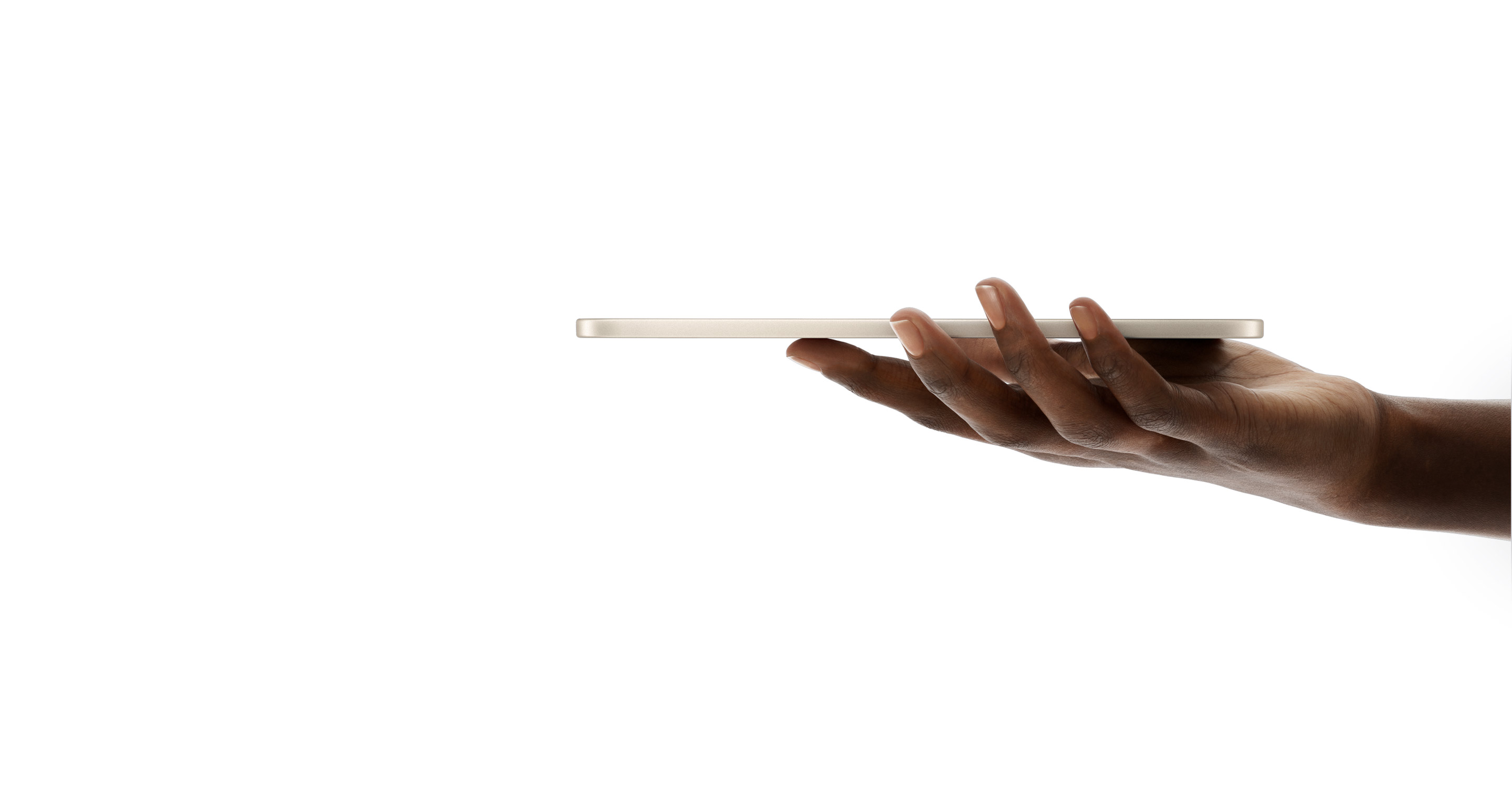
The carousel 2nd image appears to have erased the camera to make it fit the marketing narrative? That's pretty bold.
It's the top image on the product page: https://www.apple.com/ipad-mini/
I would assume, however, that they didn't "fake" it - that they instead chose a filming position and lens such that camera was obscured behind the edge of the device (the edge facing the viewer is the far side from the camera). Bit of trickery for sure though.
For anyone curious, a diagram with the camera can be found here: https://www.apple.com/v/ipad-mini/a/images/specs/buttons_con...
from this page: https://www.apple.com/ipad-mini/specs/
Is that a real video or cgi? The motion reminds me of motion tweening.
Historically, Apple used real photos and video for marketing material, only lit and polished to perfection to create a sort of hyper-real effect. Nowadays, who knows.
> I would assume, however, that they didn't "fake" it - that they instead chose a filming position and lens such that camera was obscured behind the edge of the device
I’d suspect the same. From that angle, the camera bump is on the opposite edge; when I hold my iPad Air in the same position, the camera bump is also just about hidden.
That being said, I’d also suspect that Apple chose that angle deliberately.
The usual narrative is that Apple are meticulous, therefore it is only proper that we assume they did this on purpose.
I wonder if at this point a camera bump is too closely associated with quality.
A minimal camera bump means they've advanced the technology to make it small, but no camera bump makes it look like they're using a cheaper camera?
It always reminds me of the imac from 15 or so years ago when they were touting how thin the imac was.
In reality the back was curved, and they took pictures from an angle that only showed off the edge of the screen and not how far back it curved
> In reality the back was curved, and they took pictures from an angle that only showed off the edge of the screen and not how far back it curved
You only see the thickness at the back from an angle where you can't actually use the computer (and for many people, that whole angle is going to be against the wall). This is the good kind of design - making something appear beautiful without compromising the core function.
I'm distinctly less convinced about ever-thinner mobile devices that I immediately have to slap a case on...
The older iMacs that were the same thickness all the way across, they still looked good. Except they were some of the best machines to service. Literally two screws in the bottom, the whole thing split in half, and your hard drive, memory and other components were right there. I worked on tons of them and they were fantastic. It saved people money in the long run when they needed an upgrade because it took less time. Even replacing the screen or logic board in them was a piece of cake.
woah - that's pretty shocking to me actually. in the past they generally have just used flattering angles. This is downright deception.
This is literally just a flattering angle. Not saying it's not deceptive, but they didn't "edit" the camera bump out of the image.
https://www.apple.com/v/ipad-mini/a/images/overview/product-...
this is directly side-on. they've def removed the camera bump. In the initial animation at the top where the hand grabs it too. the bump is very clear in shots later!
wait... could they have hidden it under the hand? and why does that person's thumb seem extra long?! the more I look at this the less I understand it.
Perspective is still at play. At arms length, on my phone, if I make it so the flat surface is completely aligned with my center of vision, the bottom side covers at least 1mm of whatever is on the underside. The closer one gets to the phone, the more pronounced the effect.
The video keeps triggering my sense of seeing CGI, but the hiding effect on display can absolutely be accomplished in camera.
I presume it is a flattering angle instead of a falsified image. The camera bump is near the one large button, which was furthest from the camera when they rotate it, so the iPad could have been angled slightly to hide the bump. Maybe someone can try to reproduce it after it comes out to see if it is a false image.
The argument is most people use a case regardless, so if it were the same thickness across the device, the iPad would be considerably thicker once in a case. That and weight. I don’t use cases so it bothers me too, but it does make some sense.
It's still very strange how much work goes into the materials for the case and the ergonomics and weight of holding the devices without a case just to assume everyone will put it in a case. I'm with you on iPads, they get too heavy/thick for their primary uses once in a case. The phones I sort of get but I still think it ruins a lot of the aesthetic choices they make about the case design.
I've always thought this too. An iPad with an integrated case would be able to fill the entire flat back area with a battery, and just have rubber on the edges where impact protection is needed. The existing design is really optimized around having an impressive experience in the store when holding an uncased product, before you inevitably cover it.
Why would you want an integrated case? The soft impact absorbing materials degrade much faster than the aluminum. Look at the average ipad users case and it's falling to pieces, you don't want that permanently fixed to the device.
There's also many users who don't need a case. A lot of ipads are POS systems that are fixed to the bench so they don't need a case either.
> Why would you want an integrated case? The soft impact absorbing materials degrade much faster than the aluminum.
Given that the impact-absorbing parts could be [0]
...rubber on the edges where impact protection is needed.
Apple's decision to make most of its handhelds out of various grades of "fragililum" has boggled my mind since they sold the first iPhone with an easily-shattered glass back. That choice makes sense for a conspicuous status symbol that people are going to take very good care of... but most folks either end up with one with damage that makes plain how theirs is not the kind of life that makes that possible, or they have installed some aftermarket shell that ruins the effect by covering up the conspicuously fragile part of the hardware.
I find it annoying too, I assume it's because thin and light devices sell more (both in promo photos and when used in Apple stores).
My mum's Samsung S23 Ultra has a ridiculous camera bump and rocks back and forth when you use it, even with some thinner cases. You need a super thick case for it to stay stable.
I have a hard time believing the camera bump isn't the result of intensive consumer psychology experiments. Setting a bare apple device down on a flat surface feels like chair with a leg sawed off. They need you to buy the accessories. This is part of making the ecosystem viable.
Nah it’s just easier to pick up a phone when one edge is higher than the other.
Half the time their mid-year fresh is just a new color, with a huge marketing push. If everyone has a case, colors become a moot point.
I also don’t think I’ve ever seen an Apple exec use a case, as it would imply the phones are durable and a case is needed, which they don’t want to convey. (Bumpers for antenna-gate aside)
The correct answer. The camera bump is intentional and so is building phones that aren't resilient to drops out of the box. What do you mean I can't have a phone with rubber bumpers on the corners?
There used to be an "Active" line of Galaxy phones that had built in umpers before they discontinued them.
I have my iPhone 13 in a $10 cover for years now. I don’t like the bump, but I don’t think it’s a scheme to buy covers.
Also my favorite smartphone was a motorola with a cloth back (ballistic something) and a metal frame. No cover was needed for this one.
>resilient to drops
I would be content if they'd stop making phones slippier than a wet bar of soap. My Pixel 8a is ridiculous, I don't know how they do it. If you have dry hands, it's nearly impossible to hold on to.
Yeah, I added a boring case on day 1 and would have trouble describing the feel of the bare device right now.
Found one on Amazon so I dodge Google's exorbitant plastic markup, and it is a relatively minimalist wrap that smooths out the camera bump and makes it more grippy in hand, in pockets, and on flat surfaces.
The behavior of those slippery phones in pockets is almost the bigger gripe to me. Like they are a new class of motion amplifier, trying to rotate and squirt their way out at the slightest twitch.
This made me realize I have an inconsistency I never noticed.
I would never use a case with a phone of any sort. I don't like the extra bulk, and the friction they add is annoying.
Meanwhile I never use a tablet or kindle device without a cover.
like the apple tv remote.. plus those are so sensitive too
Google Chromecast remote is bad, too.
The curvature on the back of those is such that it's harder to rotate into a position so the thumb can hit the right button than a flat surface would be.
It also means that resting it on the arm of a recliner produces about the same result as just dropping it into the void to begin with: It's going to wind up there either way.
If they levelled it out you could surely fit a far larger battery in it too. I'd far rather have a device 1.5mm thicker with a battery lifespan twice as long and no silly bump on it.
what premium would you pay for this? asking for a friend.
Zero. Ignoring that Apple prices are already inflated beyond all reason, a larger battery would add a single digit dollar amount to the BOM.
Ok, so they'll continue making thinner devices that appeal to more people then.
Since basically everybody uses a case anyways, the important factors are weight and width with the case on. This design makes both of those significantly smaller than your suggestion.
Even stupider for iPads because who even is using the back camera? Just get rid of it entirely and the device will be exactly as functional.
To be fair, the iPad mini is a way better form-factor for camera use than any of the big iPads. I think the only time I've ever used the rear camera on the 12" iPad was to scan a document...
I've seen asshats at concerts holding their iPads up to record. Bad enough when people hold their phones up, but this was next level.
WAT. Just because you do not does not mean you get to dictate how others can use it. I know lots of people that use the rear camera on iPads. I'm one of them.
> Just because you do not does not mean you get to dictate how others can use it.
No one attempted to dictate anything. They expressed an opinion. HN is a discussion forum. This is exactly what it’s for.
Your point would look stronger if you had only included your last two sentences without the indignation of the first two.
"Just get rid of it entirely and the device will be exactly as functional."
That is not expressing of an opinion but dictating an action. "I think they should get rid of it entirely..." would be the expressing of an opinion.
Do you imagine that Apple designers are trolling HN to generate their next device plans?
He’s literally expressing an opinion. There is no in here to “dictate” to.
then everything would be just tiptoeing and nothing would be interesting.... it's not like someone saying that will actually cause Apple to get rid of it
Yes they are just whining into the void about something they can’t change. Great use of everyone’s time all around.
More likely though they’re trying to signal their membership to the in-group that’s always circle jerking on every iPhone/iPad post about SD cards, removable battery, thick small phone, flush camera, etc.
Whining into the void is most conversation online is. It’s what you are doing, too.
The top comment thread here is complaining about the camera bump.
it's what actually starts conversations.
it's not super "ethical" if you're like triggered by (maybe) harsh opinions, but it gets people to chime in vs just lurking