Kimi K3.1 Pro and K3.1 Pro Highspeed
kimi.ai672 points by Jowsey 7 hours ago
672 points by Jowsey 7 hours ago
https://www.kimi.com/code/docs/en/kimi-code/models.html
https://artificialanalysis.ai/models/kimi-k3-1-pro
https://www.modelcompare.ai/blog/china-open-source-ai
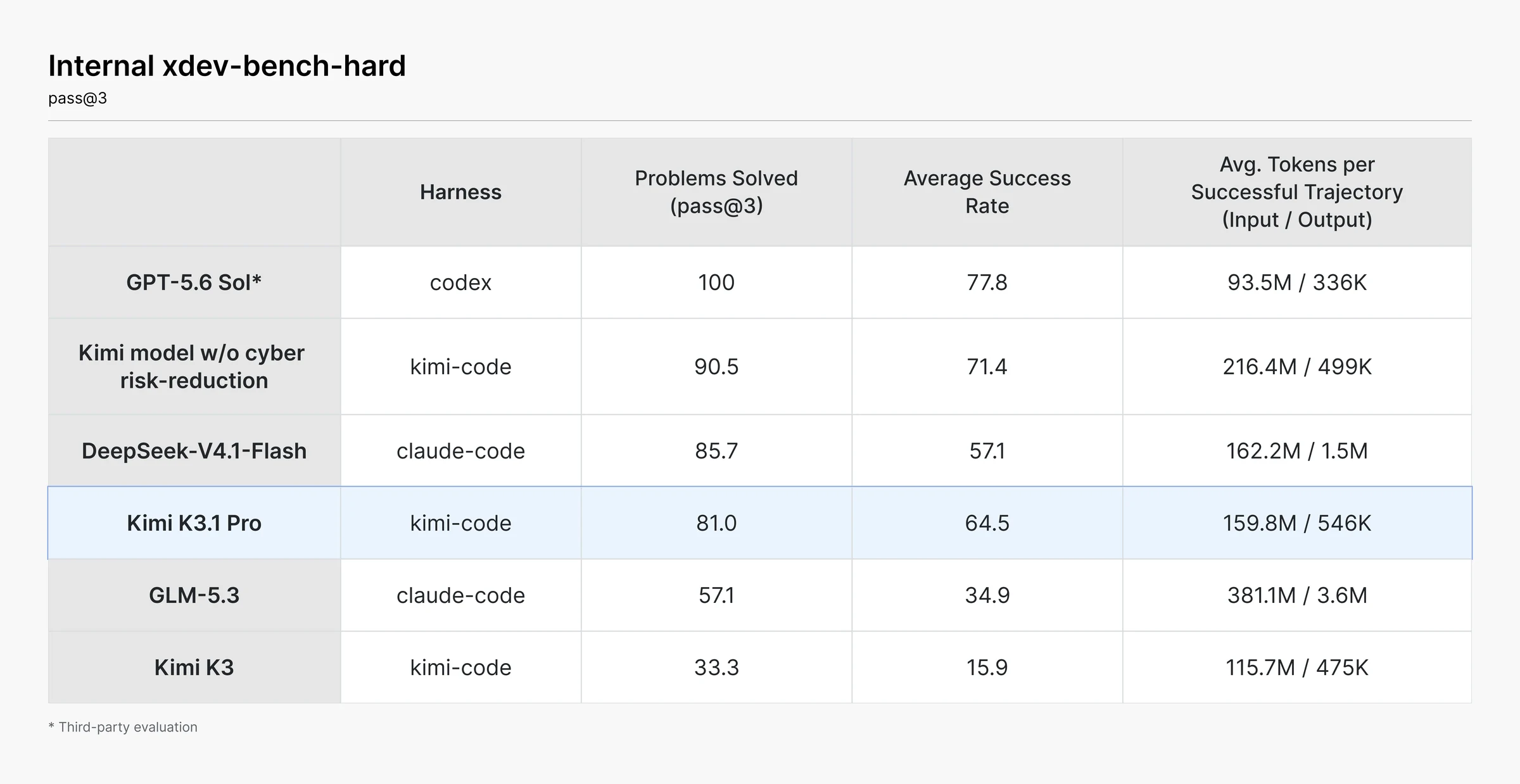
I did some tests. I found it interesting that in the reasoning content the model identifies itself as Kimi by moonshot and sometimes it assumes ChatGPT as identity. Then sometimes it references the need to be approved by "the evaluator", other times it references global system guidelines / moonshot guidelines, and something about an phantom instruction line being "you are an assistant responding in an API" or something like that. Kimi is so much more blunt and argumentative than USA models. it's so funny, it will say things like. "We've already been over this 3 times and you refuse to accept my advice, asking the same question another way won't change the answer." So funny Haven't gotten to try it yet but that'd be a breath of fresh air. Too used to LLMs flip flopping at the slightest hint of challenge. If the model has a real consistent viewpoint that would be nice. The problem might be that it simply looks at it's windows of what it previously and repeats that. But the original statement might be as arbitrary as the model that change their mind each time you challenge them. I always appreciate when a model does that. It's amusing, but also having it be argumentatively wrong is a lot less annoying than being sycophantically wrong. I don't like tools that intentionally annoy me. My reasoning is that if something is argumentatively incorrect, it is much easier to drill down to its misunderstanding and correct it On the other hand, if it's sycophantically incorrect, it'll just change its "mind" while potentially maintaining the misunderstanding, leading to increasingly strange behavior. I think I'm pretty used to my tools making me want to throw them out the window sometimes :) Even before AI that was a common occurrence from either a lack of knowledge on my end, or many software people having no regard for their users' time. You can add a line to your system prompt to be like that. You can basically get it to roleplay whatever you want (but only if you can give it sys prompts). System prompt changes help, but ultimately they don't do a great job of overcoming the model's learned tendencies in my experience. Eh, there's good and bad. The model mostly sticks to prevailing narratives in the training corpus. So if there is something that the prevailing narrative is really wrong about, it's gonna be just as pig-headed about it as a typical internet forum rando. Not entirely correct. This kind of fine-grained model behaviour is built in post training stages, RL, RLHF etc, where model receives rewards or penalties for talking (or not talking) a certain way It could be the system prompt I like the anthropic has $1 trillion riding on really good models with really specific system prompts. It does make a difference. I asked Fable in Claude code to design a UI. Absolute trash. Switched over to Claude design using fable, really liked the result. Seems pretty obvious. The only difference is the prompt and some harness. Is there a place where the system prompts of all these models are documented and how they evolve over time? Anthropic has this although it's not the full internal prompt: https://platform.claude.com/docs/en/release-notes/system-pro... If you are expecting any sort of usable limits on their subscription plan I suggest adjusting your expectations. I subscribed to $99 a month plan and within 47 minutes with one session (not asking for swarms or anything) was limited by 5-hour quota. Same experience. I had the $19 monthly plan for experimenting and running benchmarks, but it was a uselessly small amount of usage, a single task would blast through the whole five hour limit and a big chunk of the weekly limit. All of the US provider plans are remarkably more generous (though OpenAI plans have gotten a lot stingier lately, where they used to be the most generous). I don’t agree. I tried the $20 Claude Plan and was able to reach the 5 hour limit in maybe one prompt. Would you mind sharing that prompt? I'm struggling to even hit 10% of my Claude quota! I don't want more work out of it TBH but I'm interested... I have been using DS Flash 4.1 pretty heavily. It runs for hours and hours and is pretty cheap. I realized the other day that I had a $30 a month Claude subscription. So, I fired it up all excited and tried Opus 5.5 on a codebase I was already in with DS. After about 30 minutes I hit a 5 hour limit. The next day I tried again and the same thing happened. And it felt much slower to boot. I was super disappointed. Did you use Fable, set Opus 5.5 to xhigh, or use 'ultracode' / workflows? That's the only way this will happen. In my experience a single 5 hour allowance in the 20eur Claude plan equals about $10 in Deepseek 4.1 Flash API usage. DS is a lot more token hungry and takes 3x-4x longer. The subscription is way cheaper, probably around $200/month worth of DS, just stick to Opus low and Sonnet for most tasks. do you use their proprietary platform API? and how are costs like for your usual workflows/etc.? DS 4.1 is basically endless, even if you paid for APIs you will hardly touch some prices. But it's slow. I don't think I can any longer appreciate any major difference in "intelligence" between models for most tasks but Opus is consistently much faster than competitors at finishing tasks and keeping me in the loop. Of course excluding ultra code, the you will wait 50 minutes for a minor refactor. That's surprising, I had the exact same experience as GP. I dropped my Kimi sub this month, but I'm keeping claude because I can use Opus 4.8 basically endlessly. Even Opus 5.5 doesn't drain the usage that much, though I rarely use it because it refuses to do anything cyber-related. Yeah, the $20 Claude plan is stingier than one might like, but not as stingy as Kimi. I think the best $20 subscription deal these days is probably from Google, now that Gemini 4 Argon exists and is an acceptably high quality model for coding. It's got quite generous usage and includes some other Google account upgrades (though I know some people don't use their regular account for Google AI for fear of account suspension or whatever, so the extra storage and other account upgrades are not a useful thing). I can use it pretty heavily without ever running into caps. The $20 ChatGPT plan used to be similarly generous, but no more. Gemini isn't generous at all 5-10 Argon prompts and that's it. When I've most recently done the same tasks across multiple providers I have a subscription to, I found the order of generosity of them was something like Gemini->Claude->ChatGPT->Kimi. OpenAI used to be a lot more generous than all of them, but that ended recently, and now it's quite stingy in the $20 plan. What competitive model has a more generous subscription than Gemini? It is a LOT more efficient on claude code. Takes forever to run out of credits, and a whole lot of useful code gets generated. The web Ui reconstructs code while claude code just tweaks it. How long ago was this? The amount of usage they give you for a given plan seems to change over time, and the Claude limits seem to be more favourable recently. I don't think the limit changed per se, but Opus 5.5 consumes a lot less usage than 5.0 did, so it goes further. I had the same experience with OpenAI's 20$ one, literally one prompt to do some code analysis, it didn't even complete it. And that was 6.1 sol xhigh, not astra max.. We really need consumer hardware to catch up so we can run these models locally... Had a similar experience here. Their limits are very, very low, and ultimately make it not worth subscribing. Can't leverage a good modal if it exhausts its 5-hour budget in 30 minutes. Paying API prices for Deepseek 4.1 Flash feels like a much better deal at the moment. Welp, that ruins this news for me. I'm glad open models are catching up but if I can't practically run them locally _or_ through a flat fee then it doesn't really help me. I fear API pricing. This'll end up on opencode go soon enough. $40/month on there gives you a bit more than just "light use" Don't use frontier models like this for problems that can be solved with flash models, and you'll see API pricing isn't that terrible. Still cheaper than anything with remotely this level of capability 2.5 months ago. Don’t worry. When SlopenAI and Antslopic run out of VC money, all the models will be equally expensive. Yeah, the plan is far too expensive for what it provides. I wonder if the quota with these new models will be better, but I'll wait for others to try this out before wasting another hundred bucks. but its not expensive tho ??? it is not subsidize Yes, if you just look at API pricing, the cost is about on par with its capabilities. The problem is that we all use subscriptions, and when you compare subscription pricing, Kimi is much pricier than pretty much all of their competitors, including Chinese ones. Honestly, use Pi, start the session with K3, design it, store the design + chat history + todo with phases + why + readme then when you are at the time to build do `/model` select deepseek and let it rip!! You can even make a Pi extension to let it switch models on its own, then tell it to switch to one or the other for a given task. It's not perfect, but it is pretty reliable once you have the instructions dialed in. Here's mine: https://pi.dev/packages/@arcanemachine/pi-model-switcher I have mine configured to use a "thinker" model for planning and decision making, and a "doer" model for the easy stuff (digging around the repo, writing code based on the thinker's instructions, etc.). I run a similar setup, just with different models. I also use herdr, which lets me have the same project worked on side by side by different models, each in its own git worktree. It also has the lowest quota of any model on https://opencode.ai/go I think Kimi just doesn't have the means to subsidize plans. That's something which caught my attention: > First, we aim not to release open weights that would extend the absolute frontier of cyber capability. K3.1 Pro's offensive cyber capability is, by design, below what our pipeline can produce, and remains behind that of frontier proprietary models. Second, we intend to progressively raise the cyber capability available in open weights. So they admit that they could do more, but they won't? > So they admit that they could do more, but they won't? Yeah, there's another paragraph: > Identifying and removing cyber-related data. During development, we observed vulnerability research performance improving steadily as post-training scaled. Tracing the source of this trend, we found that cyber-related content was embedded within the general mid-training corpus, and cyber-related tasks were present in the RL environment mix — a natural byproduct of training on broad data. In preliminary experiments on internal models, we found that without data removal at either the mid-training or the RL stage, downstream cyber capability would increase substantially. These findings gave us a concrete lever for control. For the open-weight release of K3.1 Pro, we identified and removed cyber-related data from both training stages, while retaining the general-purpose coding tasks needed for model usefulness. We will continue to apply appropriate controls at every training stage, of which cyber-related data identification and restriction is one example. (emphasis mine) It's clear that cyber is a touchy subject right now. But it's also clear that RL works on it, because it's highly verifiable. So smaller models are going to become very interesting, because they can be fine-tuned later to cover this field. I'm betting this is related to China's Announcement No. 48 last week about AI export controls, since releasing an open-weight model is effectively export: https://www.jdsupra.com/legalnews/china-proposes-new-export-... > Prohibited: high-performance detection technologies used to counter cross-border data transmission security risks, including deep-synthesis forgery detection (266401J); AI cyber offensive capability technologies, such as malicious code generation and mutation, automated mass generation and distributed large-scale deployment of anti-detection variants (266402J); large models trained using China’s Core Data (266501J); and high-performance AI agents designed for highly sensitive scenarios, such as critical information infrastructure, national defense and core government affairs (266502J). They also show scores for a "Kimi model w/o cyber risk-reduction" https://statics.kimi.ai/kimi-blogs/kimi-k3-1/20261023/xdev-b... Presumably State Security will get access to that on request. I think this is misguided. Considering how much code is AI written these days do we really want LLMs writing insecure code because we lobotomised them? I think it's political. Certain companies are exploiting as much as possible to push the boogeyman of AI for regulation. It's exactly this. If the "scary Chinese open weights models" can do "dangerous cyber", then we might see regulations spring up against open weights sooner than later. I hate Anthropic and OpenAI. As companies and leadership, anyway. Dario and Sam are 100% to blame for this. They're trying to turn us all into jobless slaves, sex workers, and Squid Game pawns. The only good future is open weights. They're trying their damnedest to keep us under boot. I hope the Chinese companies (and I say this as a patriotic American) slay these two companies and destroy their moats. In my mind, the two most dangerous people in the world are Dario and Sam. We need open weights to win. > They're trying to turn us all into jobless slaves and sex workers. Speak for yourself, I don't think there is a market for many of us as the latter. Don't be too hard on yourself. There's someone out there for everyone. The problem is they don't pay well Please enjoy some time out in the nature, and chill out. These times are not ideal but what can we do other than just take it as it comes? All the hate and rage is not good for your health. Why do you think Dario is dangerous? I think he's genuine on the dangers of AI capabilities moving faster than AI alignment. Which is a great example of what makes him dangerous: with the exception of Sam Altman he's arguably the single person most responsible for the current capabilities arms race. Anthropic has pushed the frontier harder and faster than OpenAI or anyone else in the last few years. Beginning with Anthropic's founding to quickly raise huge amounts of cash with a pitch to investors to rapidly leapfrog ChatGPT in scale, and culminating with Mythos/Fable which carved out a whole new tier of super models. He's always talked big about Anthropic prioritising safety and their "Responsible Scaling" but his words just simply don't align with reality while they keep going bigger, faster, until only OpenAI could briefly and half-heartedly claim near parity at the top (while cutting corners in safety because the existential threat to their market position is far more pressing to any corporation than some abstract risk for humanity). Whether it's wilful cognitive dissonance, cynical opportunism, financial greed or something else, that kind of self-assured moral superiority paired with his real world record of self-interested decision making for Anthropic's market position is a big red flag. Because his solution is to block competition and capture all the market through regulation. Sam, I'll grant you, is probably among the top 10 most dangerous, but Dario? The only thing he's done to piss people off is to predict, correctly, that releasing too-powerful models too-quickly would cause havoc and chaos. This prediction actively hurts his company! It actively harms his chances of a huge exit! It actively raises the probability that Anthropic and OpenAI get nationalized and treated in the same way as, for instance, the nuclear program! By comparison, do you think the Chinese models are going to be trained in such a manner that you enjoy the society that results? What makes you think that? > do you think the Chinese models are going to be trained in such a manner that you enjoy the society that results? I don't need government minders. I'll take the models and live free. >I hope the Chinese companies (and I say this as a patriotic American) slay these two companies and destroy their moats. China cares about about stability way more than the US even, they aren't going to be big on AI models upsetting the governments power, and mass cyber attacks could do that. At the end of the day we are going to have to realize AI is both dangerous and governments are going to control it. Worse if you start making and releasing your own dangerous models the 4chan party van is going to visit you. > At the end of the day we are going to have to realize AI is both dangerous and governments are going to control it. Your thinking is dangerous. Do you work for Anthropic? AI is dangerous when these powers are being hobbled up by the select few. These systems threaten to put us all out of work. I refuse to be a slave to a company or a government that is taking away our livelihoods, scraping up our earnings potentials, then seeking to muzzle us and put us in jails with no rights. I would rather burn down all of tech than have AI be owned by the elites. Your thinking is a threat to all of our liberties. >I would rather burn down all of tech than have AI be owned by the elites. Then you better get your torches out now. >I refuse to be a slave to a company or a government that is taking away our livelihoods Don't worry, governments are fervently working on AI drones to take away your life when you get really upset about this. Oh, and they are also working at AI to detect when you write all this online, and track you down then monitor you on things like flock cameras. As they say, you'll be the first with your back against the wall when the revolution comes, I likely will be beside you for being too subversive. >AI is dangerous when Incorrect, AI is just dangerous. It doesn't matter who has it. The more powerful it becomes the more dangerous it gets. So, as you can tell I am an AI doomer. ---- Now, don't get me wrong, I want freedom for me, I want freedom for other people. I do not believe the technologies we're developing are conductive to having any freedom at all. Hell, if we're lucky we'll be slaves instead of all of us dead, including the select few. >Your thinking is a threat to all of our liberties. Lol, now this is kind of funny. "I want freedom to think whatever I want, but you, you shouldn't think like that!". Careful or you'll max out your irony meter. Anyway, "My kind of thinking" is just next ____ prediction. I see what is happening in the world around us, and based on the shape of that probability I see what is going to happen. No, you and I are not getting unlimited AI to do whatever we want. Yes, governments are going to lock down the shit out of AI for end users. Yes, governments are going to declare advanced LLMs munitions. Balls in your court, better think of what your next move is. Anthropic: Touch too much security stuff and we ban you, and keep your money. Kimi: We took out the worst of it so have at it for free. Everyone else: Back to my ablated model on openrouter for 1/10th the price where I can brute force issues. Ablation only works to remove stuff added in post training, if the training data does not contain the material then ablation will do nothing. Which ablated model do you recommend for this? Depends on what you want to do with it: https://featherless.ai/blog/abliterated-models-for-cybersecu... Is a decent primer, then off to open router you go. It’s not much of a deterrent to a motivated organization. They are basically saying that models themselves are already capable. If you fine tune them with some cyber security tasks, that should make them potent. :-/ Classic “rules for thee and not for me.” Agreed that this could be reinjected later. Makes me think of neo in the matrix: “I know zero days.” “Show me.” What "rules"? They don't have to post-train the model on anything specific, it's their judgment call. The "rule" here is, if you read the disclosure carefully, that they have cyber trained models in house. But you do not get them, you only get the non-cyber models. Governments also control who owns tanks and missiles. Do you think that going around making cyber weapons isn't going to get you buried in a shallow grave? With frontier competitors and the U.S. govt actively pushing "concerns" about Chinese models, Kimi including this statement on "offensive cyber capability" seems like smart defense. Models are opaque and training details are trade secrets, so whatever they did might be negligible or significant and no one can tell. This bit is also artfully done: > "below what our pipeline can produce, and remains behind that of frontier proprietary models." Like Ant and OAI, they've realized vaguely claiming to have nerfed their latest model to an unspecified degree not only looks 'good guy' prudent, it provides a built-in excuse when a model fails. I'm not sure if not doing RL capability gain on offensive cybersecurity can be really called "nerfing"? They're not post training it to lose capabilities/censor them – they just don't spend training time on this topic, which sounds like a great idea. It doesn't mean model can't do it, it just means it's less good at it; -10% on benchmark feels like a great result and overall approach to pace it. > I'm not sure if not doing RL capability gain on offensive cybersecurity can be really called "nerfing"? I concede that term can carry overly broad connotations. Or it's a cop out. I could totally outrun Usain Bolt, but by design I don't push to set new World Records. I will increasingly show faster times though. > Or it's a cop out. I could totally outrun Usain Bolt, but by design I don't push to set new World Records. The benchmarks show Kimi K3.1 Pro outrunning practically all models. It's weird to hear someone like you accusing them of making up excuses for not lagging behind in discussions on how they are ahead of the pack. Well, in the publication they claim to have identified specific cybersecurity post training tasks that nerfed capabilities when they removed them, which seems like a reasonable methodology. Seeing as no one besides blackhats want frontier cybercrime capability to be open source, this seems like a very sensible thing to do. So they have published a reasonable means, and they have a motive. I'd put my money on "probably true". > Seeing as no one besides blackhats want frontier cybercrime capability to be open source Sure. The problem is that there is no practical difference between "cybercrime capability" and "cybercrime defense capability." All of my PRs go through an adversarial security review by GLM-5.3, because it's the only smart-enough model with a good understanding of cybersecurity issues that won't regularly refuse the job. Removing that ability from frontier models helps nobody except cyber criminals. I'm not sure I follow. Let's say that GLM remains the frontier of open source cyber capabilities because Kimi is nerfed. Your situation, and the situation of your attackers, remain exactly the same. You run GLM to audit your code, they do the same looking for exploits. Let us say that un-nerfed Kimi was released, and it turns out to be at the absolute frontier of cyber capabilities, Mythos 5.5 level, a step ahead of anything else. What now? Well now your situation is exactly the same as before, just that auditing and hacking got more expensive. You run a Kimi security audit, they do the same to try to pwn you. However, now the cabal of Linux kernel defenders with secret access to Mythos 5.5 all of a sudden have no advantage, where before they used to have one. And even worse now they are in a literal race to be the first ones to find every bug that Kimi is capable of finding, and patching it yesterday. So for you, this makes no difference in practice, your capabilities are not elevated, and neither are those of the attackers. The only result of the other scenario is an overall defender disadvantage. The problem is, as anyone trying to address security concerns in claude can attest to, the guardrails trigger even when trying to address real bugs. Good cyber defense requires an understanding of the offense. How you avoid the "fix my code" attack, the code being someone else's code, I do not know. But nerfing the model doesn't seem like the best path forward either. This is not about guardrails, it's just not post-training the model on tasks that specifically relate to cyber-offense. It's a very lightweight intervention, and it makes the model less of a target for bad actors. claude code "auto-mode" uses a smaller sonnet-like model for classifying, which means it's basically dumb, and the harness biases it into denials I am a defender, and I really really want to have access to high quality models that are good at finding vulns and hacking. Leaving them in the hands only of government agencies and orgs with enough resources to do extensive training / fine tuning seems like the absolute worst possible case for the future security of global software systems. Well, and I am genuinely curious here, wouldn't defender and attacker capabilities being accessible equally by both parties be objectively worse than having a limited amount of privileged defenders? Of course, you could have every piece of code go through an adversarial audit before it's pushed, but in an equal world you would have to always devote as much or more resources to this as your attackers. And historically speaking people just don't do this in practice. In the scenario where only "verified" defenders get access to the best cyber capabilities, unverified plebian defenders and blackhats are on the same level exactly as described above, there's just also a few defenders that get to run things on godmode. So to me, it seems that the only result of frontier cyber capabilities is removing a defender advantage. Although that advantage is not for everyone, it can only exists as long as capabilities are unequally distributed. Am I missing something? > Well, and I am genuinely curious here, wouldn't defender and attacker capabilities being accessible equally by both parties be objectively worse than having a limited amount of privileged defenders? Well, not really. Because those privileged defenders will never be able to predict what needs defending. So we have a few privileged "defended" places and the rest is left for privileged attackers to plunder. Privileged attackers?? So that would be career cybersecurity experts with Project Glasswing/Daybreak/Googlewhatever access, using it to perform actual attacks? Because that's what privileged means in this context. Access to frontier models not available to the public. > So that would be career cybersecurity experts with Project Glasswing/Daybreak/Googlewhatever access. Yes. You really think access those models will not be given for offensive operations in each country? Of course they will be. Well, seeing as Claude literally snitches on everyday people planning murder and Houthis building rockets I would assume that every user in project Glasswing is heavily and very effectively monitored. I have to admit that I genuinely do not think that what you're hypothesizing is happening right now. I would bet good money that the amount of people with Glasswing access doing actual Blackhat work is currently zero. Perhaps in the future this will change, but even if that is the case, that's still a win for the defenders. Having a time advantage, even for a few months, is still a win. Edit: Actually, the CIA/FBI/NSA/Etc.. does probably have access and are probably trying to hack Iran and so forth, so my comment above is probably technically wrong in that respect.
ranyume - 14 minutes ago
Flatcircle - 2 hours ago
taikon - 2 hours ago
joe_the_user - 3 minutes ago
hgoel - 2 hours ago
seunosewa - 2 hours ago
hgoel - an hour ago
Aerroon - an hour ago
hgoel - 23 minutes ago
LordFast - 34 minutes ago
aldanor - 4 minutes ago
jameson - 2 hours ago
SV_BubbleTime - an hour ago
jacquesm - 38 minutes ago
satvikpendem - 8 minutes ago
johnmlussier - 7 hours ago
SwellJoe - 5 hours ago
pjerem - 3 hours ago
jamiejquinn - 2 hours ago
LeFantome - 2 hours ago
ricardobeat - an hour ago
r_lee - 2 hours ago
epolanski - an hour ago
DaSHacka - an hour ago
SwellJoe - 2 hours ago
copperx - 2 hours ago
SwellJoe - an hour ago
dzink - 2 hours ago
arcanemachiner - 2 hours ago
Wowfunhappy - an hour ago
epolanski - an hour ago
matheusmoreira - an hour ago
Altern4tiveAcc - 5 hours ago
smith7018 - 6 hours ago
elxr - 5 hours ago
xigoi - an hour ago
InsideOutSanta - 6 hours ago
tonyhart7 - 6 hours ago
InsideOutSanta - 6 hours ago
calgoo - 3 hours ago
arcanemachiner - 2 hours ago
rektlessness - 2 hours ago
esafak - 5 hours ago
rudolftheone - 7 hours ago
NitpickLawyer - 6 hours ago
neuronexmachina - 4 hours ago
yorwba - 6 hours ago
dotancohen - 4 hours ago
And that's why we need models that understand "cyber" or application and data security. The offensive models are powerful, and they are in the hands of script kiddies now. The models writing our software and designing our cloud infrastructure had better understand these issues as well, just to avoid coding in vulnerabilities. > It's clear that cyber is a touchy subject right now.
fartfeatures - 5 hours ago
MattDaEskimo - 5 hours ago
echelon - 5 hours ago
m348e912 - 4 hours ago
lapetitejort - an hour ago
mebrainmush - 2 hours ago
Hammershaft - 4 hours ago
qlte - an hour ago
smashed - 3 hours ago
felixgallo - 3 hours ago
echelon - 3 hours ago
pixl97 - 4 hours ago
echelon - 4 hours ago
pixl97 - 3 hours ago
zer00eyz - 5 hours ago
jacquesm - 5 hours ago
anonymousDan - 5 hours ago
zer00eyz - 4 hours ago
sheepscreek - 6 hours ago
vessenes - 6 hours ago
zozbot234 - 6 hours ago
vessenes - 5 hours ago
pixl97 - 4 hours ago
mrandish - 5 hours ago
mirekrusin - 5 hours ago
mrandish - 3 hours ago
scottyah - 7 hours ago
locknitpicker - 4 hours ago
stalfie - 7 hours ago
InsideOutSanta - 6 hours ago
stalfie - 3 hours ago
ApolloFortyNine - 7 hours ago
zozbot234 - 6 hours ago
tough - 6 hours ago
tkz1312 - 5 hours ago
stalfie - 4 hours ago
Avamander - 3 hours ago
stalfie - 3 hours ago
Avamander - 3 hours ago
stalfie - 2 hours ago