Most people prefer traditional architecture
worksinprogress.news206 points by alihm a day ago
206 points by alihm a day ago
Perhaps there’s a difference between what people prefer looking at and what’s actually nicer to inhabit? Architecture is optimizing for people inhabiting the building, not just staring at it in a photograph. It’s like if you asked someone to judge a phone based on a photo. Yes there’s some aesthetic judgement but it matters more if the phone is usable.
I know that personally I find New York’s prewar buildings more beautiful than your average soulless luxury tower. But I enjoyed living in a soulless luxury tower because it had good lighting, not terrible elevators and decent fixtures.
> Architecture is optimizing for people inhabiting the building, not just staring at it in a photograph
With modern materials and structural design you can absolutely have both.
You would have to convince the design community that form can follow things other than function.
Until form is no longer synonymous with function, design will eschew ornamentation.
When form doesn't follow function, usability suffers.
Or you can do like modern UI designers and throw both form and usability in the trash and optimize for novelty and "brand" instead.
My kingdom to have RAD developer tools be the norm again. I don't want yet another website as an app, or website bundled in a Chrome fork as an app. You could have built the same thing in VB6 or Delphi with less effort and used less of my resources in the 2000s...
It might be subtle but interior and exterior matters. The housing projects (70s, 80s) often had nicer interior design and comfort, but the overall neighborhood felt void, full and worse.
Architecture is about optimizing for people inhabiting the city. Cities with detailed human-scale architecture at the lowest few floors are nicer to live in. You can still have a city full of soulless luxury towers, as long as you avoid cheap hostile architecture in places pedestrians can't avoid looking at.
> I find New York’s prewar buildings more beautiful than your average soulless luxury tower
There might be some survivorship bias there.
Modernism is the act of using cheaper resources and more standardized/cheaper methods of production. The aesthetic is more of a side-effect of those limits. Ugliness has become a cultural norm in order to suit the modern economy. It may come as a surprise but it required years of cultural development and education for most people to accept the work of Dieter Rams as some aesthetic pinnacle rather than soulless mass production. It's only recently, (with designs like the Ferrari EV for instance) that people are starting to see how limited our aesthetic language has become. Modernism is too cheap to replace so the "beauty" of soulless minimalism will likely endure in the zeitgeist, but it's not a very interesting environment to be in.
I don't think this computes. Modern 'efficient' industrial design can absolutely fail at efficiency. I have lived in spartan, utilitarian apartments that you could tell were built without any regards for efficient use of living space, and ended up wasting huge swaths of their floor area to interior corridors, winding tunnels between rooms, random walled off mystery areas and overall such poor planning that I'm sure despite their builder trying to save every buck, ended up costing more money relative to usable living space than seemingly more luxurious alternatives.
I have seen the opposite as well. Building an efficiently laid out, beautiful building doesn't take that much more raw material, it just requires more thought. Big US cities used to also have copypaste mass housing even a century ago, built with a strong eye towards cost efficiency, but designers also kept aesthetics and livability in mind.
And since they were basically identical to each other, they had to figure this out only once, and they could build the same t
The 'cheap and nasty' design school usually succeeds at the latter, not so much the former.
And this supposed efficiency of modern architecture often doesn't really show up. The Empire State Building was famously built in a year. Nowadays the most utilitarian housing project takes longer.
They didn’t say anything about efficiency. It’s all cost driven. Cheapest inputs possible. The PE backed builder isn’t dealing with the building in 2 years, what do they care how well it works?
I think most developers have a captive market. They don't really compete, they build whatever they want, and still sell, because somebody somewhere will still buy, since they know they can sell for more.
The units are basically commodities. Same floor plans same amenities same building about the same rent. True across the country for these sort of newer buildings, only real difference is the pool doesn't close for the season for those in milder climates.
It is designed to be this way for investors more than consumers. Investors want these units to be as fungible as possible so they can better compare local market dynamics. Commodity trading has a lot of advantages for the investor after all. The consumers have no choice really but to be in this market if they want to be sheltered at all. It isn't like you really can exercise free market selection for something necessary like shelter. You have to take what has been made available and you cannot do without.
There is therefore no incentive to make a smart building that is favoring the tenant since this doesn't grow the potential pool of tenants in the area, that pool remains the same size as it was. It is unlike a lot of other markets where having a better product might actually grow the customer base of the product segment overall.
If you just look at hard costs and ignore beauty and comfort, is it also the cost-over-what-timeframe question? If a building is expected to be actively used for 100 years vs 20, you get to different decisions.
My other question that I've never found a good answer to, is with mechanization, how is it that "cheap" modern buildings are so expensive. Or were old, traditional buildings super expensive? What is the cost of a unit of beauty per year, then and now...?
Unfortunately only custom homes can afford to care about beauty. Developers are building for cheapest possible and letting the long term owners deal with the consequences.
Homes still aren’t really mechanized. I’ve seen attempts but they haven’t worked well yet. Labor and materials are so expensive!
And most new homes are built by one of a few big groups. Oligopoly issues again.
"The aesthetic is more or a side-effect of using cheaper resources and cheaper methods of production."
This is a really interesting argument and very much not the story I've heard. Can you cite any sources for any of your statements at all?
Industrial modernism is an aesthetic of distance, abstraction, predictability, and containment.
But the flip side isn't anti-modernism, it's mass-market kitsch, which is at least as ugly.
Minimalism isn't bad on its own, and the best minimal design really is beautiful.
But the abstraction and containment went too far, and the result is often functional (on a good day) and joyless even if it's a prestige product. And claimed efficiency is often purely decorative. (Which is ironic.)
The worst is block sprawl and suburban slop - endless subdued and constrained repetitions of the same thing, with very minor variations.
If bespoke robotic manufacturing becomes a thing it will start being possible to build and make exotic, individual, decorative things at scale. Most of the results will be terrible, but some will stand out as examples of new aesthetics.
> But the flip side isn't anti-modernism, it's mass-market kitsch, which is at least as ugly.
It's far more common than it should be.
> The worst is block sprawl and suburban slop - endless subdued and constrained repetitions of the same thing, with very minor variations.
The economic of bathtub curves incentivises designs nobody hates, even if at the cost of nobody loving them.
The bathtub curve is not the most optimal however.
I mean look at the ecology of our world. What do you see out there when you look outside? Solely some lumbering generalist beast doing not good and not too bad taking up all the energy that comes off our sun?
Absolutely not. The opposite happens. The generalist tends to die out, outcompeted by the litany of specialists who better occupy the specific niches the generalist attempts to fill.
Left to its own devices, the market ought to look like this: hyperspecialized at all scales and levels such that every demand is maximally occupied by the most efficient manner to serve that demand. One might ask instead what artificial constraints are allowing a generalist to emerge and not be swallowed up by the sum weight of the countless specialists who are more optimal at every possible thing?
We are too rich to be able to afford things like Sears Roebuck houses now.
> Modernism is the act of using cheaper resources and more standardized/cheaper methods of production.
That's how they sold it, but it's not true. By the end of the 19th century, all the building ornamentation that you can still see in European capitals, had been stadardized and was mass-produced, while the construction techniques using brick and mortar had been further refined, yielding building designs that were cheap to construct and easy to maintain.
Modernist buildings were, at the same time, more expensive to build and less durable because of the reinforced concrete which has a much shorter lifespan than stone or brick plus mortar. The only advantage they had was that of increased height, but that was only an issue due to the restrictive zoning in Anglo countries. Without NIMBYism that pushed towards sky-scrapers, NYC could well have ended up like Paris: replacing 1-3 stories buildings with 8-10 stories, but allowing mixed commercial/residential space everywhere.
Literally had nothing to do with "NIMBYism." That's anachronistic bullshit. It had to do with the desire to remake the country into Garden Cities with lawn-based neighborhoods filling the spaces between shopping malls.
The people in the places where these neighborhoods were built didn't get a say, they were removed and new middle-class "YIMBYs" were moved in to be little lords on their little lots.
> Ugliness has become a cultural norm in order to suit the modern economy.
I read someone's argument that the ugliness results in market failure. Because the ugly results in not only local opposition to building renewable it results in everyone in the area being opposed. And they then use the political process to block new construction.
What really bad is after a 100 years of this the construction industry no longer knows how to design attractive buildings. Starts with architecture where 2/3 of the architects are aesthetically blind. And the remaining 1/3 had it beaten out of the in school. Ends with manufactures that have long since stopped manufacturing pleasing materials for construction.
That plus in the early days traditional/classical architecture was rejected as "bourgeois" or aristocratic by the socialist movements who pushed for modernist approaches. See: the early days of soviet architecture and even Bauhaus in Germany was based on left-leaning/utopian ideas.
So it had dual pressure, from economics because it was cheaper/efficient and from the cultural reform side.
This is sort of a just-so story that isn't completely true. Stalin pushed "socialist classicism" [1] as an aesthetic, and it wasn't until his successors took over that modernist architectural ideas imported from the West became a hallmark of actually-existing socialism.
There was a whole decade of Soviet design before Stalin, which was often radically modernist even by the standards of its day, and that is what the OP was referring to. Stalin was notoriously conservative in his artistic tastes.
> Ugliness has become a cultural norm
I love modern architecture (and art); I find many older forms to be garish, focused on pointless decoration and on wealth display, rather than on the beauty of function and form. The imagination of [some] modern architecture, starting from those fundamentals, is stunning.
You don't like it, which is just as valid, but trying to turn your preference into a universal truth for humanity is not valid. Can't it be just your preference?
Why is it so important? I think the real subtext for most such comments is culture war: A reactionary take on modernism and postmodernism, trying to make them outre, outside norms, attached to political liberalism which is often the real target.
Innovation is usually greeted by reactionary responses; what's odd is that, in our world of modern double-speak, reactionary has become seen as cutting edge instead of a lack of imagination and progress, of retreat and regression. Let's go back to what we were doing 100+ years ago!
I think a lot of the reflexive distaste for the modern would be softened if we were still able to build in The Old Way, whatever that might be. People like these older brick mid rise buildings with the bit of trimming decoration. But, they just don't get built. Sometimes in NYC or chicago someplace you might see a more recent build where they tried to get those old elements down. They used brick and made it square and tried to do a little decoration, but something is missing. They didn't do the thing where they use nicer brick on the street facing side of the structure, or they didn't do the actual cement formed decorative trim pieces throughout. All the brick is laid the same instead of having some lines on the top edge turned out in a decorative way for example. The whole thing feels severely value engineered even if on paper it's actually a quality building with modern amenities and comforts.
Instead it just feels like some knowledge was lost to time and we lost the plot along the way, because there is a refusal or inability to just do what used to be done all the time in the past. Yes building codes are different, but stuff like trim or brick work or generally curb appeal shouldn't affect that. No one is asking for no sprinkler system or no hvac, just a better looking building from the outside. Many of those old buildings do get gutted and end up modern inside but maintain the old facade. People want more of that facade I think without it being a diminishing resource.
"Traditional" isn't really defined here, but seems to mean "first half of the 20th century," which feels like a relatively narrow tradition. Not a lot of preference for teepees and yurts.
People definitely like teepees and yurts (and thatched roofs, dry stone walls, log cabins, etc.), it's just that at some point the practicality gap becomes too wide to contemplate.
But this is a reasonable point to raise. Although both would serve their purpose a concrete viaduct is much cheaper to build than a masonry one, to the point that it may be difficult to justify the latter no matter how strong the public preference is for it.
Somehow, it always makes me smile that the Glenfinnan Viaduct (as seen in Harry Potter) is concrete. I'm not sure quite why.
Not to mention their comparison, modernist architecture, is just mid-century. There is post-modern architecture after that and arguably also contemporary architecture further after that (however vaguely defined).
In public spaces I have no doubt this is the case.
I'm more curious about residential though - see huge interesting in MCM over the last decades. I am biased but I think there is a great deal of interest in warm, modernist spaces with ideas like natural materials and lots of natural lighting, especially when compared to the beige boxes of American home building.
There's more to architecture than just the façade, which is what people are rating when they are just looking at photos of the exterior. The interiors, structure, and services, etc. of modern building are often far superior to older ones, and i suspect many 'ordinary' people would agree.
Yes, every time people get grumpy about modern architecture and look over to see if I agree I tell the story about how I used to work at a company in Boston which moved from a beautiful 19th century building to a soulless Modernist steel-and-glass skyscraper. And thank fucking god: the old building was too hot in the summer, too cold in the winter, had too little natural light, and was too cramped. The Modernist building was better to actually be in in every way. Buildings are there to be used, not just looked at in pictures.
I'm pretty sure that some kind of hybrid can be found where the exterior could look nice and the interior would be very nice as well.
Now, not every modern building has to look like a glass and steel colorless brick.
For example, I really like the look of Oodi [0], Helsinki's new library: it reminds me of wood covered with snow, and the interior is exactly what you would expect from a modern building (built in 2018).
It's not hard to make an old style building with modern amenities. I have a 1920s home and with like a few days of work it lives like a modern place. This is not some dichotomy.
> It's not hard to make an old style building with modern amenities
In my experience, the biggest issue is natural light - it's hard to beat glass walls when you need a structural skin with some windows where possible.
Right but that's not because modern architectural style has made the interiors better. It's mainly technological improvements that allow larger windows, bigger space, better insulation, etc.
You can totally have a traditional style building with a modern interior without a hint of brutalism or concrete.
If it's my building, e.g. the building that I live in - I care more about the ease of maintenance and repair than any facade.
Because I spend 80% of my time indoors, and 20% working in the garden, so frankly don't even care what the building looks like.
Maybe only care that the property looks neat when it's time to sell.
As it stands, these studies are just cherry-picked navel gazing with extra steps. You can't design a study like this well. There are hundreds of thousands of buildings, and tens of thousands of variations of subjective preference. And all of those go out of the window as soon as practical concerns (like affordability) arise.
Am I hot or not architecture edition?
Nonetheless, I think it is a failure of architecture that modern design is ugly. It shouldn't be impossible to make good looking, practical, cost-effective buildings with all the options of materials and engineering that is available.
So let's start as the baseline of these 77 to 23 blowout victories by traditional architecture.
Now gradually substitute other modern designs until you can get more of a 50/50 agreement at least, and hopefully 60/40 in favor of modernism.
You could be right. Some of these might be cherry picked bad modern designs. From the article one of them looked like it should have the wicked witch of the West telling her pretties to fly out from their caves to go attack Dorothy. Another one looks like a massive collection of missile launch tubes.
Some designs I almost have to laugh at, when almost similarly disjointed mcmansion hell type monstrosities are snootily dismissed.
Next thing you're gonna tell me that English speakers overwhelmingly prefer novels written in English.
Cultures have visual languages just the same as they have written and spoken (and signed) languages. The crucifix symbol has an understood meaning in most European cultures, because of how foundational Christianity is to their cultures. Is it really so surprising that people prefer buildings in a visual language they already understand?
There's also this paragraph at the very end:
>If this is true, a greater puzzle comes into view. Almost every architectural school in the world exclusively teaches broadly modernist styles, and probably more than 99 percent of architects practice exclusively in them. In Britain, there has been hardly a single public commission in a traditional style since the 1950s, and only a trickle of commercial and institutional ones. Except in the market for private housing, traditional styles have been virtually extinct for seven decades. Although in some cases this can be explained by anti-traditional planning rules, the broad trend is still evident in jurisdictions whose development control systems are stylistically neutral.
In a world where we've seen nothing but modernist designs for 70 years, is it really that surprising that people might prefer novel designs? Especially novel designs in a style they are repeatedly told is better, or references a more refined time?
Seems to me that your positions are in opposition to each other.
1. There’s a traditional visual language that people instinctively prefer.
2. Modern architectural sensibilities have superseded traditional visual language through repetition.
I’m reading this to mean something like “people like their own traditional foods but since they've been drowning in pizza for the last 70 years, they’ve forgotten about their traditional foods.”
How can a basal, instinctive preference just disappear? Can the sex drive disappear with enough brainwashing?
I absolutely love neoclassical architecture.
I wish more people were building brand new, modern neoclassical buildings that are truly beautiful in a Haussmannian way, yet as practical as modern skyscrapers.. something like 1 Mayfair in London or 150 East 78th Street in New York.
It seems like these comparisons are more "expensive traditional design vs low cost modern design." None of their examples had what I would consider a single expensive and nice modern design. But every single example of "traditional" design was essentially luxury pricing.
The missing part is that traditional building used to be cheap (in fact the cheapest way of building things).
What changed is labour costs in western countries relative to the cost of materials and other physical things
It's not just that, but that too. E.g. a cottage like this https://www.superkul.ca/projects/double-island-cottage/ vs a "traditional" cottage. I'm sure people have preferences for both, but to me this is still a beautiful design where all the examples in the article are just low cost ugly designs.
Or on the flip side, go with cheap "traditonal design" like https://mcmansionhell.com/post/809937203073581056/mctuscan-h... and no, sorry, that's ugly as sin.
I think it's true that construction in general has become cheaper over time, so comparing older buildings to newer ones often results in comparing more expensive design to cheaper design. But that's different than aesthetic. To properly compare aesthetic they should normalize for cost at least, if not also execution.
I suppose they did have the expert vs non-expert study, but the only example they showed from it had a hideous buildings in both types so I'm not sure what that's supposed to really accomplish.
> The missing part is that traditional building used to be cheap (in fact the cheapest way of building things).
This is only partially true.
Traditional building used to be cheaper than it is now, yes, but things like ornate decorations and facades were still expensive additional work. It's worth considering the survivorship bias here - the traditional buildings people know and love are the ones that were well built and cared for.
> but things like ornate decorations and facades were still expensive additional work
This again, is partially true. A lot of ornamental decorative elements in public facades were, essentially, mass produced using molds --- very few were hand-made in the way they are done now.
They would degrade over time, however they could also be repaired or replaced relatively easily.
Your point about survivorship bias is also somewhat more nuanced. The buildings that have survived were often, as you said, made with more expensive materials, and they lasted longer; but there was also a change in tastes over time, in particular against ornament and decorative elements, and a change in the idea that certain buildings should be maintained. In the past, people were just way more accepting of tearing down or replacing buildings. Conservation as a general approach was not as common, nor were people as inclined to see certain buildings in particular as uniquely worthy of conservation. It is those buildings which were deemed "appropriate" for conservation and "historically significant" which have largely shaped our understanding of "traditional" architecture, a somewhat snapshot idea of architecture on the cusp of modernism,
Material costs changed too. Hardwood slats over a raised perimeter foundation used to be the cheapest way. Nowadays that would be a premium build.
Well then. The solution is obvious: we need to educate the public so that it attains the correct tastes. It's doable: after all, the architecture students do manage to obtain the taste for the modernist architecture during their time in the college/university.
Or maybe do nothing, it's not like the public opinion really matters in the technocratic settings.
My theory is they end up preferring buildings that are easy to draw in AutoCAD.
Akin's Law 38: "Capabilities drive requirements, regardless of what the systems engineering textbooks say."
If you're really looking for causes, the largest one is price optimization.
But, I think one missing piece between architects and the general public is how architecture students are taught to design (and thus, see) buildings first through the lens of massing [0]. When you compose a building primarily by shaping the different masses, you lose sight of the ornamentation and complex decoration that sets old buildings apart. Then, you add air conditioning and modern building systems and the need for high ceilings and windows with airflow also disappears.
What you are left with is a sealed box. Essentially, architecture has ceded too much design space to engineering in the name of cost optimization and there isn't much 'art' left in it. But look around - that's true across our society.
Nah I think modern architecture is popular among many architects and unpopular with almost all of the public for the same reason modern art is: it justifies their existence.
It gives them some clever thing to know that normal people don't know anything about. If King Charles is right about architecture (he is), then what new experimental architecture can you research? You can't, because we've basically already discovered what people like.
I fully agree! And if they still disagree, perhaps we could open special camps where we could forcefully reeducate them! After all, there is but one correct design language for buildings and it's a hideous slab of concrete that our ancestors would weep if they could see.
On a serious note, I've seen conspiracy theories about how such ugly modernist architecture is being used to break our spirits, to make us numb to ugliness and to promote an acceptance of mediocrity. While I originally dismissed it, I've become old enough to see many beautiful buildings replaced with caricatures of them. I'm starting to wonder if there weren't a kernel of truth to these ramblings.
I can't tell if this is serious or sarcastic. I'm going to err on the side of serious though. Maybe the majority is actually correct, and traditional architecture is just plain better. I certainly find it more welcoming than the modern concrete and glass box jungle.
I do actually like the "concrete jungle" style like the Barbican and Salk Institute (by all accounts a pleasantly human place to work despite the famously stark-looking courtyard).
I think the biggest problem with them is that the minute you stop maintaining things like gardens in contrast to the concrete and let it get dirty and scarred, it looks apocalyptic and stressful very quickly. Whereas even quite dilapidated neo-classical-ish buildings look innately reasonably pleasing.
>I think the biggest problem with them is that the minute you stop maintaining things like gardens in contrast to the concrete and let it get dirty and scarred, it looks apocalyptic and stressful very quickly.
There's a trend in some Eastern European countries to paint older brutalist concrete buildings as a cost-effective measure to reduce concrete spalling and do thermo-modernization. It's actually pretty amazing how much nicer some of these buildings look even with just a uniform white paint job (others involve more color).
Architects seem to be largely opposed, seeing it as an erasure of the material honesty that brutalism was supposed to represent, but IMHO it suggests that a lot of the core issue with these designs wasn't the shape or creativity of the buildings themselves but just the way the concrete look quickly aged.
> I can't tell if this is serious or sarcastic.
Well, let's try crank the knob yet another notch then.
> Maybe the majority is actually correct
What a horrible thing to say. The liberal democracy, may it be known to you, is about protecting and empowering the minorities of various kind, and the aesthetical minority exists, and its tastes matter.
> traditional architecture is just plain better
It's unsustainable [citation not needed].
Am I the only one who thinks they use especially weak modernist buildings as references?
Maybe the average modernist building really is that bad and the issue is that "traditional" buildings are more forgiving for an average architect.
To me, the public seems to prefer a design that integrates, or fit in, with the rest of the street/location it's in.
Modern buildings often are their own idiosyncratic isolate in the middle of the city.
When looking at movies, cities tend to have a uniform feel and look (like the elvish Rivendell), and I think people enjoy that.
Like Mont-Saint-Michel in France, or the Chuxi Tulou village in Fujian, China.
When we moved to the bay area in 2015 (south bay), I was absolutely stunned at the variety of residential architecture, having come from the mid-Atlantic where everything tended to be uniform based roughly on construction date/period. Since land is exorbitantly costly, homeowners tend to build what they like, no matter whether it fits the neighborhood aesthetic or not.
Just the usual things. There are a handful of gatekeepers who somehow, miraculously, dictate trends, and everyone follows them like some sacred text. To draw a parallel with porn, OnlyFans showed that people actually do not care that much about long form porn movies. I wonder when people will realize that most minimalist modern buildings are cheap, tasteless, and soulless, and start building whatever they actually find beautiful.
Classical and in a sense neoclassical architecture literally stood the test of time.
Always seems weird to me that "classical" is stark white columns and sculptures. The original Greek buildings were quite colorful, it's only the intervening millenia that are responsible for wearing away their paint.
It is a fact they improved with prolonged exposure to the atmosphere and UV light.
Many of the architectural styles didn't get enough time to stand the test of time!
the tragedy is that architects (experts) prefer the modernist buildings. while common people prefer the classical buildings which makes cities more livable. the other tragedy is before 'regulations' normies designed buildings - they didn't have architecture degrees. don't know if that's still possible anymore.
& buildings shape lives.
the only way to reverse the modernist trend is to have laws that incentivize classical buildings otherwise we gonna keep getting ugly buildings.
> architects (experts) prefer the modernist buildings. while common people prefer the classical buildings which makes cities more livable.
Good architects match modernism with livability. A couple months back I visited the Barbican Centre in London and it never ceases to amaze me how thoughtful is every little design item.
I DO NOT prefer traditional architecture. I prefer whatever is inexpensive and practical. Hanging brick cladding in front of a modern building is neither inexpensive nor practical. What I really care about is the savings associated with this ruthless cost cutting and brutalist simplification to be passed on to the ordinary folks instead of being hoarded by the oligarchs.
Once there was a blackout in my neighborhood that affected commercial properties too. While driving down the street in total darkness the only structure that stuck out when my headlights pressed them was the local Mexican restaurant which isn't traditional in the least—it sort of looks like what Davy Crockett would've built if he survived the Alamo and opened a Cheesecake Factory. But it stood out that night.
The traditional examples look sturdier and heavier. The brick bridge looks overbuilt and hence safer.
The examples where arch students gave higher scores, like with that god awful-looking house, I don't have an answer to. Maybe they had terrible taste. Just because you are a student of architecture it does not mean you have good taste or how to build beautiful things that evoke a specific emotion.
Now try 1970s public housing in Paris and Vienna, socialist blocks in Poland or projects in Chicago. It will be a lot more balanced because these places were designed for people to live in, not as radical statements. They are simple to save costs but there is no "artistic" movement behind them doing it on purpose.
Abstract modernism with random shapes and obsessively minimalist design is only the worst case scenario where all the hate is justified. It's what happens when architects design for each other and not the rest of us.
Architecture schools don't really teach you the pragmatic side of the trade. Their projects are building those sorts of abstracted models, talking about forms and voids. It is just so far abstracted from the sort of practical architecture that leads to stuff like built in cupboards in a Sears catalog home. Something to also consider is while these young architects are getting trained they aren't really living like adults either. They are in their early 20s after all, still perhaps lashing out in reflexive opposition from their suburban upbringing, and probably don't understand why a built in cupboard would be so exciting.
The results will absolutely be the same. Having spent the first 12 years of my life in a commie block apartment, the absolute best thing that has happened to that building over the years is the trees have covered progressively more of the ugliness. Note that this article is about external visuals, not the layout or any other consideration relevant to buildings being "designed for people to live in". This is about buildings being designed for people to look at.
You can design two buildings for people to live in, make them identical in layout and build quality but one of them has slightly more classical style of architecture and people will invariably prefer it, all else being equal.
> one of them has slightly more classical style of architecture
If aesthetic sense is distributed according a bell curve, the majority of the population will have "average" taste. If you say good taste is one standard deviation above the median, then the majority will have worse taste.
What is traditional now was once modern.
Most people have no taste. Most people prefer pabulum representational "art." Most people if they were allowed to design a car would design the Homer.
This whole newsletter is a white guy advocating for a 1950s world. But with flock cameras.
> This whole newsletter is a white guy advocating for a 1950s world. But with flock cameras.
It reads uncomfortably close to an anti-intellectual discourse so popular in the far-right.
Something fascinating that you may not know: traditional architecture is one of those things that is simultaneously:
a) Genuinely widely preferred, with many articles on this, ranging from aesthetic preferences through to scientific studies of how eyes move and what causes fatigue. There is genuine value to architecture before modern architecture -- and...
b) A stalking horse for right-wing thinking.
It's really interesting how this happens and it mirrors other right-wing techniques. A common way to get people into right-wing thinking is to find something that is genuinely unpopular or that people have concerns about, yet which has constrained discourse. Examples: lower incomes. You then talk about the good old days, and reframe it: lower incomes becomes, 'people taking your income, agh those immigrants'. Architecture becomes, '1940 and before were better, oh and everyone was white then'. You get the idea.
Another popular one on social media is the Greek and classical world, especially its comparative lack in modern education compared to, say, 1900. That's an easy intro to colonialism and racism, disguised in the neutral or even interesting format of ancient history.
Once you recognise this, you see it everywhere.
But don't let this fool you re older architecture having genuine value. We just have to avoid saying people have no taste, or referring to their preferences as 'pabulum'. That is condescending, makes normal people feel unheard, and then when someone does hear them on the innocuous subject of architecture, they pay attention to what else that person says.
Very well put. I've also heard it said like this, "abusing the truth is the easiest way to lie".
The pattern is 1. take something that's true then 2. use it to imply the Truth. Step 3. is if anyone doubts 2, challenge them to disprove 1. Even if you don't deny that 1 is true and just challenging that 2 doesn't follow from 1, the waters have already been muddied in the eyes of many onlookers.
It's silly that this works but there's so much over-communication now that simplicity is very effective. People often repeat the fallacies verbatim too.
I might object that being right-wing, or having fear of the effects of immigrants even, does not necessarily entail racism. But it would be more interesting to say that they are related, and that valuable ideas about nice traditional architecture and nostalgia for the good old days are also genuinely related to racism and colonialism and fascism, which means that there's something of value to extract from all that garbage before you can do a clean separation of the ideas. Mercifully I don't have time to write this comment right now, but it was probably going to include the word "culture" in several places.
> That is condescending, makes normal people feel unheard, and then when someone does hear them on the innocuous subject
And that is why all the pollsters were caught flat-footed by Trump in 2016. The people who did feel unheard learned to not respond.
> The people who did feel unheard learned to not respond
When politics exclude a group, or a group feels excluded, it's easy to lure the group into supporting anti-politics, which is a nice way to say "fascism".
This is kind of where we are now, with the far-right preying on the most vulnerable people that feel ignored by politicians.
Casual racism paired with elitist arrogance? Who knew HN could get so bad.
Do better.
I'm a pretty strong candidate for having my picture in the dictionary next to the definition of white guy. So I must be self-loathing or whatever the explanation must be that I'm not lamenting that you can't say the N-word and that your boss might be a woman. I must be some kind of race traitor, right?
From your comments and the way you describe yourself, you strike me as the stereotype of the sort of person you'd find at a DSA rally. Over-schooled (as opposed to over-educated), arrogant, and finding grievance in everything.
The author writes an article observing that people find more beauty in traditional architecture and you immediately slander him as a racist white guy who wants to go back to 1950s segregation? You think you're the reasonable one in this conversation?
You don't have to return to the 1950s to find racism and segregation in present day America. There's a lot of work yet to do. Get on it or get out of the way.
Sure, but it's a massive leap to go from "there's still some racism and segregation in America" to "traditional architecture perpetuates racism." The latter sounds like something from 2020 that's now being disavowed as "woke 1.0."
Nostalgia and white guys have a fraught relationship. The good old days weren't even that good for them, killing them off with cigarettes and booze in their replica colonial and Cape Cod homes.
There isn't just "some" racism and segregation, either. Check the text messages sent by cops in the Karen Reid case. What are the odds that the most racist cops in the state worked that case?
You seem to be making up arguments against some caricature that you have built in your mind in order to satisfy some form of virtue signaling or sanctimonious belief. Whatever it is, it makes no sense and I feel dumber for having read it.
Go touch grass, it's healthy. (And get off bluesky)
> You seem to be making up arguments against some caricature that you have built in your mind in order to satisfy some form of virtue signaling or sanctimonious belief. Whatever it is, it makes no sense and I feel dumber for having read it.
> Go touch grass, it's healthy. (And get off bluesky)
You seem to have been triggered by the OP pointing out that a lot of this traditionalist architecture movement is - yes - racist old white dudes who want everything to be like it was when they were kids. Nostalgia is a powerful force, but it's worth remembering that the times filled with traditionalist architecture also had entire lower classes that slept in Flop Houses [0] and Shantytowns [1].
Ultimately traditionalist architecture may look nicer, but it's not surprising that buildings which cost more to build also look nicer.
If someone simply pointing the driving force behind this upsets you so much that you start posting replies like this, I would advise spending less time on X. Go outside, take a break from your "culture war". It's healthy.
Many have never seen a really, truly beautiful high modern home, and it shows. Lots of both traditional and modern slop out there, with gems on both sides every once in a while.
There is a nice youtube channel called The Aesthetic City. There are some really nice new projects done with traditional architecture in Europe.
OT, but I've discussed Gothic cathedrals with Gemini, and we don't make 'em like we used to--charitably, because they take up a lot of space? A Gothic cathedral looks like a bird with massive wings. Those "wings" are outside of the church's interior; people call them "flying buttresses"--they stop the walls from bursting outwards.
Then again, I wonder whether the modern innovation of using steel under tension could enable us to make the "wings" (buttresses) smaller.
Most people also prefer IKEA furniture.
This feels frustrating.
They are comparing "same buildings" with AI but I would imagine they are not controlling cost.
Imagine gargoyles and metal dragons on drainpipes and all the ornamentation now and how much that would cost.
People prefer ancient dry stone walls over fences but they cost orders of magnitude differently.
I wonder if with robots and what not if we will see a resurgence in detail and ornamentation and other kinds of expensive but nice constructions.
Cost is a big factor, but so are modern building codes. Some classic architectural features are outright illegal to build in 2026. Others might be allowed, but there's almost no one left who knows how to do it (e.g. plaster walls or ceilings).
Robots are not going to bring any of this back because robots will just create a new set of optimizations and constraints needed to make robotic construction cheaper and easier. If modern cars (which are the result of similar optimization) are anything to go by, this will result in output that's easy to build but hard to maintain or modify - so largely a continuation of existing trends.
Take a look at "3d printed" houses for an imperfect example of this kind of optimization for automation in action. Better robotics will bring about a more balanced version of this trade-off (walls will probably be possible to modify, unlike 3d printed ones) but the incentives remain the same.
Edit:
Trivial example: One of the easiest way to autonomously insulate a house will probably be with spray foam insulation - you can get a robot arm to hold the sprayer and move it in a specific, continuous motion pretty readily even today. But spray foam insulation is hard to modify after the fact. Removing it is time-intensive compared to removing insulation "batting" and applying it again requires specialized tools, PPE, and perhaps licensing.
When I was a child I saw Blade Runner. Ever since that day I've had a weakness for concrete jungles. Tokyo, Singapore, Shanghai- that's how humans were intended to live.
Unfortunately my European brothers and sisters prefer to live in open air museums. However slowly but surely skyscrapers have been creeping up into the Netherlands- you just can't beat the efficiency.
> ... that's how humans were intended to live
Humans weren't meant to be packed like ants. Wrong species.
modern architecture is best understood as an expression of the ethos of efficiency. because it is cheap, easy to maintain, uniform, reproducible (which are machine values), therefore it is good, aspirational, wholesome (which are humanist values) for people.
as an aside, for the longest time i have thought modernity was fully understood by the 60s (ellul, debord, macluhan, ...). but maybe there the focus was too narrowly political, sociological. it has been revealing to see this ethos (and it is an ethos, make no mistake) recently linked to autism. high modernists are uniform, monomaniacal people. like machines. and the world they fashion, is therefore one that is uniform, principled. how the unsociable autist colleague cannot distinguish between is and ought, so will modern architecture barrel down deductively to its unpleasant conclusion.
modernisn is the commodification of all spheres of existence, it is an unprecedented evolution, how to break out of this, how to get of this train with only a single endpoint.
It’s interesting how many studies were performed that confirmed this, and yet most (all?) of the time, the modernist building was built anyway. What was the point?
> Respondents preferred the traditional design by 74 percent to 26 percent. There was almost no variation by social class, and only modest variation by political party. Older people were, as in most studies, more traditional than younger people, but even 18–24s still preferred the traditional design by 61 to 39 percent.
I might be missing something but isn't this all a bit of a no-brainer?
In the old days, buildings were made to impress, to project wealth, to show the generosity of wealthy benefactors to their town or city. Take a look around somewhere like historic Bruges, which benefited from the wealth of local merchants. Incredibly impressive. Not remotely cost effective.
Today, buildings are typically functional, or at least financial considerations are top of mind. And cheaper tends to be uglier. Why would someone invest in an elaborate and expensive design when they could simply throw up a slab of brutalist concrete and punch some windows into it? It's all the same to the workers inside.
And of course for older folks, older buildings are closer to what they grew up with. Even if only a bit. Seems a natural effect for older people to enjoy older architecture.
Also there is survivorship bias.
The olden times were no stranger to slapdash, poor quality construction, but most of it has been demolished either due to having low perceived value or due to not lasting as long and people not doing the necessary lifecycle replacements.
I had to scroll way too far to find this comment!
All the terribly kept tenements that housed 10 families on two floors were also "traditional," but you can't even find them now. Even in places where there are some left, the ones still standing were probably the best of the bunch AND have been extensively repaired since.
I find the Habitat67 brutalist apartment complex in Montreal to be tasteful and livable?
The worst architecture is a combination of cost optimization and aiming for looking traditional-ish. That's a recipe for future blight.
> Why would someone invest in an elaborate and expensive design when they could simply throw up a slab of brutalist concrete and punch some windows into it?
But why do the students of architecture prefer brutalism? I don't believe they factor the financials in when they choose which picture they like better.
brutalism doesn't refer to the architecture being "brutal".
it refers to "béton brut" - french for 'raw concrete'. in this case, brutalism could be more readily understood as 'rawism'. it also emerged during (and is a descendant of) the modernist architectural period, which is well known for those boring, non-descript office towers.
there's nothing wrong with the simplicity of raw concrete. but just like other architecture, it can be done well and it can be done poorly. it can be done for utility, and it can be done for extravagance.
I think many people think of non-descript office towers when they think of brutalism, rather than all of the interesting things that can be done with a single material (shapes, textures, designs, etc. it's a very versatile + strong medium!).
> But why do the students of architecture prefer brutalism?
Because they study architecture. The article is profoundly anti-intellectual. This discourse, that colleges indoctrinate people and, thus, cause them to disagree with some form of "truth" that the uneducated masses know.
> Because they study architecture.
If the architecture they're studying is divorced from the preferences and needs of the uneducated masses then who cares? They may as well be studying their own butts.
Brutalism isn't cheaper. Not even in the secondary market. Brutalist masterpieces like the Barbican are highly desirable residences.
I am a fan of brutalism, but there is also some survivorship bias at work - I'm sure some brutalist hellscapes were demolished because nobody wanted to live in them.
Now, as a contrast, another masterpiece from the city where I grew up: https://www.scribd.com/document/955270807/g10-Cultural-Cente...
>But why do the students of architecture prefer brutalism?
It's probably some combination of the subculture effect (i.e., subcultures tend to develop their own in-group aesthetics) and as a functional shibboleth (i.e., being able to "appreciate" things average people don't has an in-group signalling function).
Why, indeed.
We really need to understand why people who study a subject and dedicate their lives to studying and perfecting their understanding would show a clear preference for something...
Because the commenter you're replying to has no idea what brutalism is, and is confusing a ugly concrete block with holes in it with brutalism.
I've seen plenty of examples of Brutalism in architecture (in the UK) first hand and to most people it looks like ugly concrete blocks with hole in it.
Sometimes being "ugly" is the point. You want to bring out emotions - the building can be grandiose, imposing, surprising, but, if you look closely, it's a carefully crafted work of art that's also highly functional.
One great example from the city where I grew up: https://hicarquitectura.com/2024/09/lina-bo-bardi-sesc-pompe...
>In the old days, buildings were made to impress
Google "survivorship bias".
If survivorship bias had anything to do with it, you would not have old villages where every house is in the same style, and they're all beautiful. There's simply no evidence that old buildings were randomly ugly or beautiful, and only the beautiful ones survived.
Look at 1950s New York - almost every building is beautiful, and every building is more beautiful than modern ones: https://stuffnobodycaresabout.com/2020/01/31/new-york-city-i...
That's not survivorship bias, that's going from near-uniformly beautiful to uniformly-ugly.
I don't think a single building in those postcards is beautiful. Most of them are incredibly forgettable run down old buildings.
Almost all the buildings in those postcards look old, plain, and boring to me. Some look decent. The Radio City Music Hall building, while definitely impressive for 1932, just looks old and worn out and it's and old postcard. Ooh wow another government building in the classical revival style with big tall roman pillars making up a Portico made from white stone, how original, never seen that before. And are you really telling me the building on the left here actually looks good? That's the kind of building you'd love to walk past every day, the kind of building you'd want to spend all day inside? These buildings look like they're covered in tons of nasty soot and gunk and generally don't seem like clean places to be.
https://stuffnobodycaresabout.com/wp-content/uploads/2020/01...
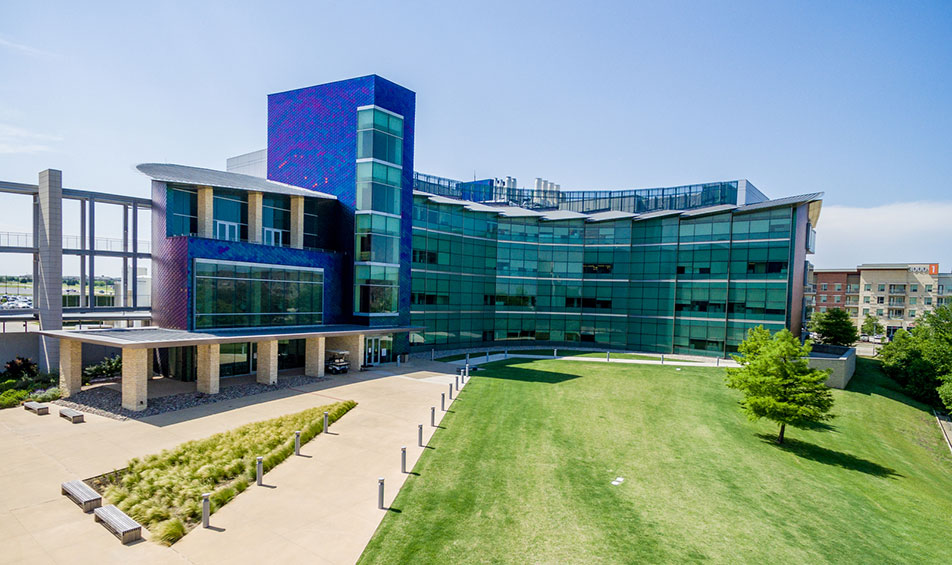
Personally I'd prefer to spend my time in and around a building like this than any of those:
https://labs.utdallas.edu/mems/files/2021/08/nserloutside.jp...
To me a building like this looks a lot more interesting. Lots of mixtures in materials, textures, and colors. And as mentioned before, this building lets in a lot of natural lighting. It lets you see outside instead of just constantly feeling like you're trapped in a jail cell.
Its not even like I really hate old architecture, I just think a lot of these examples given suck. I like this, for example (although it is getting close to overstylized for my taste):
https://www.adventuresofacarryon.com/wordpress/wp-content/up...
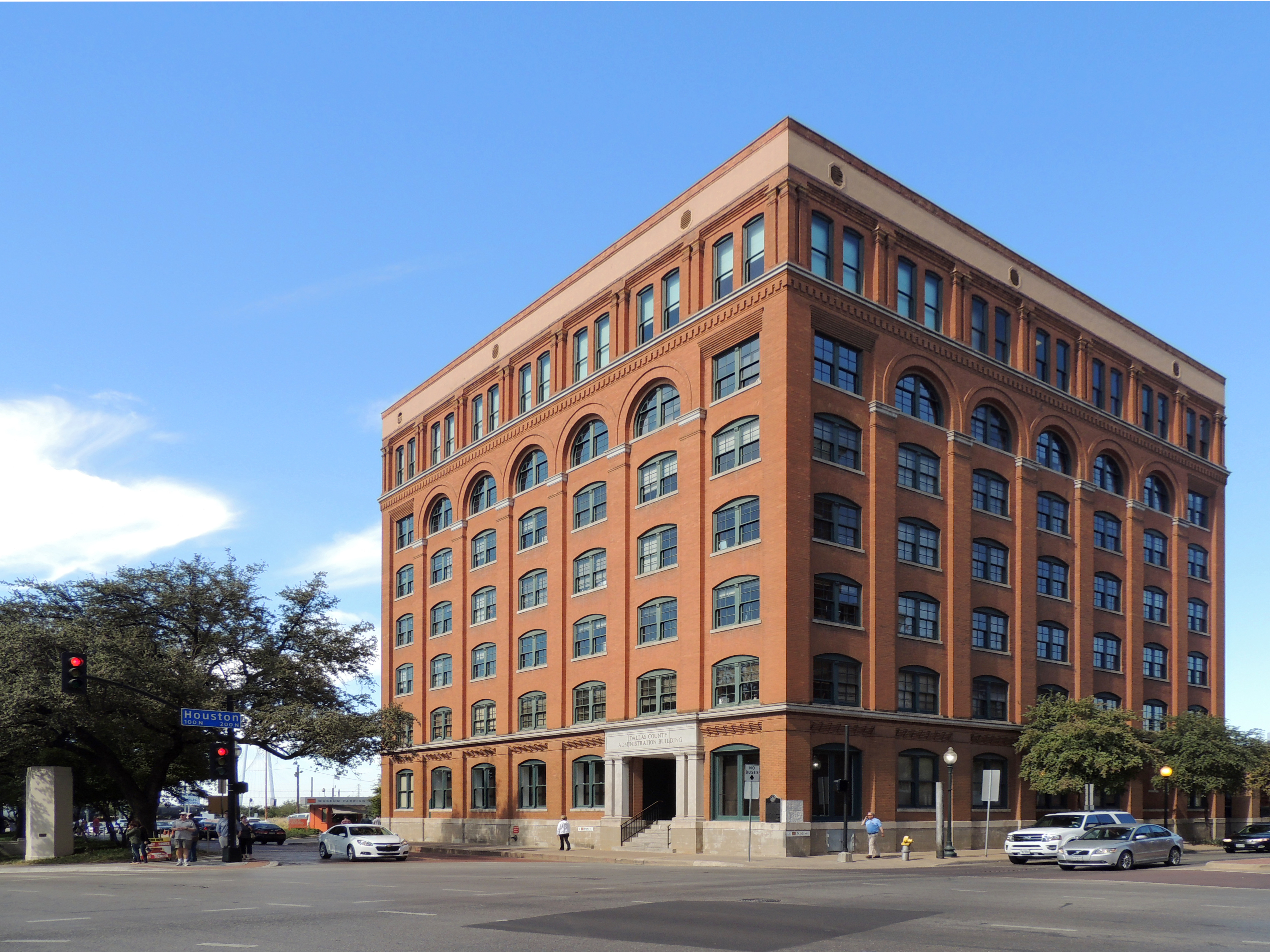
Buildings like this as well, although definitely not as much natural light. Notice its actually nice, clean, and maintained compared to the other examples given. Still kind of old and boring though in the end.
https://upload.wikimedia.org/wikipedia/commons/1/14/Dallas_C...
> how original, never seen that before.
If you're defending modern architecture, you have NO place complaining about originality, when 99% of it is steel & glass basic geometric shapes.
> you have NO place complaining about originality,
I can definitely complain about a lack of originality for works which lack originality.
Modern designs can often lack originality, I agree. Classical designs can lack originality as well. A lack of originality can make things boring. Don't let your personal choices get in the way of objectively analyzing things. Its not good to put yourself in a camp and act like everything in group A is good without question, everything in camp B is bad without question.
You can't honestly say the modern building I linked above lacks originality. How many other buildings have anodized scales on the outside which change colors based on the lighting? Are you really saying you'd prefer to actually be in and use one of the buildings in that postcard image I pointed out?
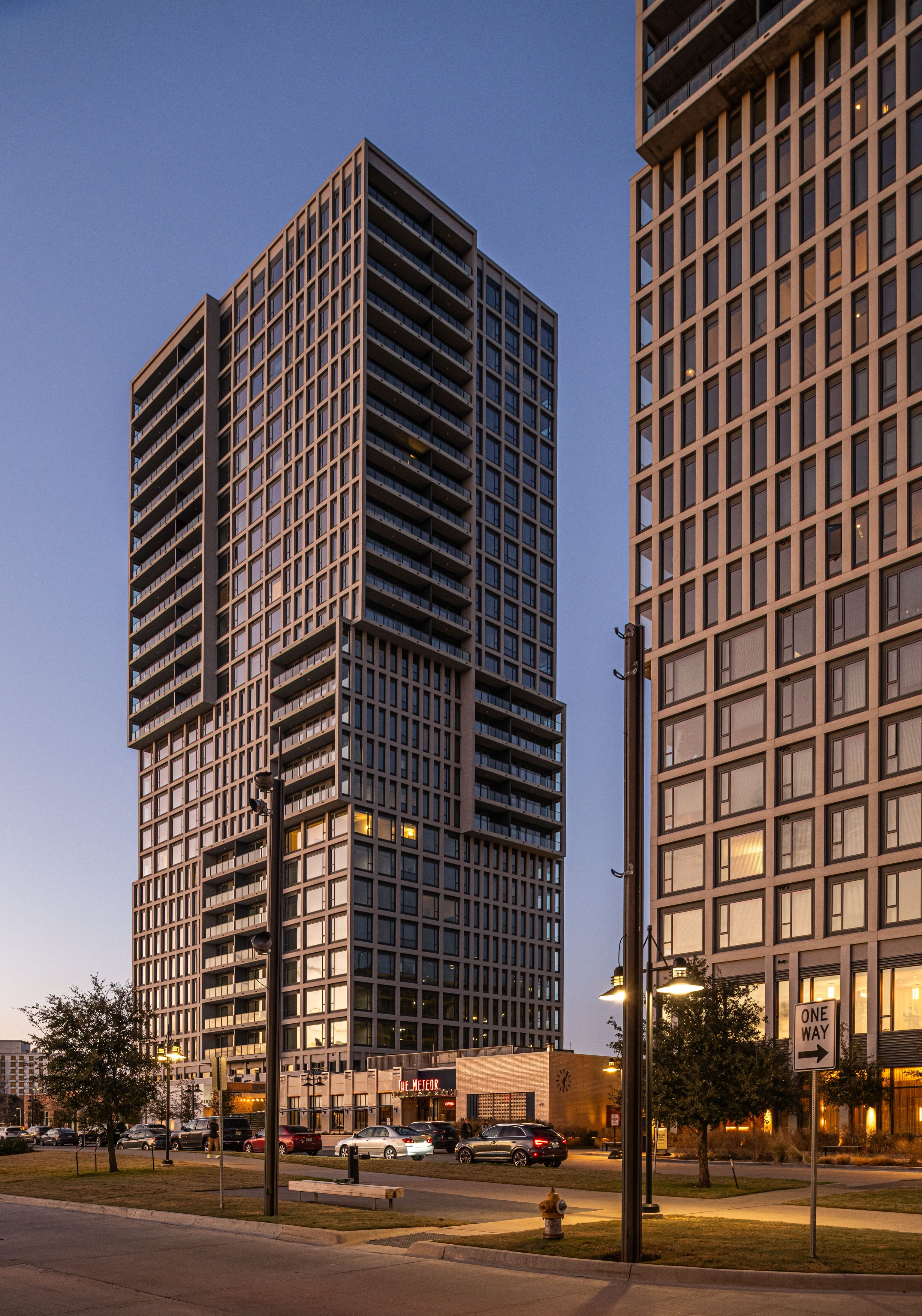
Buildings like this have way more originality than all those brick buildings in the postcard I linked, other than the one featured center in that postcard. Or yet another white stone government building with roman columns in front and endless small windows. And I don't even consider it that original.
https://img.imageboss.me/concrete-assets/width/3072/format:a...
I'm not saying all modern designs are good. I'm also not saying all older designs are bad. I'm not even saying those classical revival government buildings are inherently bad, they're consistent and unoriginal for a reason. I am saying I am a human being and like to have some sunlight and see trees and the horizon from time to time, and that's more important to me for a building than some little intricate stonework that I can't even really make out because its three stories up and the whole exterior facade is covered with black gunk because its too expensive and fragile to actually maintain.
> In the old days, buildings were made to impress, to project wealth, to show the generosity of wealthy benefactors to their town or city. Take a look around somewhere like historic Bruges, which benefited from the wealth of local merchants. Incredibly impressive.
Take a look at any old poverty-stricken farming village. It'll be strikingly beautiful compared to anything modern.
This is the Anamosa state prison: https://en.wikipedia.org/wiki/Anamosa_State_Penitentiary#/me...
This is Anamosa middle school: https://www.anamosa.k12.ia.us/wp-content/uploads/2017/08/IMG...
> Not remotely cost effective.
This is the main building of the Ontario college of art and design: https://en.wikipedia.org/wiki/OCAD_University#/media/File:OC...
Why are we still humoring the "cost effective" explanation, when, whenever the people in charge of design are given free reign, they make non-cost-effective, ugly buildings, ugly in the exact same way all the other "cost effective" buildings are ugly? Whenever they are asked which they prefer visually, ignoring cost, they pick the ugly buildings. Meanwhile anything old, from farms to literal prisons, is beautiful. And all those old buildings you claim didn't care about cost effectiveness, were built in a time when the GDP per capita was 4.6x lower than today [1]. If you believe GDP measures wealth, if you believe there was economic progress and we are materially better off than in the aftermath of WWII, we should have ~4x more "wealth to project". And yet this is what we get.
The explanation that fits the data is that they're building exactly what they want to build, and they're building ugly on purpose.
Personally I'd rather spend my time in the building with large windows and tons of natural light than holed up in that dark old castle thing.
That prison building is overly stylized to my taste. And given how complex the exterior is and seeing it's state it's obvious it's hard to maintain. Unless you like all the gunk growing all over the building all the time.
Is the old building "fancy"? Sure. So is that fragile china that's kept in the fancy vitrine but rarely actually used because it's such a pain to maintain and actually use.
Then you're part of the 20% of people who prefer modern styles, for whom 99% of buildings are built. You have plenty of choices, while the rest of us are lied to about why buildings look like they do and why we can't have what we want.
I think the prison looks better from the outside, but if you asked me which building I wanted to spend time in I'd pick the school without hesitation (assuming they were both being repurposed for the same non-school/prison use).
There is a clear preference for other people to build in traditional styles, but as soon as you have to care about more than what the facade looks like from the outside people choose the uglier functional option.
Plenty of old people now grew up in a phase in history where we were building ugly cheap things
So new buildings ignore externalities in the economic sense but also very literally.
[dead]
[dead]
[dead]
It is normal to gravitate towards beauty, it's in our nature. The root of efficiency is always someone's greed, pity that is also in our nature.
You see the same thing in literature, where modernism has crowded out of other styles. As one example, you see way less description today than in older books.
I'm not a hater on modernism -- I like stripped down literature and architecture (though I wish concrete buildings were cleaned more regularly). But there does seem to be some truth in this idea that "the elite critics" have dominated these fields, resulting in the production of art (and buildings) that are broadly unpopular. I think the overriding goal of these critics is avoiding kitsch, which they see in classical forms.




.jpg)