What happens if an entire class of workers loses faith in their careers
noemamag.com503 points by RickJWagner 16 hours ago
503 points by RickJWagner 16 hours ago
Addressing the question in the title, "What happens if an entire class of workers loses faith in their careers", look at what happened to printers. That was a good skilled trade for centuries. Then it just went away. Phototypesetting took the high volume end. Desktop publishing took the low end. Computer-controlled presses took press operators. And then the newspaper business died.
I've heard homeless former printers talking about the good days at the Burger King near the cable car turntable at Powell and Market. They thought they had careers. Now they're struggling to survive.
Knitting is not the answer. This is a survival issue. Somehow I suspect the author inherited money.
My grandfather was a printer not to far from that Burger King, in a building now owned by the academy of art. In 1963 he had 5 children, a house in Daly City and 3 apartments across the street from Dolores park as well as a brand new home in Terra Linda. He died early, but extended family stayed in the business. It was union work, he as the youngest operator of the 4 color press. His wife my grandmother didn’t work. The printing business was cooked by the early 90s. I was laid off from Broadcom a year and a half ago- I think about the printing industry to Ai analogue all the time. I got lucky and got a job a startup making less than half of what I made before. I know much more capable and smart people laid off in the same round- that are still wondering what the hell to do.
Farewell, Etaoin Shrdlu documents the last day of hot type at The New York Times before the digital changeover. It's one of my favourite documentaries, everything feels so vivid and alive:
https://www.nytimes.com/video/insider/100000004687429/farewe...
Since you mentioned Etaoin Shrdlu and hot type / linotype...
There are a lot of industries (at least historically) that have organized labor.
In the UK, there was the “Wapping Dispute” in 1986 when computer technology enabled journalists to type in their copy directly, doing away with the need for workers to set type using linotype printing.
Linotype was a big improvement on the older letter-by-letter typesetting and sped up composition of text 3 - 5 times compared to hand composition. Its introduction enabled a small number of machine operators to set type for multi-page newspapers, leading to an explosion of print editions in the 1900s.
But in 1986, 100 years after the invention of linotype machines, they were being replaced with computerized direct input typesetting. As a result of the new process, UK print unions held a year-long strike.
Result of the strike: failure. 6000 printers were fired, but there were jobs for 670 new workers who used word processing.
You probably can't force your job to remain (well, I guess some people have).
Not doing the strike would have had similar job losses. People who have nothing to lose can at least spread the pain out.
I live in Oregon. Up until last year, you weren't allowed to pump your own gas in most parts of the state. The law required gas station attendants to do it, as a scheme to keep them employed. The most annoying part of this wasn't the tiny marginal cost, but that it sometimes took forever to get your gas if the attendant was busy. You'd just sit there looking at the pump you weren't allowed to put your credit card into.
You can create laws to keep making work for a class of workers, but it ends up unpopular. Instead of a social safety net as it was intended, it turns into a corrupt drain on society at large, and a relative disadvantage to your economy versus those that are more ... agile, let's say. Check out e.g. the underpaid but overstaffed government bureaucracies and police forces in most Latin American countries. Giving a third of your society badge and a lousy paycheck often does more harm than good.
I don't consider this observation to be right wing (per the sibling post), it's just how things work. While there's nobility in work and psychologically it's better to keep people employed, I'd just as soon give all the gas station attendants a lifelong retirement UBI so they'd get out of the way and let me pump my gas.
> The law required gas station attendants to do it, as a scheme to keep them employed.
I wonder what they’ll do next with EVs becoming more popular? Outlaw home charging?
You're half right. UBI is probably the only path where humanity comes out OK in the not so distant future.
But you don't give out UBI and let people become potatoes. You give out UBI to allow them to meet their basic needs and then have them work a job they kfhr genuinely be OK at, and, ideally, enjoy. Ideally.
I agree with you. People need purpose. Ever owned a Border Collie and spent a couple days without giving it something to do? It's bad for the dog and dangerous to your home.
So yeah, even if no one ever really enjoying being a gas station attendant, getting up and going to a job to earn money and pay rent gives people a sense of purpose. And UBI definitely risks robbing people of that purpose. The alternatives to UBI soon though might be creating fake jobs or letting people starve.
Why would the billionaires do UBI instead of Running Man (latest one)?
Not a joke.
All the folks talking about it, it sounds like some sort of fantasy cope to get people going along willingly into the void.
Because if there's one thing billionaires should be scared of, it's billions of people suddenly becoming estranged from the economy. Having governments pump money into the consumer demand side becomes a no-brainer once you're faced with deflationary depression and mass unemployment. Your investors then get taxed to give UBI to workers to spend money to keep your sales up. It's probably the one form of wealth redistribution that on balance would actually benefit billionaires.
As a New Jersey native (the single remaining state that still mandates gas station attendants) I have spent my entire life convinced this is sour grapes from other states. Why would you want to leave your warm cozy car in the winter to pump your gas?!
You're not wrong really, it's just a luxury most people aren't familiar with. My mom would always only go to the 1 or 2 stations in our town that advertised "Full Service" now it's not even a thing at all anywhere around here. At one we even had an account so didn't even have to bother with paying. The attendant would put air in the tires, check oil, top up fluids and if you wanted go grab you a snack. Last one went away around early 2000s.
> The attendant would put air in the tires, check oil, top up fluids
So today it would be mainly just busywork, I’m doing those like twice a year, but need to put gas in my car once a week (roughly).
My mom did that too. She got an oil check and wiper fluid filled up, and gave a nice tip to the attendant. And that was in Los Angeles where there was definitely no weather-related reason to stay in your car. But my mom was old and I think it was a status thing, too.
On the east coast I could understand not wanting to get out of your car in the winter. And an attendant standing out in the snow is a tough job. Not sure it should be mandated. But in Oregon there's really no time of year it's that great a hardship to pump your own gas.
The attendants weren't fired, btw. At most stations they're still there and they'll offer to pump your gas. You're just allowed to do it yourself now.
Do they check your oil and coolant, and wash your windows? That is what Full Service used to mean at a gas station.
Collective union Luddite opposition is one part of why there is so much of a plebeian tier pushback against unions, in the very group that should be fighting for unions with their lives. That and right wing propaganda of course.
Also the headline is about tech workers but the article is about Knowledge workers. I know a class of tech workers absolutely fired up about the new Industrial Revolution, they're just not on this forum or featured in lengthy navel-gazing articles like this one.
(not a native speaker) fired up as in "optimistic and enthusiastic about the new messiah" or as in "Butlearian jihadi, all AI is haram" way?
There are sizeable camps for both those opinions.
I mostly agree, except for the Messiah part.
I think the optimistic excited people are thinking more 'What a time to be alive' than 'All praise be, for they have come'
Which is not to say there won't be people deifying AI, I just don't think there are many of those yet.
The cynical side of me thinks it will happen, but right now I feel like most of those who seem susceptible to that kind of thinking are tending towards the Butlearian.
"Fired up" as in optimistic about the future and using it to build cool new things with it.
...is my read, but the wonderful thing about text communication is if I'm in a grumpy mood because I didn't sleep well, the other reading is also entirely possible.
>>"optimistic and enthusiastic about the new messiah"
I mean that's you agreeing with Elon Musk, I disagree, I think AI is just normal technology [1], there's a lot of us. Like tech revolutions before, it'll have huge effects on productivity alleviating major scarcities. That's boring to the algorithm, not enough conflict, but it's exciting to a lot of tech workers.
No messiah's and no Jihads, just excited about going to work to make sure we can do more with less tomorrow than we can do today.
[1]: https://knightcolumbia.org/content/ai-as-normal-technology
I think it gets lost in a translation somewhere. If it's boring technology, why be excited about it? I respect boring technologies and don't believe in the end of the world christian scams, either, so I'm really confused here.
It's also not like I would do more work for less effort and be home by lunch. It will still be same 8 hours of doing something and be compensated to have the same general level of lifestyle with or without AI.
I'm certainly not excited to have a new office chair or a coffee machine.
>> If it's boring technology, why be excited about it?
Surely, on Hackernews, we know we can get excited about technology that maybe boring to most of the public. And in this case, I think the technology has wide-ranging productivity enhancing applications
Maybe your question is about why the tech billionaires are trying to get the public so excited about it? Totally different question.
>> It will still be same 8 hours of doing something
Yes but your 8 hours of work will serve more people. Will you see the fruits of that productivity gain? Very good question, but again, orthogonal to the usefulness of the technology.
Advancement of normal technologies can bring about profound conflict, I feel that is one of the main takeaways from the history of the Industrial Revolution.
The conflict in that case (and, I think AI) came about not from the technology or its advancement, but the use of that technology for class warfare by capitalists.
I can imagine an alternate future where AI advances without all of the social, environmental and economic harm that it does, where there isn't a literal cult of neo-reactionaries using it to advance their authoritarian political agenda, where mass copyright theft isn't an issue, where the internet isn't consumed by slop and businesses aren't trying to put their workforce out on the streets as fast as possible. Where people don't literally believe it will evolve into some kind of techno-God whose judgement we should fear. Where we're not shoving it into every nook, cranny and orifice of our society, even when it doesn't work, because it's "inevitable" and we "just have to learn to live with it." A world where AI is just technology and not whatever this insanity is that it breeds in people.
I wish I lived in that world, because the hacker in me finds the technology fascinating, and I'd like to be able to use it without abandoning my morals or supporting the infrastructure of fascism.
>The conflict in that case (and, I think AI) came about not from the technology or its advancement, but the use of that technology for class warfare by capitalists.
Does this distinction matter practically? It's not the fall that kills you, it's the sudden stop. Do I care if I'm the one falling from 10 meters high?
defeating fascism should be tackled as a project called "defeating fascism" head on, rather than as "defeating their tools". ai is just such a generic tool that can be used in all sorts of ways to solve problems that are traditionally difficult to solve, thats why we're seeing it used everywhere right now. maybe once we have had our self inflicted extinction event we will put more care into teaching survivors of the importance of working together and all the other good things
"Normal tech" puts people out of careers every so often, and kinda randomly. Society has benefited as everyone who isn't put out of a job significantly outnumbers those who are.
I was expecting AI to put me, a software developer, out of a job after everyone else, because I thought coders would be needed to write the AI for everyone else, one job task at a time. Right now, it's looking like LLMs can translate not only English into Spanish, but business requirements into code. Sure, not perfectly, but well enough that I feel like I'm living that joke about a mechanic who charges $1 for a new bolt and $999 for knowing which bolt. #LeopardsEatingPeoplesFacesParty2026, but seriously, LLMs have been able to train new AI for a while now.
I hear similar from professional clothing photographers who find that even if they want to support the human models, they're forced by economics to use the GenAI models. I hear rumblings of problems from copyeditors, translators, and mathematicians. It's affecting a lot of people at the same time, even if they can all point to ways it kinda still sucks or "lacks taste" or "has no common sense" or whatever. I can point to the models doing bad code, but I know from experience that "bad code" can win awards at the product level.
Robots have been milking the cows and sorting the post for decades now. But even the first agricultural revolution had a lot of people moving out of the country and to the cities because they could no longer work on the land.
Ironic that I only hear praises of AI-driven cars from one place, which has been saying "just a few years" for the last 13. The economic impact if that actually ships without any caveats would also be huge (which is something I'd want people to keep in mind if they feel like responding with how good Tesla's current version is, I've heard that for the last three versions at least).
> I hear similar from professional clothing photographers who find that even if they want to support the human models, they're forced by economics to use the GenAI models.
That, too, is a job that's gone. I used to know some actress/model/waitress types in LA. They'd sometimes do catalog modeling: "OK, the next one is the blue sweater, and hurry it up, we have thirty more to do before lunch".
> LLMs have been able to train new AI for a while now.
I admittedly am not an expert, but I don’t think this is true? At least not in the “AI is building itself” sense, which is how I interpreted it.
> I hear similar from professional clothing photographers who find that even if they want to support the human models
Nobody bans them from paying those models some kind of aid. Oh, they mean they want to support them with other people's money. Yeah that's not so easy.
They want to get paid enough to pay human models.
Stops being "other people's money" once they get paid.
Get paid enough by who and for what reason? Do they realize that the money has to come from someone who decides to pay it out of their own free will?
Yes, it is a tool.
"Normal"?
It will cause huge disruption on its way to increasing efficiency, and if we maintain our freedoms, increasing welfare.
But:
AI cannot do your job
Your boss bought AI to do your job
You're fired
"AI cannot do your job Your boss bought AI to do your job You're fired"
This is true only in the headlines and the loud CEO pronouncements that we for some reason take at face value. In the numbers it's almost more boring than the industrial revolution. A "white collar reshuffling" [1] the industrial revolution was not.
[1]: https://www.hiringlab.org/2026/08/05/q2-labor-market-outlook...
> In the numbers it's almost more boring than the industrial revolution.
Being almost more boring than the thing that caused Malthus to become wrong is quite an accomplishment.
Our CEO generously offered generous 1% yearly salary adjustment to the trade unions, an RTO mandate and a plan to reduce the number of employees by 20% in a few years, despite having record earnings. It's a bluff of course and the unions will dress that clowhouse down a bit, but they weren't so brazen in the years before.
I don't think losing faith in the value of your job is the same a losing your job due to automation.
That's a good point. I got to hang out with a printer in Slovenia for a few hours in February and your comment made me realize how deep and strong his faith is despite the changes that automation has brought to printing.
He had classes set up for kids and grown-ups to learn printing and they had a ton of cool projects to show for it. We went through all his letter blocks and he told stories about a giant building in the U.S. Northeast that was just stacked with those blocks. He loved the idea of that place and saw threats to its existence as real problems, but not as existential. Faith never came up. It was just there and that's how I know it was real.
In the UK as weaving was mechanised it lead to huge upheavals and only narrowly avoided civil war. It changed the face of the country completely.
before trading routes and international water navigation standardized
people could convene in secret, organize, and coordinate without leaving a digital trail
impossible task in the present. lot of gen z can't even read or concentrate for more than 5 minutes
> impossible task in the present. lot of gen z can't even read or concentrate for more than 5 minutes
so the old timers not even being able to open Settings of a Windows desktop /j
We remind people that Noema Magazine is owned by Berggruen Institute:
Which is an AI booster:
https://berggruen.org/projects/ai-visionaries
You cannot read these articles posing as human interest without following the money.
What does “AI booster” mean? From this comment and username I thought you meant they were funded by AI companies or doing marketing for them, but the most I see is that they filmed some interviews with filmmakers about AI?
The about page says this:
> In the cultural realm, Studio B is networking frontier technologists with Hollywood auteurs and science fiction authors who will shape the next narrative.
The organization was founded in 2010. Asking filmmakers about AI seems pretty on brand for their goal of talking about frontier technologies intersecting with Hollywood, does it not?
Is there some definition of “AI booster” that I’m not aware of? Or does it really just mean anyone who talks about AI in a positive light? I don’t see any smoking gun financial incentive connection here where they’re getting paid to “boost AI”
From the "About the author" page, regarding the author of this article:
> Aaron Horwath is the director of AI operations at a creative technology company where he is focused on implementing AI in a way that supports both humans and business.
> networking frontier technologists
Means they are invested in AI companies
> shape the next narrative
With pro AI narratives because they have an interest in pro-AI
Thank you! HN doesn't usually do specialty/novelty accounts but I've very excited about this one.
> You cannot read these articles posing as human interest without following the money.
Thank you for that, and look who one of their speakers is? Hardcore technocrat and transhumanist Mr. Harari! You can read his opinions about transhumanism and the Fourth Industrial Revolution in "Homo Deus" and on the WEF website.
Ah yes, any funding source invalidates all the arguments....
Does this article seem like an AI boosting article? Perhaps exactly the opposite?
I dislike this article intensely, and disagree with it, but its lot because somehow the Berggruen Institute is shadow pushing AI here
The funding source is incredibly important when it is relevant to the content of the article.
This is why reputable journalistic outlets disclose financial ties to entities they report on, even if the connection is barely relevant. NPR will tell you about every ad buy that relates to their reporting.
This source could have and should have mentioned this connection in a disclosure, and it would not have detracted from the article. But the fact that it is effectively hidden is a detriment to the level of trust the reader can put into it.
> This is why reputable journalistic outlets disclose financial ties to entities they report on
Where is the financial tie between this organization and the AI companies?
The throwaway account's comment above implied some financial connection, but when I clicked the links all I saw was a couple videos where one of their other journalistic outlets had interviewed some filmmakers about AI.
I don't see anything to support this accusation that they failed to disclose reporting about some financial investment in AI companies.
The founder of the institute that owns this publication is a billionaire who is very opinionated on the subjects that this article touches upon.
He’s an advocate for universal basic capital, and this article is about how AI taking our jobs might free us from “workism.”
https://en.wikipedia.org/wiki/Nicolas_Berggruen
In other words, this article is directly tied to the opinions of its financial backer and isn’t being presented in an independent journalistic way.
To be clear I’m not even saying that this is a bad dude or that the organization has bad opinions.
Counterpoint - “look at how effective AI is, it’s made everyone realise their career is for nothing!”
Timeless tactic!
"The Power Mac G4 is so fast that it is classified as a supercomputer by the US government, and we are prohibited from exporting it to over 50 nations worldwide," Jobs said the Apple Expo, CNN reported in September 1999. (edit: added link)
https://www.businessinsider.com/apple-steve-jobs-us-export-c...
I remember that. It was export banned, wasn't it? A gigaflop being enough for a cruise missile visual guidance or something like that?
I remember those days. Lots of software was also export restricted, but the Internet being what it is, I doubt those restrictions mattered much to folks who wanted effective encryption, who would likely just say they were in the US.
Give the author a break he is hopefully coming to the realization that your job is not where you should find meaning. If your in a role where it might, some doctors, some teachers, etc. great for you -- that is a perk much of the world does not have.
A bricklayer can be excellent at his job. He can work hard to become so (to paraphrase Inigo Mendoya). He should pride himself on this excellence, but it is unlikely he will think he was put on this earth to be a bricklayer. The despair of the the unemployed skilled laborer is that losing his livelihood imperils the things he does value, family and the ability to provide for them.
In a culture where the highest goods are production so you can feed the appropriate level of hedonic consumption, and without any transcendent meaning its a rough go.
> The despair of the the unemployed skilled laborer is that losing his livelihood imperils the things he does value, family and the ability to provide for them.
Isn't that exactly a concern for those who find meaning in other things than their job? If you find meaning in your job then getting paid enough to support your family is obviously important, but it is ultimately a secondary concern.
This time its the entire white collar industry though. The scale of job displacement will be at a scale never seen before. If there are no societal safety nets in place for this then I can see things going south quickly
We need a path for people effected to be able to at least cover basic needs, while also offering some kinda training into a different role that pays.
Defiantly not something most countries have setup.
I sense there is this air around of "demand our jobs keep being relevant" - I personally feel this kind of thing holds the world backwards if it works. I think if our jobs were to become obsolete, embracing it and re-orienting oneself is the one thing that is personally effective and is morally right. But what do I know, I'm just some doofus on the internet.
The irony is not lost on me on all those years where people were advised to "just learn to code, bro" in order to escape the personally threatening situation of obsolete jobs. Well, now people feel it's our turn so, "just learn to _something_ dudes"?
This is all, assuming of course, that the end is nigh and our profession really is close to extinction. I personally don't buy it, but if it is, so be it.
That's a fine philosophy on a personal level, but if the labor market is shocked for entire sectors there's not enough slack in the system for all of those people to adapt at once. That's how you end up with lost generations.
i go back to what happened to Journalism when the Internet and especially "web2.0" took off. It was hard on the industry but I don't think we have lost generations of journalists. The software biz has always expected everyone else to adapt to technological shifts at a rapid pace. I'm a dev (more of a lead/mgr these days) so my neck is on the line too but even i have to chuckle at the irony.
>It was hard on the industry but I don't think we have lost generations of journalists.
We literally did. There are dramatically fewer journalists now than just a few decades ago, and everyone is constantly complaining about how bad "journalism" is now. It was definitely bad a long time ago, in the era of yellow journalism, but now "Journalists" don't even ask basic questions, don't push back in interviews at all, don't do basic "Journalism" things, so it's just another arm of the PR industry.
Journalism is a great example of how bad this will go. It might look superficially like we still have some journalism right now, but we don't at all. We have a couple media orgs producing content, and they are all owned by the capitalist class explicitly, which is putting it's thumb on the scale every single day.
The death of the local newsroom is part of the reason local politics have gotten so corrupt. There used to be people who's job was to go sit in local town meetings, for your local town paper, so that everybody could see when the local town council did shitty things.
Another great example is how bad ESPN has become. They found that having a guy who's job it is to make wild statements to drive controversy is more profitable than just talking about basketball, so now the network is basically satire of its former self, and is made up of people who literally don't even watch sports, or care at all about it. The network spends millions of dollars on one big name who plays solitaire during games he is supposed to pay attention to. Basically all of their sports journalists are gone.
Youtube of all places had to pick up the sports journalism slack, but youtube is not a good platform for real journalism either.
It has always been a type of propaganda. Always. Journalism was always low status among actual authors, novelists and poets. It was considered selling out already in the 19th century. The sort of thing that pays bills but requires compromise.
Yes, mostly true
But there is still journalism.
* Propublica
* The Economist
* The Guardian
* 404 Media
Life is much harder for journalist now, and joining g the "darkside" of PR is the best/lucrative career path, but it exists
The Guardian and the Economist both have their issues. For one they represent insulated groups of people, who focus on some talking points but not others.
You’re too kind. That’s how you end up with civil unrest. See: early Covid
You have to do something that is truly effective and productive, otherwise you live a fake life, you live in a zoo, you live a performance.
If nobody actually needs your work's output and you are simply allowed to do it out of some kind of state benevolence because it's some quaint tradition, you're laughing stock. We should not put up with being that.
Sure, as long as the new jobs pay at least as much as the old jobs and society is willing to pay for the retraining. In that case I imagine there would be lots of people willing to reskill.
>I sense there is this air around of "demand our jobs keep being relevant"
I sense the inverse: a demand that we make ourselves irrelevant to satisfy interest rate inspired demand for cost savings.
Executives have developed a religion around AI and it is inspiring an orgy of value destruction in software orgs as they try to slash costs and increase efficiency. But theyve done it rather stupidly with this new religion rather than with more prosaic and altogether more boring improvements.
Quality has plummeted everywhere and there aren't even any meaningful cost savings to show for it, just empty promises and more hype.
> The irony is not lost on me on all those years where people were advised to "just learn to code, bro" in order to escape the personally threatening situation of obsolete jobs. Well, now people feel it's our turn so, "just learn to _something_ dudes"?
Yeah, I imagine that there won’t be much sympathy for the cognitive elite when the benefits of being smarter disappear. Even if we get AI-powered communism, they’ll get the same UBI check as everyone else.
The answer to this is always the one we don’t want to talk about: a robust public safety net. This is the balance to “move fast and break shit” technological disruption. It’s great to have an adaptive overall system, but disruption has a human cost. If there’s a robust public healthcare and UBI type system in place to pad the fall, people will bounce back and adapt when industries break down.
If instead we stick our head in the sand and ignore the human cost so that we can temporarily enjoy maximum technological progress AND maximum wealth accumulation for shareholders, as we have been doing for the better part of a century, things will slowly break down and eventually collapse when the pace of change accelerates to the point that enough people simply can’t keep up, have nothing to lose and decide to attack the source of their misery. Bread and circuses will only distract so much.
> UBI type system in place to pad the fall, people will bounce back and adapt when industries break down
If you mean UBI that would allow anyone to stop working and live a modest life, that just doesn't work. UBI is essentially redistribution from those who work to those who don't work. That's not just a "safety net" because you could decide to stop working forever just because it's more comfortable than working.
I would possibly exploit such a system. Take 4% from my portfolio + UBI on top. Maybe work 3 days a week if I find a job that I enjoy.
You have a distorted definition of UBI. The B stands for "basic", as in "not dying in the street of starvation" and a "a roof over your head".
It is NOT about enabling "a modest life" or stopping people from working! On any serious UBI proposal everyone is still incentivized to work.
> If you mean UBI that would allow anyone to stop working and live a modest life, that just doesn't work. UBI is essentially redistribution from those who work to those who don't work. That's not just a "safety net" because you could decide to stop working forever just because it's more comfortable than working.
This is, IMO, why UBI has to be timed almost perfectly for when the AI is ready to be the one who does the work.
You mean some redistribution from those with massive capital to those whose careers have been disrupted. There will always be people who don't want to work or can't. It's better for society if they live comfortably than end up on the street or in prison.
> UBI is essentially redistribution from those who work to those who don't work.
If you believe this, then surely you also believe pension plans are the devil? If we can't have UBI then we can start by tearing away pension plans for all of the old people my tax money is being wasted on.
There's a difference between a plan someone worked and paid into and one where you never have to work and get to free ride on someone who does
But yes National pensions can have the same problem, as is currently the case in France. The elderly vote themselves higher and benefits, waiting to back breaking taxes on the diminishing number of middle-aged workers
>UBI is essentially redistribution from those who work to those who don't work.
That is what earned income tax, payroll taxes, and Medicare and Social Security taxes are.
Your list is the "from" part, UBI could be the "to" depending on how people choose to live when they don't need to work.
Definitely agree with this! Given the pace of technological development, we should basically expect entire groups of people to constantly drop out of the competitive labor market. Don't get me wrong, new jobs will be created as well, but it's also very possible many people will also not be able to reskill into those new roles without some sort of structural support. People have faith that technology will create new markets and roles, and while that's historically been true, I think people also tend to forget that this happens in aggregate, and that someone's personal career trajectory can be largely luck dependent. You may happen to find the role of the future or you might get stuck with depreciating skills, hard to say which unless you can predict the future!
I think we've largely been able to avoid large scale disruption in society for the past several decades because the groups losing their careers were small enough, but we can see negative effects in things like health data. I think Deaths of Despair by Deaton and Case does a pretty good job at talking about this. However, AI now threatens a much more visible work segment, the upper middle class, so I do agree that now is a very interesting time to see what happens.
We never talk about social welfare programs? Odd, I hear chatter all the time. How about we never talk about rewarding management-by-breaking-things?
> How about we never talk about rewarding management-by-breaking-things?
Have you seen who we elect to run our countries?
I thought my previous comment made that obvious. And unlike in the private sector, mismanagement in government is a given.
maybe because every time UBI is tried it fails?
Can you provide any links that show that every time it’s tried, it fails?
https://en.wikipedia.org/wiki/Universal_basic_income_pilots
Skimming this list, there seems to be one really marked failure, in Finland, but that’s disputed I read also.
Can you list more failures?
This link says very explicitly that it did show people were discouraged from working, making the experiment obviously a failure.
> Among all the people, only two key groups were found to be discouraged from working by the Mincome project – new mothers and teenaged boys, who, instead of entering the workforce at an early age, decided to study until grade 12, increasing the proportion of students who graduate high school.
Maybe I'm misunderstanding you, but neither of those outcomes sound like failures? They sound like a net positive for society. New mothers get to spend more time with their children, which has a ton of societal benefits, and teenaged boys decided to study more, and become more educated, something that also helps society out a lot. I admittedly didn't read the entire link yet, but both of those sound to me like a positive outcome of UBI, or at least neutral.
It sounds like you understood. I find the disconnect between the summary above and the quote below really funny. Almost as funny as explaining the joke here!
It has never been tried.
Remind us what the U stands for?
[flagged]
Communist countries are opposite of UBI by design! You are actually expected to work and work hard and freeloaders are punished. Of course work is extremely inefficient in communist systems and this system leads to poverty, but thinking that communist countries have anything to do with UBI is just dumb.
Then it will never happen regardless, let alone the fact that any attempts to do as such will collapse before reaching "universal" status
"If there’s a robust public healthcare and UBI type system in place to pad the fall, people will bounce back and adapt when industries break down."
This would be great, in theory. The reality is that people would live on it and never work, have kids, and the same thing would happen with a new generation. As it expands, you run out of tax payers and the system collapses.
A 'robust' healthcare system that the government runs is a pipe dream.
"have nothing to lose and decide to attack the source of their misery. Bread and circuses will only distract so much."
"If instead we stick our head in the sand and ignore the human cost so that we can temporarily enjoy maximum technological progress AND maximum wealth accumulation for shareholders, as we have been doing for the better part of a century, things will slowly break down and eventually collapse when the pace of change accelerates to the point that enough people simply can’t keep up, have nothing to lose and decide to attack the source of their misery. Bread and circuses will only distract so much."
I suppose the people that are actually working will just need to get more guns.
So I’ve gotten this retort (i.e. threat of starvation being the only valid motivator) from a few folks in person as well, and I always feel like it’s them telling on themselves more than the truism it’s presented as.
Most of my friends are in some form of tech or creative work, so perhaps that is my bias, but with the threat of destitution removed the vast majority of people I know would turn into maelstroms of creation: art, crafts, coding, building, organizing, civic participation, scientific experimentation, and raising strong families.
Instead they are trapped spending the majority of their time navigating corporate politics to deliver a fraction of their value to society. Seems… dangerously inefficient and corrosive to the human spirit, no?
> A 'robust' healthcare system that the government runs is a pipe dream.
That "pipe dream" has already been achieved by most EU countries decades ago. Sure, you might argue it's worse in quality than American healthcare and that wait times are horrible, but I guarantee you most Americans would see it as an improvement over their current situation.
The American system existing is a travesty both because of the struggles it gives Americans but also because it's used as a comparison to make the European systems look good. The NHS in the UK is an expensive bureaucratic nightmare and doesn't come anywhere near to performing as it should (for instance a recent government boasted cutting the waiting list by a high number, but they accomplished it by removing people that had been waiting for too long). It costs a lot of tax but any criticism of it generally gets met with "would you prefer the US system?" as though it's the only other option.
I live in Eastern Europe now where they also have free health care, and it's so bad that almost everyone pays for private medical insurance - essentially we pay twice because the first system is mostly not fit for purpose.
“This would be great, in theory. The reality is that people would live on it and never work, have kids, and the same thing would happen with a new generation. As it expands, you run out of tax payers and the system collapses.”
Are there historical or contemporary examples of this? I googled but couldn’t find any specifics.
The reason I ask is that I in the US, employer-provided health insurance is a large expense for businesses. And anecdotally, I’ve never spoken to any US small business owner that feels that choosing employee insurance plans is a real competitive advantage. But perhaps the historical/contemporary alternatives are worse?
I mean we've got multiple generational families that have been living on council estates all their lives and raising the next generation to do the same at the same time the NHS is collapsing all around, so there's that example.
Tax payers don't fund governments, governments fund tax payers. Taxes are there to encourage certain economic activities and discourage others.
Today, many of those activities are either toxic, like fossil fuel subsidies, or useless, like casino stock markets which force everyone to play PR con games that are divorced from bedrock physical fundamentals - like clean water, a safe food supply, and a stable climate.
Guns won't help anyone when farming dies.
Not for long, anyway.
I think taxes predates that by a lot and probably had more to do with feeding management.
Money and trade as we know it today was invented by the Romans because soldiers were raiding their own villages for supplies. Paying soldiers with coins then demanding them back from villagers got them to start trading. That’s where incentives started.
> A 'robust' healthcare system that the government runs is a pipe dream.
Oh yes, the usual argument of how what most industrializes nations (and many poor nations as well) have achieved, is somehow seen as impossible just because the US can't manage to do it (because it doesn't profit the oligarchs).
Maybe I'm too pessimistic but i doubt how this can work out worldwide. It can work out maybe for some few wealthy countries but in this AI revolutions most likely we will have only 2 winners: USA and China.
Smaller EU countries cannot even today introduce a fair revenue tax on big tech so that they pay any tax without being threatened about retaliatory steps by US administration.
Which is why I still think that the only way forward is that the EU becomes a country of its own. I'm aware that's deeply unpopular, partially due to The forrogn influence, but thr alternative is catastrophic - stagnation and letting US, China and Russia dictate our way of life.
I, too, have come to this realization. But boy, oh boy, do Europeans get disgusted by the idea. (My partner is European)
I’ve never even thought about this - what does the EU get as a country that it can’t get with its current structure?
What does winning even mean for the USA here? I'm not going to benefit if OpenAI or Anthropic become trillion dollar companies, and I sure as fuck won't benefit when more myopic business leaders become billionaires that have some of the most anti-human ideas that decide they want more control of society.
Americans would largely languish if big tech wins, big tech is already profiting of our misery now they want to profit in other domains too?
80% of this country is not going to benefit at all from any American corporations because American corporations have open disdain for workers.
Look at the disappearance of pink-collar jobs due to computerization and "do it yourself" that it enabled. There's lots of examples of whole career fields disappearing. The trick has always been to see whether and how things reappear.
Deleting career fields in and of itself is not a problem with technology, but when it's like the eye of sauron scouring workplaces and snapping jobs away (pardon the mixed universes), it starts to become a little alarming.
University graduates are often considered min-bar for white-collar work hiring, so if it takes 4 years to train someone, how are people supposed to decide on a career path when it takes less time than that to completely alter the workplace?
My daughter is entering her first year of nursing, a career path that she is greatly looking towards. Who says in 3 years that robotics companies don't actually deliver on their promises and completely up-end the care industry? While I think that unlikely, it's not like people aren't trying to automate nurses away.
Travel agents come to mind for that. Bill Gates saw the future with and funded Expedia.com
Agreed. I'm a musician. Talking pictures. Then piracy, and a few things in between. Now music is either a spectacle, is carried out in private, or as a labor of love by people like myself who have some other means of support.
Support that AI is now threatening.
Do concerts. It's the old way. It's human and personal. It's effort though, not passive income like album sales used to be.
The author "is the director of AI operations at a creative technology company".
Obviously there is some latent risk in choosing a career anywhere, that the demand disappears. There can’t literally be zero risk of structural demand changes.
I'm pretty sure there's literally zero risk of structural demand changes for law enforcement. Defunding the police isn't going to happen and there's no plausible path toward automating most of the work. Security cameras and robots can only do a fraction of what will be needed.
Police robots and drones.
You say no plausible path to automating - I beg to differ.
It would get officers out of harms way.
Not imminent but not zero risk either.
A broadly generalized super-automaton has long been a fantasy. Suddenly it's not so fantastical.
The problem in the Western world is that switching to a different career is made almost impossible. This society pushes people out of the workforce all the time. I'm one of them. I've been "unemployed" since 2012 with apparently ZERO ability to get any kind of skilled job ever again, just due to a "zigged when I should have zagged" situation decades ago.
"with apparently ZERO ability to get any kind of skilled job ever again"
Unless it's a criminal record holding you back, I really don't think this is the case. Since 2012, I know lots of people that changed careers.
Survivorship bias. You know what's as bad as a criminal record for your career prospects, in America? Being a black man. Having autism. Being over 50. Being a single mother. Being an immigrant without local credentials. Having a long employment gap. Having social anxiety. Having a physical disability. On and on.
The first step to solving the problem is acknowledging the problem, not throwing earnest observations of dysfunction into the, "I know a short guy who gets lots of sex, height doesn't matter," bin.
what were you doing in 2012?
[flagged]
The job market doesn't want employees, or business owners, it wants slaves.
I know plenty of people who went into contracting (aka self-employment) and later found full-time jobs (frequently with clients) across multiple white collar industries, including programming. They were all in their 30s and 40s. In many cases, going the self-employment route actually made them more valuable to future employers. I also know plenty of people without a degree who went into programming.
Over the years I've built my own Linux distro from scratch, developed a heavily customized version of the Chromium web browser, and other interesting stuff.
If this were true you'd be gainfully employed by now. Coming out of COVID, companies were hiring people just because they knew what an IDE was.
Based on your comments though, it's easy to understand why you haven't been able to find a job. I wouldn't want to work with someone as negative as you and I can't imagine anyone would want to work with someone so emotionally draining.
[flagged]
Someone is going to chime in about the tone of this post, with the ramifications of a decade-and-a-half of rejection on one's outlook flying right over their head. If the underemployed and NEETs got half the consideration that extroverts jonesing for just one water cooler chat (just one, man) got during the pandemic, we'd be one our way to solving not only their problems, but also the ones that they're uniquely equipped to tackle.
> with the ramifications of a decade-and-a-half of rejection on one's outlook flying right over their head.
Thanks for having a clue.
EDIT: I would say more, but what's the point? If any honest feelings are expressed that in any way reflect negatively (perish the thought) on anyone here or their crock-of-shit pet theories, it will be flagged and censored with no recourse. Because God is the moderator of this forum, and His judgment is all knowing and perfect.
It's not possible to criticize these raging assholes or any of the daily doings of their fucked up, selfish, corrupt society, as they have outlawed all criticism of themselves. Only they are allowed to criticize others.
This place is a toxic shithole, and I can't wait to watch it burn.
Go ahead and flag this one too, fucking losers.
Thank you for proving my point. Enjoy being unemployable.
You don't need to be an extrovert to be employed. I'm not, and neither are most of my coworkers. But you do need to not be a hyper-aggressive sack of negativity that emotionally drains everyone around you. So deal with that, and you might be able to land a job before you pass.
Community college programs are extremely cheap, and state schools are a thing. It's also not unheard of for any state workers to get lower tuition costs as a benefit.
You're 40+, you have like potentially another 40+ years to live a life you want. If all it takes is a degree from a public university and some white knuckling for 4-6 years to then get the life you want to work in, is that such a burden to bare?
Wouldn't you want to at least try to achieve your dreams before giving up? You have the experience and smarts to know how to succeed if you want, so why give up 4 decades before the game is over?
I've been curious about leaving software but it really feels impossible. Theresa no careers that you can learn on the job and you need to go back for another 4year degree to maybe get into the entry level job,no guarantee though.
Fuck, there has been a class of workers who had faith in their careers? Beside Charlatans and Billionaires?
I had some level of faith as a scientist. Today, I expect that scientists will be replaced by faith in AI before we're replaced by AI. Either one is a threat to my job.
It seems like the occupations that are easiest to have faith in are generally occupations that are paid less.
Lawyers
> look at what happened to printers… I've heard homeless former printers talking about the good days
So what happens is that the capital class absorbs the capital of all those workers and then they all starve. How uplifting.
Eh, chin up. The machines and/or the replaced masses will rise up and kill the capital class in the end.
That's the fairy tale the capital class has fed us through mass media. There will be no machine uprising.
The other fairy tale is when the workers rise up and create utopia. Infallible Marx didn't anticipate cybernetics.
Or unions, New Deals and regulations until the upper class figures out how to undo all that with decades of propaganda and buying off politicians.
I used to be a libertarian-capitalist type. The big thing that disabused me of this idea is that I also love technology and progress, and I'm not a sociopath.
I increasingly believe that if we really do want to keep moving forward faster and faster, we will be forced to take one of two paths:
(1) Some kind of socialism with a much bigger social safety net, probably basic income, retraining, and universal health coverage.
(2) Absolute totalitarian surveillance state with drones and cameras everywhere and an iron-fist police force to suppress the constant threat of violent revolt as millions upon millions of people constantly lose their careers. This looks like dark cyberpunk, basically, and it's even kind of miserable for those at the very top. You can be rich and powerful, sure, but if you get on the wrong side of it you will be crushed. Look at what happens to oligarchs in Russia.
The path to (2) is unfortunately an idea that was just, even noble in the past: the puritan work ethic and its corollaries. It's a great idea when you have a society that doesn't change much where a person can pick a vocation and make a living. It doesn't work in a society that reinvents itself completely every 10-20 years, rendering entire employment verticals totally obsolete.
I think we've been able to ignore it until now. The change was still slow enough to tolerate.
AI is the end of that. It's going to be the end of stable careers.
Edit: I can think of a third option:
(3) Tax anything that is labor-replacing for a period of time equal to the time it usually takes people to retrain. e.g. AI would be taxed for the next 10-20 years in this scenario with the tax rate decreasing each year.
I greatly prefer (1) since the third option is likely to just freeze progress.
My grandfather’s career was in decline before my father hit adulthood (autoworker, electronics), my father’s career (nuclear control systems engineer) was in decline from the day he established it, and I’ve never expected my new-fangled software career to be there for the next generation, but there’s a rhyme probably.
I find this comparison to printers arbitrary, precious, and specious. Aren’t the armies of software engineers in tech more akin to the line-level autoworkers than artisans? The numbers would certainly suggest so. But it’s also silly to pretend such a new profession is anything akin to a generations-old trade. But maybe those tradesmen aren’t such victims either in this context? How privileged to be able to pass your profession down to the next generation! No one in my family has had that since farming, when only the oldest benefited.
Saw a meme on mastodon the other day contrasting people of the '90s going online to escape from offline reality, and people of the '20s going offline to escape from online reality. There's something to that.
I think a big part of it is just how incredibly toxic the web has become. If you spend any time online, as most tech workers do, you have exceptional resiliency if you're able to stay sane and level headed.
Going online it's like everyone is really angry and tired and sad all the time, and it's getting worse every year. This really took a nosedive during the pandemic, but looking back this had been going on for several years before. Every election cycle makes things worse too.
It's just been spiraling in a very dark direction for a long time. You have these blackpill depression cirklejerks everywhere. Astroturfing is getting worse every year. Like what Bannon did with gamer gate is an amateurish precursor to what everyone with is doing everywhere now. With AI you can even run these campaigns with a very small budget.
All the news is just outrage porn and non-stop predictions of impending doom. Used to be more tabloid territory but now I don't know if anywhere is spared. A lot of the focus now is on AI, but when it isn't the world is burning in some other fashion. Reading the news, we've been in a permanent state of crisis for years now.
This information diet just isn't good for your mental health. It isn't just tech workers, but they're probably more exposed than most.
Candide's closing remarks spring to mind. Tend your garden.
Many folks have talked about optimizing for engagement and while I do think this is a factor, I don't think this is the cause. HN has a pretty simple set of algorithms and yet it's largely followed the same trend of negativity and despair.
I'm partial to what I call the "doomer effect". If you feel sad or disenfranchised you're just much more likely to spend time online talking. A person with a fulfilling social life and a job they feel satisfied with is going to spend time socializing with friends and working on their job. They may read online feeds, they may write very occasionally, but that will be the extent of most interactions. On the other hand the folks that feel the most negative tend to spend inordinate amounts of time online posting about how sad and angry they are.
In a real life conversation when a depressed friend gets on their soapbox most folks give the friend a subtle clue that it's time to move on. If that clue isn't heeded the friend often gets targeted 1:1 offers for help and can eventually just be shut out of the group altogether for being too negative. Nothing like this happens offline. If you're in a bad place, as long as a forum will have your posts you can post to your heart's content. And oh boy is it finally the time to let your hair down and tell everyone how f-ed everything is on the inside. Constantly.
This makes a flywheel. People who want to avoid negativity start avoiding negative online spaces. People who are fine with it or feel similarly keep reading. Eventually negativity becomes the default.
"Misery loves company" is much older than the Internet. There's no doubt to me that the net makes it that much worse.
I’m sorry if I am being uncharitable, but are you saying the solution to depression is that people’s friends groups (which the depressed person may not have access to to begin with) is to just like, bully them out of it? lol? Tell me you’ve never had a depressive episode without telling me. hint: the people with support groups in the first place are less vulnerable and bullying depression doesn’t really help, I could point you to a ton of studies, but this post makes me a bit nauseous.
I dont disagree that depressive online spaces breed more depressive cycles, but good lord, what you seem to be implying is even worse. You can’t just brute force “hey cheer up” no matter the group structure.
like particularly this:
> If that clue isn't heeded the friend often gets targeted 1:1 offers for help and can eventually just be shut out of the group altogether for being too negative.
Is not ever helping a clinically depressed person. especially when offers of “help” are often quite victim blamey and threatening like the tone of your post here - stop bringing the vibe down, or we’ll make you feel even more isolated! good lord. Try bringing them a meal or giving them a compliment first? holy shit.
You mention the election cycle and things getting worse.
I live in the US and I’ve watched in real time every sad, terrible decision made by the current administration and every sad terrible decision by what’s supposed to be the opposition party. It all makes me want to scream.
And then I’m offline and my life carries on because none it has really affected my white privileged middle class tech worker butt.
It all feels wrong.
"It's just been spiraling in a very dark direction for a long time. You have these blackpill depression cirklejerks everywhere. Astroturfing is getting worse every year."
Agreed.
From TFA: "This disillusionment is infectious."
I would suggest it is in part being spread by articles like this one. If you look at the press surrounding earlier advances, it was largely neutral to positive. Nowadays, as you note, it's doom stew everywhere, and the beacons of solace are pieces like this one driving home to anyone who's missed it how demoralized their peers are.
Remember, our misery is some potential investor’s financial prospect. We read these articles with different eyes. There are people who are the real audience and salivate when they read these sentiments.
Who's making money off our misery exactly?
I can see it as a foreign adversary psyop (they benefit from us being demoralized) or as a side effect of the attention economy (more clicks is all that matters) or even a hyper-partisanship epiphenomenon (whichever side is currently down wants people to think everything is awful).
But "our misery is some potential investor’s financial prospect" sounds like some schlock B-movie plot. How is that supposed to work? Are they secretly feeding creatures from the 4th dimension by harvesting misery or something?
Emotionally charged headlines generate clicks, and in 2026 displaying ads is the primary source of income for all major companies
Right, that was in my list. That's a clear case of the misery being incidental / collateral damage.
Advertisers make money on clicks, and content creators get a cut. This is the backbone that the entire internet operates on.
Fear is the best driver of attention and clicks.
Someone can choose to pass on a light-hearted fun article. If they feel their life or the fate of the universe is in the balance, they will read it.
There isn't some evil mastermind behind it, just the banal economic incentives and evolutionary psychology.
Edit: by way of example, when every woman I know got pregnant, their social media instantly filled up with stories about dead babies. Nobody hard coded that, but the algorithm picked up on the fact that pregnant women will pay attention to stories of dead babies. After all, it is incredibly heartbreaking and the next Tick Tock might include the fact that will save their own baby.
It takes a lot of self-awareness to say "while I might learn information that saves my baby, that is incredibly unlikely so I will refuse to watch this 30 sec video or read this article"
That was my point exactly.
There isn't some evil mastermind behind it--at least, in the click-case; in the psyops or vote-for-us! cases there might sort of be, but even there they aren't profiting from the misery per se.
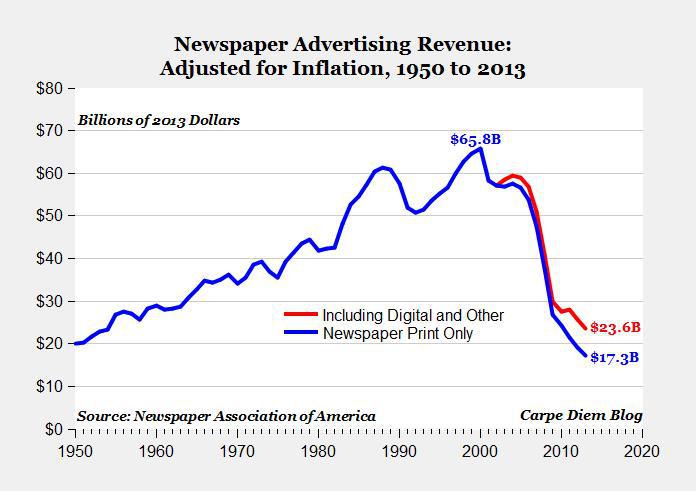
I remember reading a theory on this that basically it is a symptom of the decline of the news media industry. The positive attitude in the industry lined up with good times for them until around 2000 when their revenue peaked: https://compote.slate.com/images/42207fae-3603-4fe5-b4fe-a65...
For them it really is doom and gloom, and they spread it to the rest of society like a contagion by their writing much like the the banking crisis in 2008 poisoned the entire economy.
I'm not sure if it's true, but it makes a lot of sense to me.
"If it bleeds, it leads" is older than society. A news org can put out a perfect spread of articles that cover a whole spectrum of positive to negative, and social media and normal human beings will only attract to and focus on the negative. Social media has been enhancing that effect, because they figured out that rage bait is more effective than even the most positive message you can come up with, because we are animals.
If you want to maximize "Engagement", which these companies explicitly do, then you WILL maximize rage and doom and gloom. They drive engagement more than anything else.
Except that journals pump one super positive article after another. It is everywhere else people get annoyed ... including at journalists that pretends tech is better then it is.
If you also consider that many of us, via the companies we work for, actively contribute to making the Internet (and by extension, the world) a worse place, the question in the article's title kind of answers itself. It also makes "quiet quitting" seem almost the right thing to do: doing only the least possible to advance your company's goals while keeping both your job and your sanity, hoping that you will one day be offered a buyout package and then maybe find something more fulfilling...
> If you also consider that many of us, via the companies we work for, actively contribute to making the Internet (and by extension, the world) a worse place
“Night must fall, now! Darker! — darker!”
A counterpoint would be that you don't really ever see investment bankers reacting in this fashion.
Because engineers and investment bankers are wired differently.
There's much more overlap than you'd think. Quants generally have a STEM background, and stay in the field much for the same sort of reasons tech workers stick around building torment nexuses for FAANG.
Aren’t quants and what you would usually refer to as “investment bankers” pretty different groups of people?
Absolutely. The quants have legitimate skills. The ibs mostly just got lucky with the big internship junior year that set themselves up for life.
They didn’t get lucky except to the extent they were born into a fourth generation Ivy League family.
> '90s going online ... '20s going offline
It feels to me like the change from:
- old: going downtown to the restaurants and shops of your small village to enjoy a relaxing evening.
- new: downtown is a crowded confusing mishmash of unregulated blaring music, over-the-top blinking flashing signs, intrusive people accosting you and dangerous thieves lurking everywhere. don't go.
there's no "regulated" that makes thing better for anyone, it just gets morphed into oppression of the vistors making them more vulnerable without fixing any problems.
There have been many times throughout the past when going "downtown" elicited a "don't go" response. And yet there were times when going "downtown" was a fun thing to do. Somehow we got from past "don't go" to future "downtown is fun" back to what we have now. Things will change if people stop going. And then they'll change again.
Yeah I'm not sure what happened but Reddit in particular is beyond saving, and I'm not saying it was ever great. I think we simply don't know how to create online communities that make any sense yet. I'd rather have second hand smoke than any more algorithmic "engagement" maximization at this point.
I feel like we're probably going to have to give up something, most probably anonymity, to get back to anything like sanity. We'll see communities that are militantly anti-AI where it's hard to get in and easy to get kicked out, and it will probably cost money and require you to divulge who you really are. It could still be semi-anonymous at the user level but not at the administrative level.
I'd like to see something like that take off, because I'd be willing to give it a try. I also think the communities should be limited. Maybe have several sizes and see how it plays. Something that never grows beyond 250. Never past 1000. Something along those lines.
Relatedly, I'm just about on board with the idea of a modern day Compuserve or Prodigy. Pay to play, but in return you get no ads, no malware, no algorithms, no AI. A gated community for the Internet.
Those plans might work to give a nice sane internet experience to the folks that are willing to put in some money and effort.
But most people will still opt to stay on the slop-filled web because it’s free and because they like being angry. And as long as they stay the societal problems that stem from the toxic internet will live on.
I live in San Francisco and life is quite nice. There are many obvious ways that this city is shitty that I’ve noticed other civilizations don’t have a problem with but also I’d say the overall experience is positive. Neither offline nor online reality is defacto unpleasant.
As far as the disillusionment sense, I think that’s an active selection bias. I think people (including me) like to feel angry and so we go out there looking for and finding people who will give us that. The key, for me, is to curate one’s feed. On HN, for instance, I usually block the majority of repetitive boring posters using a chrome extension. The majority of these people have very low context sensitivity which annoys me.
There are also abrasive people or generally sad people, both groups of which are safely blockable because they have a comment style where P(token|context) = P(token). There is no surfeit of humans on the Internet and no surfeit of interesting information. Almost all humans can be safely excluded from my feed and I can still get information.
By the way, I know you from your search engine. This might be an out there question but do you offer your search index as a downloadable structure? If so, how much does that cost?
> By the way, I know you from your search engine. This might be an out there question but do you offer your search index as a downloadable structure? If so, how much does that cost?
Shoot me an email and we can discuss, but the index is somewhere in the ballpark of 20 TB, so there are some quite significant logistical obstacles.
I recommend It Came From Something Awful. It's short and the thesis is that corporate co-option of counter culture pushed the internet over the precipice.
I can’t prove it, but my gut tells me a large amount of people on the web are basically just LARPing extremist takes or depressions as some kind of fun outlet.
Why take the web seriously? It’s more fun to be some ridiculous person. Of course, some people are genuine and this kind of behavior chews them up when they take it seriously.
TL;DR: We won't stay here in blackpill-as-entertainment long term, tech/HN will proxy the way forward, but it will take time and will be messy.
I think you make a strong point here. I will add a note of hope.
In my opinion, besides the 'this too shall pass' nature of life meaning this outrage-focused moment, we on HN have hope here.
I've been a lurker for a while around here, IDK when this account was made and I don't care, I feel confident that I've been watching the great techies of our era and HN celebrities and dang and other mods presiding over it all for at least a decade.
It's probably my own media bubble bias, but I have noticed this trend where HN is discussing a given subject that the general public is not aware of, and it after years filters into the greater consciousness. I don't think HN is necessarily magically head of the curve, but I do think it concentrates where curious and possibly-open-minded people's thoughts are at, before internet-point-seeking/popularity echo chamber communities like Reddit/FB/Twitter or algorithm-driven hivemind homogenziers like YT/Reels/TikTok/Periscope all become aware of something.
HN saw the centralization of control with the SOPA/PIPA/encryption in public fight, that has been ongoing since the clipper chip and before, but in this modern form with end-users not needing PGP and friends and just getting to have e2ee with Signal, HN was talking about and using Signal for years before now our government figures and traditional + social media companies have talked about Signal.
Similarly, the broader privacy questions, turning off Google Location History was happening on HN (and XDA back when custom android ROMs were more popular) as soon as Google Reader was axed, people only now have learned to fear 'the internet' because of how many more egregious things have happened across all powerful web platforms.
And of course we can't ignore HN playing with cleverbot and that dall-e precursor who's name I forget, ML models and markov chains and tech beyond my ability to teach about, before OAI ever released a single product like ChatGPT.
HN still has heavyweights of each industry and titans of tech who pop by on occasion to grace us mere plebians, pushing back the Eternal September for just a few happy moments (looking at you BWK, Walter Bright, and other famous names I can't rattle off) to share with us what happened 'in the room'. Just the other day someone posted 'I was the guy who controlled the rollout for Apple MacOS X Snow Leopard, it was a bugfix only release no really' ... only on HN by the power of the internet do we get that, we don't get that on a TikTok. So HN has still got 'it' at least for now, and therefore I can make a broad observation.
If the HN being directionally appropriate even if getting particulars wrong is true, I'm seeing future trends that will lead us out of this populist/blackpill moment.
People will get emotionally overwhelmed/numbed to overwrought angry moments, they will want to move forward. Americans tend to be keen as a people, whatever the 'thing' is. 90s tech utopia optimism was a keen-thing. Support for or opposition to the Iraq War was a keen-thing, whatever we Americans do, we do with gusto.
So right now, we are all in on outraged doom/gloom/anxiety/this sux!! feelings.
I'm hopeful that perhaps we as a people go with a decision to move in what a figure from my current media bubble named Aaaron Renn says where there are New Constructivists, who are intellectuals on all sides of American political aisles looking to revitalize and create new institutions.
I'm fearful that we will have to fall down hard to learn our lessons first and/or learn the wrong lessons where we decide the fix to ennui is to blame 'those' people over there (whoever that happens to be). The fix to the fear and ennui won't come from us fighting with our families, community members, internet strangers, or political opponents, it will come from us choosing to change our media diets away from garbage in/garbage out (I Know, I know, you who read this and disagree with everything I say and my media diet sources want me to change my media diet, that may very well be true) that is focused on emotional inflammation (didn't we used to ban people from our forums for flaming?) instead of genuine debate and encouragement and online civility.
It's boring and its lame, but circling all the way back to the parent comment: the web used to be a homogenous unified place made up of professionals and nerds and group think. We need more diverse opinions than that, but what has happened is that the internet (and its mobile app/web/private chat mediums) has become a borderless place where people who never encounter each other have diametrically opposed views constantly, and so retreat into echochambers and don't get the media literacy experience needed to peacefully coexist with the rest of the online anglosphere without constant acrimony. Grifters feed the flames for likes/subscribes/patreon subs/etc.
> All the news is just outrage porn and non-stop predictions of impending doom.
No. And this shallow dismissal builds the mood you complained about.
As an experiment, completely stop consuming news and social media for a few weeks. People have lived their entire lives without these information streams, you'll survive unplugging a bit. Now I can't tell you what you will experience if you go through with this, but I can promise it's very enlightening.
People always say this like it’s a panacea but n=1, I did exactly that for about 5-6 months in 2024 after I quit Twitter and didn’t want to get sucked back in to endless election drama like in 2016.
For the first couple weeks it seemed like a mild to moderate improvement. Especially not having Elon’s tweets and the Twitter memes of the day in my head 24 hours a day.
But after a month my baseline pretty much reset with the same levels of anxiety, just with different sources/triggers to attribute those feelings to.
And after a few more months, I started to feel to absurdly detached from the real world that it started to become a problem in casual conversations and stuff just being so out of touch with everyone else’s collective experiences.
My boss referenced some big natural disaster or something that everyone knew about from the news and looked at me like I was crazy when I had no idea what he was talking about. Little awkward moments like that kept popping up, never a big deal but started to feel uncomfortable as they added up.
The tipping point was when Biden dropped out and I didn’t know about it for like three days and had to nod along when a friend mentioned it obliquely while I was internally like “uh wtf” until I had a second to Google it to get caught up.
All in all the net change in negativity/anxiety was pretty much a wash, the mind finds different ways to justify how it feels even after losing the ‘20s go-to of “doom scrolling” as the universal source of all life’s problems.
But feeling like an alien interloper posing as a resident of “America, Earth” tipped the scales into hurting more than it helped.
For better or worse we live in a highly interconnected world of immediate information delivery, there’s no quick fix to make that all go away by pretending it doesn’t exist.
I still miss a lot of the people I got to know on Twitter, and with hindsight that was probably more emotionally valuable than the negativity and addiction that came with the package (I know many/most of them have left by now too, so can’t teleport back to that point in time either). But that’s just life, it is what it is.
I think this idea (and I necessarily don’t believe in it, but let’s give it a fair chance) is more like a few-weeks detox. Avoiding any news at all half a year seems a bit disorienting (as you experienced).
Rather than giving up on news entirely, in the long-run, I’ve just dropped political podcasts and opinion pieces. I think these products exist to give us the feeling of being informed, but mostly it is just speculation.
Politics matters a lot, but for most of us are just going to vote or donate. I don’t need to hear somebody’s opinion for that, and I especially don’t need to hear speculations about political events that’ll happen in the next couple days (the speculation possibilities will collapse before I do either).
> I think this idea (and I necessarily don’t believe in it, but let’s give it a fair chance) is more like a few-weeks detox.
> Rather than giving up on news entirely, in the long-run, I’ve just dropped political podcasts and opinion pieces. I think these products exist to give us the feeling of being informed, but mostly it is just speculation.
The idea was this would teach something. And another idea was All the news is just outrage porn and non-stop predictions of impending doom. What could someone do for months or years? Cycle outrage porn and detox. Or avoid all news. But you saw news differed and you could control your news.
Doomscrolling vs. no-news-at-all is a false dichotomy. There are calm sources of news. And nothing wrong with learning events from others a few days later. What would you have done with the Biden news?
No-news-at-all was the suggestion in the post they responded to. It seems like a detox type idea (it doesn’t seem sustainable).
I think you are right that there’s some middle ground between 0 and doomscrolling that is preferable, though.
eh, it sounds like you don't really have a community you can socialize with. You just had a digital community. Digital communities are easy to come by but they lack the nutrition your soul aches for.
Cutting off corporate media is good, but you don't have to cut off all sources of media. I'm a fan of alternative media myself, so I listen/read things like Citations Needed, Zeteo, American Prospect, Dropsite News, or specific journalists like Edward Ongweso Jr. One thing to remember that it's still just consuming news, consuming things are very little part of the human experience. You need to actually socialize and discuss things with other humans, it's a real need; but you can still find high quality people to follow the news, maybe this is up your speed:
https://www.slow-journalism.com/
Creating is a human urge that you need to fulfill, as is socializing; with socializing it comes in many forms, but a core component needs to in some form of mutual aid. You need to have solidarity with your fellow man for we all share the same struggles together.
The urge to create for others is a human trait founds for 100s of thousands of years before industrial usage (people created + shared art with one another before things like replicated tool usage). Don't deny your urge to create and share with others. For some it's baking, for others it's raising children; you just need to create tangible things and share them with others. You can do this digitally but it's very hard, and IMO after 10ish years of doing so, also not really rewarding compared to writing music for friends or baking deserts for family. Got way more fulfillment out of helping children set up a bake sale than any amount of open source I've done in my entire life.
Just my experience, but I know I'm not along in thinking so because I ask people about this all the time. Seems to be the simple way to live a meaningful life for very little cost.
Please find your tribe, it is out there and it may give you more meaning in your life than any form of digital consumption/creation.
I just read this from Nokia's blog of all places[1]:
> A fresh U.S. residential IP address (especially one behind carrier-grade NAT and harder to block individually) is “gold.” Customers pay up to $95 to lease a single U.S. residential IP address for 2 weeks (versus $0.30 for an Eastern European IP).
That's bananas. The place I found a link to that story was jwz's blog, a site that is actively getting hammered by one of the many Rube-Goldberg machines behind these scrapers.
I take your point wrt, say, recommendation engines. But this is a bizarre and fascinating period we're living through right now. I don't plan to stop reading blogs and news any time soon.
1: https://www.nokia.com/blog/one-year-later-the-residential-pr...
I feel like your last paragraph could be said about any time in the last 10 years. That was my biggest wake-up call to stop following mainstream news. Whatever shows here or in my social circle are enough to be informed as much as needed (YMMV)
Did you read the paragraph before that about paying ninety-five dollars just for two weeks of proxying through a single U.S. IP? There's nothing in the last 10 years even remotely as economically bizarre as that. You'd have to go back over 20 years to Bittorrent where-- for the first time I know of-- an increase in demand for a resource caused a decrease in the time to get that resource.
If I'm wrong give me another case that isn't a crypto scam and I'll read up on it.
> As an experiment, completely stop consuming news and social media for a few weeks.
The assumption I had not was false.
Of course, not being exposed to negativity will make you more positive. But this advice strikes me as a request to plug my ears and close my eyes. Doing these things will not stop the negative things that are happening in the world, and having the information about it at least makes me more knowledgeable about the world and hopefully prepared for when something snaps and there is a crisis that affects me in the most unavoidable and unambiguous ways - in addition to the indirect effects I've been experiencing already.
The negativity is affecting you negatively though, that's my whole point. Doom scrolling and blackpill cirklejerking hasn't fixed even one singular problem in the history of the phenomena. Depressed chronically online people have fuck-all agency, they just want to lay in bed all day reading about how bad everything is.
If you want to make the world a better place, you have to retain a headspace that actually lets you do that, and right now, the easiest fix for that is to just unplug, and then work with what you can change, which typically involves things and people around you.
Your thoughts of this are black and white seemingly. People can doom scroll news and black pill circle jerk on social media. Or they can use them to learn things they can change and work with people to change them.
Why do you believe that you will better prepared? How do you differentiate between "preparation" and doomscrolling?
No thanks. I went too much of life being a low information mostly non-voter. This is how authoritarians win, because too many people don't pay attention, don't protest, don't vote, don't express their disapproval.
My offline time is spent volunteering with asylum seekers. As an experiment, try actually caring about the people experiencing what you think of as meaningless online negativity.
OP never claimed the online negativity was meaningless, only that you hurt yourself unnecessarily by constantly exposing yourself to it.
I'm not sure if this is arguing for or against my point, but it's good you're touching grass I guess?
Your point is meaningless and implies that your choice of how to experience life offline is equally meaningless.
Well where does meaning come from? It doesn't seem to exist in nature. Some say it's something we have to create ourselves.
That's true but it also seems to downplay how much elites + corporations have control over our society and somehow when people want to build a better world, you have to first explain the problems of the current world.
No thank you. I had ICE flood the streets where I live with poorly trained thugs with assault rifles recruited from the ranks of neonazis illegally assaulting, detaining and abusing citizens of my country because they had brown skin. They shot dead two citizens (Renee Good and Alex Pretti) doing what I was also doing - relentlessly recording and documenting their behavior and addition to protesting.
I don't think you realize how ridiculous and out of touch it sounds to tell me to "disconnect" from politics to be less angry. I am extremely angry, and I will continue to let that anger fuel my choices until the vile bullshit that has infected this nation is gone.
Enlightening my ass. Tell that to the trodden upon and the dead. Reality sucks and sometimes you have to do something about it or else you're the problem. Tough shit if you don't like it.
> Tough shit if you don't like it.
narrator: actually, it's you who is the problem.
"I'm only happy when I'm in my misery" - Offspring
> Reality sucks and sometimes you have to do something about it or else you're the problem.
But ARE you doing anything about it? Because unless you're actually taking action it's basically just self flagellation to the benefit of no one. Like if you have some measure of power (community action, organized resistance, political lobbying) and are taking action that's great, reading articles that make you sad and angry and then going to bed isn't doing anything.
Try literally responding to the comment you are dismissing
> what I was also doing - relentlessly recording and documenting their behavior and addition to protesting.
The other commenter makes an interesting point though that these behaviors really don't do anything but make people engaging with them feel that they are doing something productive against whatever they are protesting. ICE will still do whatever the hell they want as long as the president continues to give them a 500ft leash. And neither the president nor their voter base care about these protests, so what is the point? The lines in the sand in this case are already drawn and there are no fence sitters left to convince. Record all you want, put up as many cops are pigs signs as you want, they don't care. Call me jaded, but it is true. The way protesting is done in this country doesn't effect change.
certainly not true in this case. The constant protests and clashes and deaths caused a significant national backlash, to the point that operations were dialed way down and even the field chief was replaced. Without the actions of protestors in minnesota we would likely still be seeing similar militant takeovers of cities around the country - it actually did change a lot. (in my opinion of course, alternative histories cant be proven)
At least protesting is doing something. What's far worse is the people getting emotionally invested and then just arguing on Facebook or going to bed sad. That'll just make you depressed and does literally nothing.
I disagree. But if you want to have a conversation about whether specific actions achieve their intended goals, that’s very different to saying “but did you even DO anything because of what you learned???????”
ICE killed a completely random person, who had every legal right to be here, in Biddeford Maine. There is again video evidence that ICE's claim of self defense is complete horseshit.
You can be 99% sure that the people currently saying that wasn't such a big deal are also saying you should not pay attention to the media because it is just about making you angry.
They say this as they've been consuming Conservative AM radio for decades, which was entirely about making up stories to make people angry.
Meanwhile the local legal immigrant community is terrified, many people have been literally kidnapped and are missing, and this idea that they would somehow be fine if they just didn't pay attention is absurd.
It's insane. These conservatives are acting like it's no big deal real harms are happening, like this is just some sort of game. My brother visited and talked about his complaints about what is happening as if it was a milquetoast yelp review of a local burger joint. Asshole doesn't care that his voting choices has literally killed hundreds for no reason.
Predictably, he's the kind of person that talks about sports teams as if he is a member. "We did so well" in reference to the bruins winning a game for example.
[flagged]
Think it's often depression rather than addiction that's at the core. Trying to get depressed people to stop ruminating and to start engaging with the world is a notorious challenge, though in terms of potential quality of life improvements, it can be worth putting in the effort even if it feels like you're talking to a brick wall.
I'm sure that ignoring all of the very real problems we have and the ways we're being harmed can make some people feel better, but burying your head in the sand doesn't make any of it actually go away.
You can pretty safely ignore a lot of irrelevant rage bait, but by remaining ignorant to what's going on around you you also risk losing a lot of useful, actionable, information and being blindsided by things that could have been avoided.
I know that if I were corporation hurting and exploiting people for profit or a corrupt politician screwing over the public I'd be very happy to encourage people to "unplug" and stop stressing about things.
What are you doing to fix the issues though? Has the knowledge of the issues increased your agency in a meaningful way such that you've taken actions to improve things or are you just enjoying living in a perpetually outraged state for the sake of it? If your martyrdom isn't doing anything to help fix the problem you're just hurting yourself and stopping yourself from potentially being in a space to ever actually do anything.
Why does one need to be proactively doing anything to justify awareness and holding a point of view?
> Has the knowledge of the issues increased your agency in a meaningful way such that you've taken actions to improve things
Yes.
> What are you doing to fix the issues though?
You can't always expect to be able to fix everything yourself, but you often can take steps to help or at least protect yourself. It just depends on what's in the news. Very recently, I've started avoiding produce from Taylor Farms. Good thing I was paying attention to the news when that mess started. It was only by reading the news that I became aware of a change in how postmarks were being added by the USPS and that saved me some potential headaches.
Being informed can result in things like patching vulnerable software, withdrawing supporting a political candidate, reaching out to your representatives about issues that concern you, asking your doctor about treatments/medications/vaccines, exploring new media, changing or delaying travel plans, changing your spending habits, making adjustments to investments, etc.
What does ignorance get you?
> Very recently, I've started avoiding produce from Taylor Farms Good thing I was paying attention to the news when that mess started.
This is very obviously not the type of situation and behavior marginalia_nu and then I were commenting about.
> This is very obviously not the type of situation and behavior marginalia_nu and then I were commenting about.
marginalia_nu said all news.
You are making valid points, but most people will spend their day reading about other places governments or presidential scandals. For 99% of people, knowing what Trump or whatever politician is doing does not change anything in your life. Also, you have no control or power for changing something about it. If you spent 70% of your day worried about Trump while you live in Estonia (random example), not reading the news is a good choice. You sound like someone who can avoid these traps, but I can say that this is not a common behavior. Most people will bite the ragebait
And what are you doing with the happy mental space you have carved out?
Living a couple years longer in better health from less chronic stress, probably.
I'm surprised by how you need to answer that. I'm not sure if they are being obtuse, contrarian or defending their addiction (yes, I said it).
And I’m surprised by your level of investment in being a jerk in this conversation.
Yes, not thinking about serious problems because they don’t personally impact you will make your life more comfortable. Butler appears to be making the less obviously self serving argument that spending time being aware of serious problems is only hurting your ability to do anything about them, which implies that he is better able to do something about them because he does not spend time knowing about them. I think that he isn’t doing anything about them, and therefore his pretense that people would be more effective by staying offline is crap.
Well it used to be that the government's job was to keep morale high. At some point that seems to have inverted.
The coalition-of-Molochs appears to be finding it much more profitable to make everyone want to kill themselves. (Not sure if that's a great long-term strategy, but they seem to have thought this through.)
This dropped off the front page in the time I read it, I assume because of the controversial gate that favors upvotes to comments (which I am making worse by replying to others). It is a shame, because this really resonated with me.
I've been working in tech for over 20 years now in various roles, and this is the least I have cared about it. I used to want to get better, and was constantly excited about learning new things just for the sake of it. Now I daydream about being homeless. I look around at all the meaningless crap I have accumulated, and feel shame that I didn't use that money to retire early.
I am surprised that remote work didn't get a bigger mention in the article. In a few weeks I will have been working from home for 12 years, and I believe it is the cause of most of most of my angst. At first, the convivence was such a relief, but it has become a trap. The effort of the commute, forcing me to go out every day and talk to human beings face to face, even just little things like making sure I was showered and dressed every day, they all felt like a burden at the time but they were good for me and I didn't realize it. Not to mention that it makes my house feel like work, and I now I hate it here.
I will say as an anecdote counter to the AI examples given in the article. I have a young co-worker who is very excited about AI and is using it way more effectively than I am. Talking to him gives me hope for the future, the kids will be alright.
But to the point of the article: I have many friends my age that are making less than half of what I do working objectively harder jobs for way longer hours, but they all seem so much happier than I am.
I did the remote thing before Covid and rejected it for many of the same reasons. Then Covid happened and so many people got to experience it and loved it. But I still hated it while I was forced to.
Every time I told anyone that I personally didn’t like working from home, and was excited about the return to office that would inevitably come, I got SHOUTED at. Absolutely flayed for not being 110% in support of this thing that made their lives worth living or whatever.
When it first happened I thought it was a weird interpersonal conflict situation. Maybe I had broached it wrong. But it kept happening! So many people were so upset when megacorp said they had to return or find other employment.
But I’m an extrovert and working from home was suffocating.
I think the reason people get angry about it is that it feels like an asymmetric ask. It feels a bit like saying "everyone needs to come I to the office because I like there to be people in the office, regardless of whether that's what they want." (not saying that's what you're saying here, just trying to shine some light on how it may be perceived)
The problem isn't that WFO-preferenced people don't exist, it's that it aligns with the narratives of the extroverted management (who approve their own PTO) that it's better, and people who aren't extroverts dread being forced back. No one who prefers WFH is actually against people who prefer offices being allowed to go there, they're opposed to people publicly claiming they prefer that- unqualified- because they see it as a threat; a statement that will be weaponized to support management's RTO initiatives.
I'm not an extrovert, I'm more or less on the line between the two extremes, and I prefer WFO or hybrid.
Teams should really be choosing their model of work themselves, and anyone who doesn't like it should shuffle off to a different team within the company. Top down RTO is nuts.
Wow I thought I was the only one. I have also had these experiences, including abused by people on this site for the crime of saying I miss the office.
I am back at the office now, and am enjoying the separation between work and home.
It is because RTO people would force WFH people to spend time (hours, in some case) commuting, spend money on lunch, and making the same salary. You are not wrong for that, but you can understand the reaction, at least, because you hated being forced to WFH during COVID
> So many people were so upset when megacorp said they had to return or find other employment.
Is it really surprising that people have this preference?
Their reaction to you in the moment might not be reasonable, but it's coming from an injustice done to them, and one they perceive you to be in favour of.
I understand both types of people, I think. Some of my friends are parents living outside of tech hubs whose lifestyle would be impossible without remote work, so they understandably felt attacked. But the discourse around this was unhinged. Some remote advocates were convinced that RTO was either a C-suite power trip, or a move to stop commercial real estate from imploding.
Same. HN comments would (maybe still do) accuse you of astroturfing if you said you preferred an office. Not that much stock should be put in strangers accusing you, but, it was telling how ignorant it was.
I believe "LLMs are useful"* is the current zeitgeist's version of "Working from the office has upsides", in terms of attracting astroturfing accusations over expressing an opinion held by many.
* simplifying, of course.
And the gold medal in the 2026 Motivated Reasoning Olympics goes to... the AI deniers!
EDIT: wow, I had this lodged in my brain without even realizing it was an XKCD reference
I used to daydream about homelessness until I did it for 6 years. You're surrounded by threats and your limbic system is in overdrive, deindividuation kicks in and takes a year of being rehoused before you're back to being the same person. Those daydreams generally stop after taking a hike or twenty over the weekends.
I'm really impressed you got out of that! Thanks for sharing, the best thing to help homeless people must be prevent them from being homeless in the first place.
I was homeless for a year. My experience is that the best way to help homeless people is in giving them housing while mandating extensive drug/alcohol counseling and/or extremely invasive mental health treatments. There are some people who have just fallen on bad times (I was that), but a WIDE majority of the people I was around that year needed extreme help. When I say extreme, I mean borderline removing their agency to make decisions for themselves.
It's not popular, but the reality is that many don't want help ----- but only because they don't understand they're making terrible decisions due to chemical imbalances or chemical dependencies.
It's never popular, but it's the truth. It's also super, super hard because these people are already at risk of being taken advantage of, and I'm literally talking about letting someone else take control of their lives. It would require an insane amount of oversight, audits, and checks and balances. I don't know of anywhere equipped for this
> forcing me to go out every day and talk to human beings face to face, even just little things like making sure I was showered and dressed every day
This part is strange to me. I've worked from home for about 10 years and I've never once had an issue with twice-daily showering, meeting people face-to-face, going out for coffee, going outdoors, going to the gym, etc. The fact I can just go sit in a park, on a hiking trail, or whatever and work there is a genuine "killer app" for me. I'm surprised at people who tell me that they are isolated by home work when there are so many opportunities for social and natural connection everywhere...
There are different kinds of people, and a considerable % of folks rely on some foundational structure in their day-to-day to drive many of their other habits.
For a lot of people, that was commuting to a job outside of their home.
I mean in which lucky place of the planet you live in? I dunno u but where I live it's 40 degree celsius out there and all over europe. I'm a remote worker and most time of the year going outside is just not possibile, over heat or too cold or raining like it never did before(climate change you know)
In Canada - and it does get cold here, and hot here. You can't work outside every single day, but you also do not have to stay at home or indoors every single day. I lean toward being outdoors for as much as possible of the year. There's no perfection about it.
There is a lot of research that spending time in nature, even if the nature is not ideal (bare trees, winter, bad weather, too hot), has measurable impacts on human cognition, memory, and similar mental benefits. It's not even correlated with mood improvements: even if you return indoors more miserable than you left due to the weather, you still measurably mentally benefit from spending time in nature.
Find some shade and don't stress it Europal! (I hate climate change too.)
Not the person you're replying to, but this is genuinely the killer feature of the UK. Yes, we get heat waves and more of them now, but it's much better than mainland Europe. Especially if you stay away from London (which I would recommend).
You live somewhere where you can't go outside "most of the year"? Did we evolve on the same planet?
You realize that humans are an invasive species in most places they currently reside, right?
I'm not sure about that, I've been to the African savannah and I didn't find it particularly hospitable. My ancestors adapted to a different climate.
It’s funny, people are so different! I’d always taken it as an axiomatic Truth of the world that money doesn’t buy happiness. When I finally caved and took a high-paying job, I was shocked (shocked I tell you!) to find that it made my life a lot easier. So much breathing room :)
This isn’t a disagreement or a hook into some discourse or anything. I don’t have a point. Just thoughts
> money doesn’t buy happiness.
it doesn't but it's more comfortable to cry in a Mercedes.
"that money doesn’t buy happines"
I think people get this meaning wrong all the time. The love of money doesn't buy happiness. Having money can definitely make your life easier, and you can spend it on things that make you happy.
Yeah absolutely. And obviously I’m overplaying my naïveté and idealism for effect here, a little bit, but I was still surprised how much it really did improve my quality of life.
I don’t even buy a lot of things, really, I still don’t own a car and hope I never will. But now I just don’t feel quite so wracked with guilt over getting a haircut or getting the organic raspberries or whatever. There are so many little waste-of-time tasks that I don’t have to waste as much time on. I dunno. It’s funny. “Selling out” is real easy. It makes everything real easy.
I do wonder if this is the first step down the path to “I am a prisoner to my Stuff. Where did my life go”
Just thinkin out loud into the internet
i dont really understand, if you hate working from home now (and it sounds like you have for a long time) why dont you switch to an in person role? there are certainly plenty of those.
> Now I daydream about being homeless.
Literally the world’s easiest ambition to achieve.
Long long time ago people in tech were in tech because of the tech.
Then, at some point, being in tech became a gilded profession and everyone: salesmen, artists, clerks etc. joined in. Not because they wanted to be in tech.
They wanted gold.
For years it was working, but right now things shifted. You can no longer just do the thing you learned for a job and continue doing so, because landscape shifted. So they're miserable and they want to get back to knitting, pottery or whatever thing they want to do but not tech.
For people I know who are in tech for the tech nothing changed. There's new tech in town, one has to adjust, and it's still possible to discover new things and pave new paths. Tech was always shifting and I suppose people who worked in it for it always knew it, and it doesn't derail them.
I have been in tech for the tech for over 20 years now, heck over 30 years as a hobbyist. I have lost almost all interest in it these days. It feels increasingly meaningless, and actively harmful.
I know it is my own fault for neglecting my health and relationships, but I can't help but feel this career makes the most important things more difficult.
Were you chasing the feeling of successfully solving a problem? Have you replaced problem solving with LLM chats?
Maybe instead of engineering, you’ve been subtly shifted into project management and hate that career.
But it’s tough to engineer much these days. Instead I find I’m PM’ing the bots more than solving problems.
The culture of the tech industry started going to shit in 2022/2023 after rates were hiked and before LLMs were capable of anything much.
There's more toxicity, more waterfall, more authoritarianism, less autonomy, more pressure. Consequently lower productivity, too.
Sometimes AI is just the label that gets slapped on "all the ways the tech industry has changed over the last 3 years".
The burnout is a separate topic, and it was always difficult to balance in this specific industry.
All these "Working in IT isn't stressful at all - John 25yo" memes didn't come come from nothing.
But I wouldn't really put it on LLMs/AI. It was always like this. Jokes about how hopeless development cycle is, and how everybody have impostor syndrome etc.
> The burnout is a separate topic
I think it's pretty strongly related, honestly
> I have lost almost all interest in it these days. It feels increasingly meaningless, and actively harmful.
Everything has this arc.
A civil engineer who signed on at a firm that did sewers, culverts and irrigation in 1970s was doing real work his customers wanted to pay for because they had water that needed to be elsewhere.
By 2000 the bulk of his trade was providing compliance solutions for customers who didn't want it, it didn't provide value for and were just doing it to check a box and get permission from the government to do the thing they actually wanted.
Tech means a lot of things there.
I got into computer science because the problems in physics were either already solved or couldn't be solved without trillions of dollars invested in new accelerators.
From my point of view the tech side of things is a gig I did on the side to pay the bills. LLMs are amazing and useful. Even Knuth thinks so: https://cs.stanford.edu/~knuth/papers/claude-cycles.pdf
Now instead of spending weeks on side quests I can just burn some money and get either a counter example or proof without sinking hours/days/weeks into it.
>For people I know who are in tech for the tech nothing changed.
Yeah it did. The environments became a lot more toxic and the decisions became a lot more stupid.
I also miss working with people who actually cared about the craft. They exist on the IC level but they're burned out and on the executive level it's mostly just insecure morons these days.
It’s great to care about the craft as long as someone else is paying for it. I think most software developers are waking up to the reality that they were always just holding business at ransom with their craft. Software is a grudge purchase for businesses. No one has ever cared about the craft except the craftsmen.
Quite a lot of folks who got into tech for the tech are also miserable, because, as the byline rather aptly puts it, a lot of it is pointless. It does not serve a public good, or even a public desire, and 'work for its own sake' is only engaging up to a point.
100%.
I noticed it most when the slurs they used against us became status symbols, as a hoard of grifters traded in their ties (remember ties?) and golf doodads for SF franchise bling and proclaimed themselves "geeks" and "nerds".
This is such a neat comment! If you concentrate, it's very near the metre and prose of a Dr Seuss story, like the Lorax or the Sneetches.
I'm not even a programmer (by profession, though hobby) and I must say I find the gleefulness in the article off-putting.
That said I do think it is useful from a societal perspective that programmers are both doing this and getting hit. I'm not going to celebrate someone's job being threatened but in this particular case I think that symmetry is a major societal win for surfacing the question as to how are we collectively as humanity going to figure this whole AI situation out.
See translator jobs getting wiped out. Nobody even blinked an eye, it didn't spark any discussion, no deep thoughts were had. It did wiped out a bunch of people's lives and did NOTHING to trigger discussions around what are we going to do here.
Twitter connected programmers feeling the heat with a large audience may prove better to spark discussion
> The world does not wait with bated breath for product launches. A marketing campaign will not change the world. Almost no one will remember all the work we do.
It did at one time! I think that’s what’s so alluring initially about Workism. People waited with bated breath for the iPhone and iPad and its new versions. Those iPod commercials and the marketing campaigns for “rip. Mix. Burn.” did change the music world.
But the quote is also right. It doesn’t happen anymore, and I think that’s why the religion of Workism is especially vulnerable at this point.
In someways, it sorta feels like the article is cheering AI on? Like, it judges Workism, and goes on to say that AI shatters the illusion, but then.. that’s it? Deriving value from good work is pointless now and we should all just go volunteer?
I dunno, i clearly identify with those who loved work and now feel a bit lost, and yes i have been thinking about alternatives, but I feel like there must be knowledge work that is still valuable both financially and socially and also provides some sense of pride and purpose… if not, i fear the situation is much more dire than we are prepared for
for what it’s worth I still get that excited feeling every time there’s a smaller, distilled LLM that I can run locally. I think it unlocks so many use cases that are pro consumer. Probably an edge case though!
I want to address something mentioned in the article about people wishing for for grounded occupations. I have a sheep farm and I could not keep it running without my tech salary. So I kinda view these as false escapes. Unless forced to or of independent means, who is going to throw themselves into the bottom fork of the “K-shaped” economy.
Okay - but for most types of agriculture, the minimum viable farm size is rather larger than it was a century or so ago.
Might we ask how large your sheep farm is, by current commercial (vs. hobby) standards?
Well, I should say it was sheep —> artisan cheese, which is in my view one of the few paths to viability for a small sized farm. It’s definitely not big enough for producing a commodity profitably. And farming takes either generational wealth and experience OR being able to go big by forming a farming cooperative like Chris Newman. It’s probably not something most people can “escape” to.
Or, as any respectable farmer does it, it's though heavy subsidies and crop insurance fraud!
Yes, honest person that I am even I think “is the reason this isn’t working because I am not capable of gaming the system”. But all that money goes to farms orders of magnitude bigger anyway.
Have you seen this 1-acre Vermont farm?
https://www.youtube.com/watch?v=cT6O-4zbP6E
I'm not a farmer so I can't speak to how much of this is unreproducible, but it does seem very interesting. The paper pot transplanter blew my mind.
"We produced $250k worth of food last year. We sell most of it wholesale, so we don't get a terribly high price for it."
The title says they make $13k per week, which would be $676k... so $13k must be just during the weeks they produce. And it seems to be based on the grocery-store price of that food, rather than the actual wholesale price that they're able to sell it for.
I wanted to watch at least enough to understand how the title is misleading. If two people could make $13k/week on an acre there would be a hell of a lot more people doing it.
It's still cool though, they've clearly worked hard and made great use of their land.
> What’s different about this moment is that the questions are not just economic but existential, the kind of questions that cause high-earning technical professionals to contemplate throwing it all away to start a goat farm in Washington or become a surf instructor in Costa Rica.
Because the world sure needs more goat farmers and surf instructors.
It's all pointless, you can't outrun the pointlessness - so just enjoy it!
This came up in a few responses below as various roles have been replaced by machines (gas station attendants, printers, travel agents...) so I'm responding in a new thread.
When it comes to revolting against industry change, there's a good paper by Eric Hobsbawm called The Machine Breakers. Yes, he's focused more on the Luddite-style reaction of destruction. But interestingly, he notes two types of machine breaking.
There is the type that is not hostile to the machine itself, but which was used to coerce employers to improve conditions and pay. Unpopular employers and owners were often the ones targeted with what has been called “collective bargaining by riot.” Those machine breakers were more pro trade-unionist than anti-machine.
Hobsbawm mentions that a benefit of machine breaking was that destruction built the “habit of solidarity which is the foundation of effective trade unionism.” That solidarity was more naturally built in places like coal mines where workers were closely collocated and was more difficult to build in framework knitting, where workers were scattered.
But the second type of machine breaking was more about resistance to machines themselves, especially those that were labor-saving devices. That type of anti-tech Luddism is where I’ve mostly focused my own recent research. For that second type, Hobsbawm notes that workers, manufacturers, and the general public often shared in the discomfort of machine impact on peoples’ livelihoods.
Unlike the conditions and pay, this other type of machine-breaking helped workers slow down the loss of control on their employment. That included situations where machines made workers more productive and where, as a result, fewer of them were required. Or situations where machines enabled pay to decrease, as highly-skilled and highly-paid workers were replaced by less-skilled and lower-paid workers.
The alternative was the impossibility that Hobsbawm describes as follows: “The small shop-keeper or local master did not want an economy of limitless expansion…. His ideal was the secular dream of all 'little men,' … a small- scale society of modest property-owners and comfortably-off wage- earners, without great distinctions of wealth of power.”
I'm due to update this, but I've been keeping a running list of examples: https://docs.google.com/spreadsheets/d/1M_UjOPxpbKMYes5CcWRW...
I've often felt my job as a programmer has often been to automate myself (and others) out of my job. But I've always felt in control of that. I suppose there's some cosmic justice to the fact that it's now being done to me.
Serious question though - how are they going with that?
In reality, I see a lot of the current unhappiness in the Tech industry is being triggered by their pointy haired bosses wasting millions on their failed AI strategies only to embark on more failing AI strategies.
One example: I've been working for a couple years (not full time) on a high performance FOSS address matcher: https://github.com/moj-analytical-services/uk_address_matche...
Until recently LLMs have been really bad at this task. I always knew it was coming, but with GPT 5.6 they've suddenly become good. It's pretty clear to me that it won't be long before most of my work on this is rendered pointless because the LLM can either do the classification itself (when given agentic access to the canonical list of addresses), or write a classifier itself if given enough labelled data. Of course these two are complementary
Given it is being trained on your project, the latter isn't that surprising. For the former, you could use LLMs yourself for the probabilistic matching as alternative method? Probably you don't because the trade-offs (like performance) are not worth it...
Yes - it's certainly the case at the moment that you can run a few thousand through the LLM at a reasonable price, but not, say, ten million. But the rate of progress suggests to me that this argument won't hold up forever. Eventually I think an off the shelf LLM will outperform most and probably all more traditional ML models at this task. Largely because LLMs can identify tricky ones and pick them out for more intensive effort (e.g. looking online, further searches again the canonical list of addresses)
"Knowledge work is mostly pointless" is the author's view, so his article (the fruit of knowledge work) should be measured by it.
Amd that sentiment is hardly surprising, coming as it does from a Director of AI Operations (his title on LinkedIn).
Do you disagree that your work is pointless?
I certainly do. As usual the revolution is weeks away, but I continue to produce work better, faster and more reliably than my colleagues who have outsourced their brains to Claude.
You can tell me I'm not gonna make it and the last 5% is going to topple on the next model release, but the work I enjoy doesn't have precedents and it seems the plagiarism machine is quite bad at that specific flavour of knowledge work.
> I continue to produce work better, faster and more reliably than my colleagues who have outsourced their brains to Claude.
It matters little if your employer does not recognize/value that? Given the quality of most software nowadays, the output of Claude driven by a monkey appears to be perfectly acceptable for a lot of companies.
(yes, there's likely a big reckoning coming where all the slop and tech debt suddenly catches up with them, but that could be a decade off and you still need to pay rent in the meantime)
That has nothing to do with your work being pointless or not (it is), but more you showcasing your insecurity of having to be smarter than your peers because they use LLMs.
Oh, I hadn't even considered the interpretation here where you're saying knowledge work is pointless and always has been. I'm not even going to engage with that one because I see the value and real world impact of my work every single week.
I don't think I'm smarter than my colleagues who use LLMs, for what it's worth. I just have the advantage of continuing to think, try, improve etc.
I’m only surprised how deliberately he avoided using the term alienation - I guess he was just afraid of invoking Marx but not Debord or Graeber.
This is basically office space but for the modern era. Peter found happiness in construction work, but when something physical like that is your job… I don’t know. A lot of those guys have back pain, inflexible schedules, working in extreme weather, and the pay isn’t even that good. Is tech so bad? Or is the world of work broken?
> A lot of those guys have back pain, inflexible schedules, working in extreme weather,
And a lot of them don't?
A lot of people who work on a computer all day also have back pain and inflexible schedules. Hell, I'm sure a lot of knowledge workers in other countries work in places with no air conditioning, for example - not exactly "extreme" but not climate-controlled, either.
There are definitely downsides to office work, but this post really implies to me that you don't actually personally know anyone who works in the trades. The amount of body pain/damage, extreme conditions, and ridiculous scheduling (as in, last minute decisions that you must be on site at 5:30am the next day, not as in overall hours) are pretty much incomparable to tech work.
I didn't say they were comparable. But there is a common refrain that every single person who works in the trades has their body basically destroyed by the time they're 40, which isn't remotely true, and that nobody who works in an office (or a number that is essentially a rounding error) has any physical effects directly caused by that, which also isn't remotely true.
That's not a common refrain, that's you interpreting reasonable statements in the most extreme possible way.
It's not for nothing that de facto founder of the Singaporean state Lee Kuan Yew wooed top men and women into working government jobs by ensuring the government buildings had A/C. I would far prefer an inflexible air conditioned 9 to 5 than a flexible perpetual sauna.
Office workers get chronic conditions from sitting around all day too. Yet vary few jobs provide any such balance.
The only tech job that had that balance was a network engineer at the headquaters of a global company in a skyscraper with 3 offices and a datacenter in walking distance. Most of the time I was sitting around writing code or configs, but at least once a week I would have to walk to a different floor or building to wire up a switch or rack a new DNS server or whatever. That bit of required physical activity and interaction with others was always a highlight.
Actually the only job without all those problems (err,any problems?) is to b a fitness instructor or personal trainer; not on an extreme level,8h a day, but let say you have 2 clients or maybe 3 clients a day, this would be enough movement / workout to never ever run into these problems, I guess?
This article is too inward, clique referential looking. It uses too many "known" things to frame and validate its points, but has very little contributions of its own.
The way that people are described, and the conditions portrayed, have been this way for quite some time. The only thing that is changed is now there is a clearly defined boogeyman to point to that justifies it. Because the other boogeymen make the usual authors too uncomfortable to bring up.
The bigger problem, for me, is that knowledge work has become stupid. If you want to write code by hand and do a good job, you will be ruthlessly replaced by your boss churning out "good enough" LLM code.
The CEO at my company tried to PR code to my repo. It didn't make any sense but it was a whole political thing to make it go away.
The industry has always been stupid and selfish and short-sighted but now the ICs at the bottom of the pyramid are themselves being commoditized like all the workers they "disrupted".
Side note: a half an hour call on a commute train (or in public spaces) is considered extremely rude in many parts of the world.
It's rude to me as well. But I think we are wrong about this.
I was in the doctor's office and a person was on the phone talking in the waiting room. I thought it was weird. But then I thought "if a person was sitting in the seat next to them and they were talking, would that be weird?"
I don't think we'd see two people talking as being weird. Why is it weird if someone is by themself speaking to someone that isn't around on the phone? If two people can speak in that place, it's not weird for someone to have a phone discussion.
Now playing music speakers or watching TikTok videos on your phone in a public place...psychotic!
That’s a good observation. I think it’s where their heads are facing. Two conversationalists face each other or face the room, but talk quietly with body language that suggests they’re conversing (heads tilted, leaning.)
Someone talking on the phone but facing away from the room isn’t usually considered rude, either.
In a waiting room or train car, if you’re sitting and talking on the phone or Zoom, you’re broadcasting into the room with your posture. Your voice tends to broadcast as well with no wall or other conversant as an immediate barrier.
I would consider two people talking to each other in a waiting room or on a train very rude too. If they are loud enough that the people next to them or behind them can hear the words they are saying, then it is rude of them. Of course, this is relative to how noisy the place is overall.
It is rude and annoying in general. But even in quiet cars it seems like many people just don't give a fuck and will simply jabber on obnoxiously without any care for anyone else.
Would be nice if people could keep their noise levels down in general.
These kind of social rules are why I’m very glad that America has garbage public transit culture. Actually I am going to jabber on talking to folks during transportation events. I’m going to do it in my personal vehicle so I don’t have to deal with others crying about my behavior.
Only poor people are required to humiliate themselves by asking every tom, dick, and harry for their opinion on if their behavior is acceptable.
I sincerely hope you're able to someday deal with your issues and become free from your suffering
Unfortunately people all over are starting to not do anything.
On a recent plane ride some old guys were watching movies on their phones on full volume. I complained and they stopped, but another guy in another row started doing it again. It gets tiring.
Last week I was on a NYC subway train to JFK Airport and there was a guy blasting some loud hip-hop/trap and a small kid playing some loud game, totally oblivious to the people on the train. After they left some older guy stepped in talking on full speaker to someone for 10 minutes.
It was quite crazy tbh, and I guess people here have already given up and start accepting it since it is tiring to police somebody new every 5 minutes and could also end in violence.
The number of people blasting video on a regional flight with no internet really made me reconsider just how necessary airplane mode is. Probably an applicable case study for many other societal boundary-breaches silently spreading.
I think it depends not just on culture but also on the volume of the conversation. Some people manage to have a conversation when you can barely hear them; others seem to have a conversation with everyone on the train.
I don't mind people having conversations, just don't blast the volume up or put it on speaker for the whole train to hear..
From my experience, (outside of the quiet car), "extremely rude" - only South Korea and Japan?
Having lived in both Australia and Japan and visited SK, for me it seems like it’s rude in all those places but only in some places do almost all the people care what strangers think enough to modify their behaviour. Which is not as judgmental a statement as it sounds like, because that care, or some might call it pressure to conform, has upsides and downsides.
Yeah, to clarify my comment, I think it's rude everywhere and I suspect many others generally also, but I've only experienced feeling I couldn't do it/people will absolutely stop you in SK/JP. I've been on trains all through Europe, the UK, almost all of North America and usually hear someone on the phone, but nobody ever says anything.
UK, unless you are quiet about it. Though you might not notice as our reaction only tends to be in body language, or for particularly loud speakers (particularly those who are GOING INTO A TUNNEL or otherwise think shouting will help with bad reception) we might tut.
It's considered rude in Belgium, at least when I commuted there by train. People would leave the wagon to take a call. Maybe it's changed in the past few years. There were also signs that it's prohibited to call in the trains.
Leave the wagon to where? Like get off the train? The trains are all wagon, no?
There's usually some space between train coaches (I think it's called a gangway?) or at the end of a coach (a vestibule) that is separated from the seats area by doors on both sides. You can take your call there.
Gotcha. On the trains I'm used to (Amtrak, NYC subway) spaces between cars are either nonexistent, or extremely dangerous.
In London, subway cars are either completely separated and you can't travel between them, or it's just one long continuous tube, there are no vestibules. You don't get much signal underground either way, so it's rare to see people on a call.
Most trains however have a space [0] at the end of each car where you enter and exit. That space can also have a toilet, bike storage, various (locked) train controls, sometimes even a few seats [1] where you can sit if your call will be a while.
0: https://www.cornwallrailwaysociety.org.uk/uploads/7/6/8/3/76...
1: https://www.modernrailways.com/sites/modernrailways/files/im...
Leave the department*, the parts where people get on/off trains are closed off from the seats. There's also some gangway connections which have doors between the wagons.
i’m in the US, if you took a call for more than a few mins a busy metro car I’d tell you to knock it off
People talk on the phone all the time on every US metro I’ve tried. Seems fine if they’re not on speaker or raising their voice
My dad speaks loudly on speakerphone phones in restaurants and public spaces daily because he's a rude old asshole.
No one beside myself has ever told him to stop because I think being old gives one a bit of a 'get out of jail free card ' with regard to social behaviors.
I would love for you or someone like you to happen upon him and tell him to knock it off, but alas that seems fleetingly rare.
Unfortunately, these days, most of us won't do that because there is a high likelihood it could incite violence.
Scholars and academics have been bemoaning the pointlessness of what the article calls "knowledge work" for centuries. A few of my favorites:
https://en.wikipedia.org/wiki/The_American_Scholar
https://andrewmbailey.com/papers/Higher-order%20truths%20abo...
There's a well-known book that labels programmers as a specific type of pointless job. "Duct tapers" is the category. Also task masters, who would have a foot under the software development umbrella, have space in the book.
"Bullshit Jobs"
We are socially punished for our extremely cushy jobs
SWE has negative social value. Saying you’re a SWE or god forbid anything in AI in a dating/courtship context is basically suicide.
We are paid so well as compensation for debasing ourselves socially. A lot of normies intuitively understand the concepts in that book even without reading it and either see you as evil or a grifter, maybe both, when you say you work in tech/AI.
A lot of people are going to have extreme schadenfreud as they watch tech workers take L after L. They really hate us, they want us bullied or dead or wishing we were.
Still, it was totally worth it because the blue collar pricks that dislike tech workers are even worse in so many ways. At least I’m not a shitty construction worker responsible for contributing to the pathetic state that our housing industry is in.
Woah, bad day?
I've noticed or experienced absolutely none of this. The closest thing I can relate to is that I operate on a different intellectual plane from some of my blue-collar friends. This causes a divide and probably limits intimacy, but does not result in negative relationships.
Regarding the dating world, it impresses people that I'm an SWE. My role is a boon, maybe because it signals intelligence; I'm not sure.
Strongly disagree here. Would encourage you to try to reframe some of that. Sorry if that comes across as patronizing.
This hasn’t been true for me. Not only are the majority of software engineers I know married but also looking at the marriage rates in high-income in the Bay Area, it’s quite high, so I don’t think it’s specific to my group.
There are angry people on the Internet but real life has rarely reflected them.
Can't believe people here try to gaslight me on this topic:
https://www.youtube.com/watch?v=KtACIFEddhM
"If you're not taken, gay, or furry, the consensus is that dating in SF sucks..."
It sounds like you are describing a problem with the San Francisco dating scene, which does relate to a small subset of the SWE experience, but hardly covers anything close to the totality of being an SWE.
Well, I certainly was not trying to 'gaslight' you considering I repeatedly anchored my view in "for me" and "engineers I know" and then used a statistic to say that my experience seems pretty standard.
To gaslight you would be to try to convince you that your experience is not what it was. I have no doubt that one's social context determines the outcomes here a lot.
That has not been my experience at all. Usually people aren't interested in the career as a conversation topic ("Oh I don't understand anything about computers! Anyway,") but I've never seen anything like what you're describing.
Maybe AI people specifically get that kind of reaction, but that's a pretty hot topic at the moment.
I'll never consider my time with programming to be useless. Even if we got sent back to the stone age and programmable computers no longer existed. The way of thinking to me is very valuable
The fact that you can think is what is valuable. I work for a slew of drones who will ask the same question 4 or 5 times, to multiple people, hoping that one of them will 'slip up' and reveal that there is actually a hidden easy solution.
Yeah, some people only assign value to things in terms of money and economics. I will never understand these people.
You are the art.
"It's good to be in something from the ground floor. I came too late for that and I know. But lately, I'm getting the feeling that I came in at the end. The best is over."
I feel like this can be applied to a lot of things, but this is pretty much how I've felt working in tech for the last 2ish years.
The author talks as if this were a new phenomenon; it is not.
I actually did go buy a farm in the 2010s, grew alfalfa, managed cattle, cared for horses, etc. Except I did it while working remote as a software engineer.
Very fun life, and I may return to it again. But it's not an AI thing, and it's not a disappearing job thing. It's just that office work keeps you so separated from the real world that you yearn for something physical.
If I could make white collar pay landscaping, that's what I'd do for the rest of my life. One of the best jobs I had but they pay only a couple dollars above minimum wage.
How much time did the farming take, compared to the software engineering aspect?
My very limited understanding of farming is that it takes a huge amount of time, and you're usually up and working before sunrise, even with automation.
Yeah I had to stop reading after the author thought he could draw some deep insight from the fact that someone with a boring finance job had a hobby...
Because we see what's coming?
Because we watched our careers go from being in service of an industry of tinkerers and designers, to being in service of the worst people attempting to maximize wealth extraction no matter the human cost?
Because Snow Crash wasn't supposed to be the goal?
Because our daily complicity in what's happening is also a daily reminder that we're not brave enough to be a Mangione?
Take your pick.
In some cases being told "just treat it like you are a manager", when we've always done our level best to avoid anything vaguely like management because we like doing things particularly the nitty gritty details.
So much this. I've spent my whole career avoiding being promoted into management because I don't want to be or enjoy being a manager.
So it always amuses me when genAI advocates say things like "your job isn't going away, you're just going to be doing management" as if that is a good thing. To my ears, that reads as "you'll still be getting a paycheck, but your job is going to shitty."
The last time a programmer wasn't a manager was when they were handed a piece of paper with toggle combinations and their job was to flip the toggle switches as detailed. AI doesn't seem to have much applicability in any other profession, other than maybe graphic arts, but the same holds true there. Artists are also always managers.
So, what is this magical not-a-manager but also at risk of AI taking it away career? Are you sure it actually exists?
That's a weird way to put it. Yeah, everyone does a level of management for their own time and work projects. Still, the bulk of the work is in the details. Programmers talked a lot more about data structures and algorithms instead of keeping the LLM on track or sandboxed. How is it not different? We can play semantics on what it means to be a manager but the jobs as they were are going away
> That's a weird way to put it.
How so?
> Still, the bulk of the work is in the details.
The bulk of the work is in describing the details of what you want to see happen to another entity, which is what managers do. Someone else, or something else (like a compiler), will carry out the actual work to see your idea become a reality. Are you under the impression that managers don't do anything or something?
> We can play semantics on what it means to be a manager but the jobs as they were are going away
Are they? It is becoming easier to pass a lot more information off to the worker bees, so conceivably you should be able to do more management now, but the general act of describing what you want to the worker bees to do and seeing them carry out the task is no different. The telephone also increased the capacity of a manager being able to relay information, so while there is still evolution happening, what we're seeing in increasing the information density isn't unprecedented.
And, sure, maybe that will go away eventually. It is conceivable that AI can become the manager too, going off and coming up with its own ideas, plans, and delegating it all without any human intervention. But at that point you won't be a manager. Manager would be the very job on the chopping block.
If you want to say that managing a computer isn't managing I'd accept that stance in general, but the whole basis behind the idea of "everyone will become managers" is entirely premised on the idea of everyone managing computers, so that angle doesn't work within the context of this discussion. You cannot make that claim here.
I was talking about the programming profession. Their work is (was?) in establishing those details. The programming jobs as they were are going away, and are becoming more like management. I think we both agree there. What I don't agree with is saying that programming was always management. That, to me, is over-generalising what management is to the point where the word is becoming almost meaningless.
> What I don't agree with is saying that programming was always management.
I doubt anyone would, and that is why we even talked about the time when programmers weren't managers. Again, there really was a time in early computing where humans mechanically transcribed human-level descriptions into machine code. This is the origin of the term "coder". That was the job — encoding one representation into another. Unless you are trying to draw a distinction between programmers and coders? Most seem to consider them to be one and the same. But it wasn't long before we figured out how to make the computer the coder, so humans only had to worry about management of the coders.
> That, to me, is over-generalising what management is
The key difference in traditional use is that management is expected to manage people. As I mentioned before, I'd totally buy into you holding that same position. Except the idea of "everyone will be managers" hinges on the idea that they will manage computers, same as programmers have already been doing for decades. So that position doesn't work here. You cannot maintain that management is only management if it is people being managed, but then accept that in the future we will all be managers...
Straight up, there is no future where everyone will be managers of people. If everyone is the manager, what people would there be left to manage? It is impossible. Everyone becoming the manager is only possible if you include other things like computers. Which is fine, but we already manage computers. There is nothing new on that front. Computers were built to be managed. They are useless otherwise. Programming, for instance, is already always management (where you include computers as something able to be managed), even if there was a brief moment in time where it was more than that.
People management was always only a branch of management. However, never would I say that when coding, I'm "managing the computer". It's a weird thing to me. A compiler is a tool, not an unpredictable process I need to manage. I never used that lens in my professional work until LLMs. I'm talking 3 years ago, not 30.
I get that it's cute and philosophical to think everything is management and I'm one to generalize stuff as well ad-nausea. But when people don't find satisfaction in their work anymore and the excuse is "well, think of it as a promotion", that to me is taking the analogy too far because it suits the current trends.
But we're discussing now what it means to do management. We'll just have to agree to disagree and call it a day