USDA Projects Smallest US Wheat Harvest Since 1972 Due to Plains Drought
agweb.com253 points by littlexsparkee 2 days ago
253 points by littlexsparkee 2 days ago
Title claims "due to plains drought" but the article text largely attributes this to increased planting of soy for its lower fertilizer requirements (related to Strait of Hormuz).
Wheat isn’t grown in the same places that beans grow.
If you can, you’re rotating beans and corn every year. (“Roundup ready” of course)
Wheat is on the marginal drier land. Not that they couldn’t plant wheat there but beans are way more profitable and so they don’t.
The plains is by definition more arid, marginal land a step up from pasture/grazing.
A lot of traditional wheat/sunflower/barley/oats has gone over to beans and corn bc roundup and GMO.
On my family’s farm I don’t remember the last time we had wheat crop but that was our staple for like 50 years.
> Wheat isn’t grown in the same places that beans grow.
It depends on what you mean by "beans". The Palouse agricultural region is famously one of the highest yielding wheat and legume producing regions in North America.
Wheat is absolutely grown on the same place they grow beans. The field directly across from my house did that last year. I don't survey all the farms in my area, but It does seem like there is much less wheat this year on fields where I know it was grown in previous seasons.
Whean and soybeans are often grown on the same land. Your 1st and 5th sentences seem to contradict eachother, I might not be understanding.
> If you can, you’re rotating beans and corn every year.
Nah. Wheat isn't profitable if you look at it in isolation, but it is still net advantageous to have in the rotation.
> (“Roundup ready” of course)
Nah. IP soys aren't as attractive as they once were, granted, but the premium is still compelling enough to grow some.
> Wheat isn’t grown in the same places that beans grow.
...
> A lot of traditional wheat/sunflower/barley/oats has gone over to beans and corn bc roundup and GMO.
So wheat absolutely can be grown on the same places that beans grow, despite your leading claim. And I grew up in the Midwest plains; wheat IS a crop that can be grown there. Marginal? The breadbasket of the US? Huh. News to those who live there.
US farmers are planting less wheat, which made the crop harvest marginal, and along came a drought.
My parents live in Ohio and rotate wheat/soy/corn every year as do their neighbors
You are wrong and the drought attribution is correct: Winter wheat is the dominant variety in the U.S. and is (and is projected to be further) down due to drought.
"a severe drought in the U.S. Plains has curbed production of hard red winter wheat, the largest variety grown in the U.S... The USDA projected U.S. wheat production in the 2026/27 season at 1.561 billion bushels, down from 1.985 billion in 2025/26, as a severe drought in the U.S. Plains was likely to slash the hard red winter wheat crop by 25% from a year earlier."
"The USDA rated just 28% of the U.S. winter wheat crop in good-to-excellent condition in a weekly crop conditions report on Monday, the lowest rating for this point in the growing season in four years."
This was mentioned in the very first sentence, it's the very first attribution of falling wheat harvest.
Yes Hormuz and rising oil costs are also a factor, a secondary one since they are impacting spring wheat planting decisions as you mention.
> Winter wheat is the dominant variety in the U.S. and is (and is projected to be further) down due to drought.
Both drought and the fertilizer shortage (which, as the article notes, was too late to effect planting decisions but DID impact the costs, and thereby decisions on the applied quantities, of nutrients for the winter wheat crop this year) are impacting winter wheat yields.
At many of these publications the editor chooses the title, not the author. They know full well that most people will read the headline but not the article.
Sadly, this is very accurate.
Relevant example from today:
"The commodities guru who warned about silver falling now, is saying the hantavirus could do the same to oil"
Click later:
Guy is just hedging against losses.
I am genuinely starting to wonder how much of the trade swings are from algo trades reacting to headlines ( and subsequent ones reacting to content;p ).
Has the USA's potash supply been reduced due to strained relations with Canada? They are our top supplier, by far.
Fertilizer is pretty fungible and is a global market, so even if the US is primarily supplied by Canada, and overall global demand remained constant, prices would go up since there will be supply reduction due to the Hormuz strait being closed.
Having the two major inputs turned off turns fungible to non-fungible
No, but it makes it pricier. In case you don't know:
"Fungible describes goods, assets, or commodities that are mutually interchangeable, meaning one unit is equivalent to another of the same type and value.
mind you, the hormuz fertilizer and the canadian fertilizer arent interchangeable.
they are two parts of a three part whole.
they arent perfectly fungible either - the core nitrogen, potassium, and phosphorus can come in many forms, and need some chemical processing to get into the right shape for use
"Fungible" here means "traded globally", as others have noted elsewhere in this thread.
Yes. Despite what others have said, yes. But, in general, because of the current global dynamics, fertilizer is more expensive wherever you're going to be getting it from. It just doesn't help that the US has picked a trade war with all allies at the same time, while also engaging in real wars that disrupt global supply chains of critical resources.
It shocks me when I realize it's only been 16/48 of his term. We still have 2/3rds to go.
Yes, the amount of change the world has experienced over the last 16/48 has been pretty dramatic. And the perception of the US external to he US has changed proportionally. I'd like to think the trend won't persist for the full 48, but I also did not expect quite so much in the first 16/48.
US and Canadian production is largely irrelevant to the price. These are world comodities. If worldwide production drops, prices rise. As with oil/gas producers, domestic potash producers are under no obligation to sell locally. If prices are higher in europe/asia/africa, that domestic potash will be loaded onto ships until domestic prices rise to match.
much of canadian oil should be pretty insulated and thus also the US consumption of it.
its not particularly available to the rest of the globe because you need different refining.
i find it to be kinda funny that albertan oil prices jump with global markets when albertas major complaint is about a lack of access to global markets.
Canada also doesnt have the export capacity for selling potash directly. if its being redirected away from the US, its US importers deciding they can get a better price by re-exporting it
like a "in theory in ten years from now, these other customers could swap what oil theyre using, so were gonna charge you more now just in case"
Not that I've noticed looking at the cargo trains going by, but definitely a lot more bitumen tankers that's for sure.
Though potash is one part of three (Nitrogen < Hormuz / Phosphorus < Florida / Potassium < Saskatchewan) used in commerical fertilizer I believe.
(One person's perspective living in Southern Alberta)
It's the nitrogen fertilizer almost all of which is manufactured from methane + air.
Pedantically, most of it is manufactured by biological processes in the soil. Soy Beans are really good at this which is why it is planted so much (the food value is secondary, but enough to give it the edge over alternatives)
For supplemental fertilizer you buy though you are correct.
i dont think canada has had any drop in potash sales to the south. the main potash producers are even planning new US ports for exporting potash to global markets through.
which itself is a major factor - the US imports tons of potash from canada, only to re-export it elsewhere. a clampdown from canada would be more likely to hit a south korea or china more than the midwest
A lot of crops need nitrogen. What has been impacted by Trump's Iran war is the supply of Urea through the Straight of Hormuz.
If the closure persists then no doubt other sources can ramp up to fill the void, but it's going to be too late for this season. Some Asian farmers have already chosen not to bother planting rice crops since the increase in fertilizer (urea) cost has meant they'd be losing money.
Fuel prices are also impacting imported produce prices.
Are you forgetting the nitrogen? :)
The US produces most of their own nitrogen, but the same is not true of potash.
The US does have potash mines for example around Carlsbad New Mexico. But these cover only a percentage of domestic need. Perhaps they could be scaled up not sure.
The US provides a lot of its own supply there.
Nitrogen is pulled out of the air which is free but the process requires hydrogen which is acquired from disassembled methane, the price of which is a significant contributor.
US shale oil notably has a lot of natural gas - methane.
the methane isnt the issue, building and operating the processing plants is
Hard to find exact data but 60-80% of the cost to manufacture ammonia comes from the cost of natural gas. Feel free to look a price charts for both to see the correlation.
Long term yes, however the building in such a plant is very expensive in the short term. As such, no one is going to build a plant unless they actually think it will have reasonably high utilization.
The fact that the US is growing more soy when one of its largest importers, China, hasn't agreed to an import deal and actually seems to be importing more and more from Brazil instead, is extremely confusing. That is unless the farmers are pretty confident that the US will come to an agreement or failing that, expecting some type of US government bail out/subsidy.
Agreed.
But there's a very weird underlying sentiment on HN where many people seem to directly or indirectly jump whenever they can to downplay the existence of climate change. Sometimes, they are emboldened by articles like this which intentionally use misleading headlines.
You're completely right, though, that in this instance, soy beans were mostly focused on because of consumer trends and less fertilizer need. Wheat is just an expensive crop right now. Also, soybeans would actually be less resilient to drought which furthers your point re: the article headline.
There are a number of people who are motivated to deny or downplay climate change, whether they have a financial stake or just because they've made it part of their personality.
Conveniently for them, it's very difficult to attribute any specific weather event to climate change in isolation.
Maybe a positive. Soy Beans are more healthy.
So lower fertilizer demand, and healthier produce, could be a net positive.
Kind of like an oil shortage is driving an increase in EVs and renewable energy.
Finally waking up the US that oil dependence is a National Security issue that renewables are possible solution for. That renewables aren't the 'woke' enemy, but a valid technical option.
So, maybe a net positive.
> Finally waking up the US that oil dependence is a National Security issue that renewables are possible solution for. That renewables aren't the 'woke' enemy, but a valid technical option.
Amazingly invisible fact to the US political right. Glaringly obvious, yet they can't see it. It's almost like they don't even have their country's best interests at heart...
Finally waking up the US that oil dependence is a National Security issue
Even worse, oil dependence is a competitive liability --- not an advantage.
AI is energy intensive. And more expensive, carbon based based energy is a competitive disadvantage.
A competitive disadvantage in AI is an economic issue --- which ultimately translates into a National Security issue.
China leadership understands this. USA leadership is clueless.
We're in an energy crunch, and Republicans think it is a good idea to cancel wind farms because they ruin the view.
They have defined themselves in terms of their opposition to causes favored by the left.
Many of these causes imply spending copious money that they are less well disposed to stuff in their pockets or give as tax breaks to their benefactors.
Others make good political ammunition for their uneducated base.
They don't care about the view, they want to cancel them because they are "woke"
These are the people who roll coal
> growers expanded plantings of soybeans, which require less fertilizer than grains like corn and wheat
It's not the drought per se, it's input costs. Farmers are favouring crops that need less nitrogen and potassium.
Commodities have responded accordingly.
> growers expanded plantings of soybeans
A year ago China stopped buying soybeans from the US is seems ("China Bought $12.6 Billion in U.S. Soybeans Last Year. Now, It’s $0." - https://www.nytimes.com/2025/09/25/business/china-soybean-sa...), was that resumed, or who are all these new soybeans going to? Is it all for national use instead of export?
When China buys from someone else (Brazil - nobody else has significant soy bean surplus) that means whoever was buying from that someone else now needs to go to the US.
The US also uses a lot of soy beans internally. Prices are down, but farmers are still selling soybeans and with careful management are making money.
I don't think international trade is so stable that any shift would imply equal and opposite shifts in trade. For example it looks like Brazil's production is up 5% while China's overall usage may be down 6%.
Do you think China's new demand on Brazil could be handled by Brazil with previously idle capacity?
It'll know however Brazil has been greatly expanding how much farming they've been are able to do in recent years. I wouldn't call that idle capacity because it never was used and it never was intended to be used in previous years but now they're turning what previously was wild land - forests and such into farmland
I think these changes were mostly from earlier factors but will pressure the prices of soybeans in the opposite direction from the wheat shortage which isn't very good (for soy bean farmers) given the risk that higher fertilizer costs isn't adequately reflected at the next harvest time.
Yes, with one change.
If you can sell to 3 markets, you can negotiate. If one stops buying from you, now you only have 2 markets. And they each know that you can't sell to the other, regardless of demand.
The less favourable your selling position, typically the less you get...
Soybeans are a pretty stellar food for protein per calorie.
And to stop misinformation in its tracks:
> A March 2021 meta-analysis published in Reproductive Toxicology concluded that neither soy protein nor isoflavone intake significantly affects reproductive hormone levels in men. Analyzing data from 41 studies and 1,753 participants, the researchers found no statistically significant effects on testosterone or estrogen regardless of intake dose or duration.
so Gemini says, link - https://pubmed.ncbi.nlm.nih.gov/33383165/
Downvoted even with a reputable link lol. It’s obviously true though. If soybeans could even semi-reliably affect hormone levels in either direction, trannies would be all over them.
some other options than buying american:
- tap into a reserve, like buying from china itself - buy from somebody else who grows their industry - consume less and produce less of the downstream item - swap to an alternative input, eg. canola
its a national security issue to take dependencies on imports to or exports from america now. if a nation does, it will be part of trade negotiation, where the benefit from the US outweighs the liability.
If you havent watched the Carney Davos speech, its worth a watch or a rewatch - this is how the world is thinking about US trade. Significantly risky. I think the US soy price still has room to go down, as other countries take over the production, and have favoured nation agreements with each other
idk if its really a bif deal though, farmers grow soy because its good for their fields, and getting to sell it is an extra bonus. if a farmer is dependent on selling the soy, they probably arent doing so well overall
China has a tendency to shift to self-reliance or importing from more pliable neighborswhenever they execute policies like that. So even if they’re buying again, I highly doubt it is at the same rate it once was
I expect other nations are still consuming US soybeans. China stopped because it was particularly negatively targeted by US tariff policy.
But make no mistake, it has caused problems for farmers.
The report from my small hometown farmers is that everything, except for beef, is down right now while the prices of inputs like fertilizer are high. Some of the farmers in my hometown have already sold their land to megacorp farmers in response because they simply can't survive.
> I expect other nations are still consuming US soybeans
But who? Compared to 2024, 2025 had almost half soybean exports it seems (https://www.fas.usda.gov/data/commodities/soybeans), I'm guessing most of the difference was China basically stopped buying soybeans.
But it's a huge difference, yet production seems to be ramping up? I don't understand why they'd do that when the exports are going down?
I don't think it's ramping up [1]. Production is pretty static.
And the chart you linked appears that exports for non-china countries is basically static.
Were I to guess what's going on, but we'll see when the 2026 data comes in, is that soy farmers are likely storing a good portion of their bean harvest. Some will still have contracts that keep them farming. I suspect that many have switched over to other crops.
> I suspect that many have switched over to other crops.
On the margins. However most farmers consider their soil health and long term plans. All good farmers (especially the mega corps) will intentionally plant most crops not based on what they expect out of the market next year, but what their soil needs. Most fields will not produce well if you don't consider what was grown on it last year and in turn what you want to produce next year. A few fields (millions of acres worth, but still only a few) there are options and those will adjust, but for the vast majority you have to follow a long term plan or your soil will fail and bankrupt you long term. Even the fields that do have options, it is just this year, and next they will have to return to a long term plan with no option. That where I live you have go [corn, corn, soybeans] or [corn, soybeans, corn], but [corn, corn, corn] is not an option. (I'm not aware of anyone doing two years of soybeans but maybe it happens)
> Most fields will not produce well if you don't consider what was grown on it last year and in turn what you want to produce next year.
I've never worked at a megacorp farm, but my observation is that the majority of farmers aren't thinking like this. Granted it might be different because the crops around me which are most commonly grown are wheat, barley, and hay. IDK the effects of soybeans/corn on soil and it's possible they have a much more pronounced effect. For wheat, barley, hay, most the farmers I know will plant it YoY and use fertilizer to counteract soil deficiencies.
Crop rotation, AFAIK, is mostly employed to reduce the need for fertilizer.
It definitely is a problem because farmers tend to over-fertilize which can cause nasty problems the runoff water.
I also expect this will likely become something a lot more farmers start to practice as fertilizer prices spike.
There's a risk of food prices increasing across the board and shortages in poorer countries if fertilizer exports stay restricted, or in other words increased demand for soybeans in the later half of 2026.
It wouldn't surprise me, at all, if the soybeans rotted away with no consumers.
One of the wild things about farming is that crop storage works a lot better than what you can do at home. They have it down to an exact science, the temperature, humidity, etc of the crop in question and how long it can be stored for.
On reddit, some farmers have cited 1 to 1 and 1/2 years of storage. [1]
I suspect that a large portion of these soybeans will be stored with the hope that the market gets better in the future (I've never farmed soybeans. We did wheat and hay). Potatoes and apples are the same way.
For Potatoes, they'll measure for hotspots throughout the year to make sure there's not rotting going on in the core, but assuming that doesn't happen, they can be stored for a very long time in giant potato piles. Hay is weird. Fermentation is actually a desirable thing because it releases nutrients (and the cows LOVE it). It makes storage super easy. I've had multi-year old hay bales that we've fed to cows.
[1] https://www.reddit.com/r/farming/comments/113t3nx/how_long_c...
They all need diesel to run the equipment as well, which is also approaching all time highs.
Western hay prices are as much as double what they were last year for feed: https://www.reddit.com/r/homestead/comments/1ta64d0/breaking...
I'd take that source with a grain of salt.
The website's domain was created 3 months ago (site doesn't even have any entries in the wayback machine) and supposedly pulls from USDA AMS data but when I looked at reports[1][2] I didn't see double prices compared to last year.
Some prices even looked lower? But it was hard to make comparisons because of report structure and data disparity.
[1] CA Hay: https://mymarketnews.ams.usda.gov/viewReport/2904
[2] CO Hay: https://mymarketnews.ams.usda.gov/viewReport/2905
From the hay prices I’ve seen recently as a consumer, they’re up by like 20-30%, but not double.
You may be right, but I think we'd need to wait for another report or two to be sure because the reddit post is arguing that this happened in the last few days and their statement
> Last week I posted about how hay buyers and sellers were frozen, waiting for each other to move first. Here's an update....
looks generally correct. On the 2025 CO hay report you can see that last year in this period, there were 22k tons sold. This year, there were 9750 tons sold. Last year[1], the week before (4/28/2025) there were only 400 tons reported sold.
Seems like there is an annual inflection point that causes prices to settle, and it wouldn't be in the report linked just yet. Meanwhile, if you do a news search for hay prices, you can see plenty of articles from different sources discussing how the drought is driving prices higher, so it appears to be at least a common discussion point.
[1] CO Hay 2025: https://esmis.nal.usda.gov/sites/default/release-files/r207t...
When I read this thread, "Interstellar" immediately comes to mind.
Thanks for sharing!
Same region all the new data centers are being built. Unfortunately, humans can't eat data like they can wheat.
Wheat, being basically worthless, is predominantly not irrigated. A data center that draws water from a river or aquifer is not a rival to wheat, which relies on rain. When farmers have invested in irrigation they largely grow something else that's worth actual money.
You can eat soybeans, though, which are seeing record production thanks to it supplanting what is affectionately known in agriculture circles as poverty grass.
There's some cosmic irony that this is happening when the people who came up with the derogatory term "soy boys" are in office, but I'm too depressed to laugh about it.
AFAIK the first occurence of that expression is from Katy Perry in 2018: https://youtu.be/tWbLkXhGEmo?si=EGtXdwHneXGQRWbP&t=153
Perhaps someone in the industry can chime in, but I had read that the soybeans that the US primarily grows and previously sold to China were used for pig feed. In my mind I pictured it like "cow corn" -- humans technically can eat it, but it's chewy and not very good.
Are there different grades of soybean?
> humans technically can eat it, but it's chewy and not very good.
Not just technically. It is a relatively common food. A fair bit of it is crushed (i.e. turned into cooking oil). But it is also a product used in a number of processed foods, tofu, etc. Granted, it does seem to be eaten less commonly in the USA, but is more often used in Asian cuisines.
> Are there different grades of soybean?
All crops have different grades. Poor weather conditions is the most likely reason for a downgrade.
There are different grades with different properties. However very few are consumed by humans. When sold for humans it is called edamame.
The most common use is crush the beans, and collect the oil feeding the rest to pigs. If you read the ingredients at the grocery store, soy bean oil comes up a lot. Soy bean oil is also often used in diesel engines after processing.
You can also buy dry soy beans. They're not popular human food not because they taste bad or are hard to eat, but because they take so damn long to cook. However, stick them in an Instant Pot for an hour, and you can walk away while they cook.
They're mild, a little nutty, but also a little waxier in texture than most beans (similar to edamame in that way, but closer to other beans than edamame when they're cooked from dried).
I still haven't found a great use for them other than as a slightly weird substitute for other beans, because there's not a lot of recipes around for them (because they historically took like 3 hours to cook), but I personally enjoy them just fine.
> When sold for humans it is called edamame.
or tofu, soy sauce, miso, natto, tianmianjiang, a thousand other things made from soybeans
all of them are heavily processed and don't look like soy beans. (not everything heavily processed is unhealthy)
Natto still looks like soybeans when they arrive on your plate. They are fermented, but calling that heavily processed seems like a stretch.
> When sold for humans it is called edamame.
Edamame is limited to special varieties that are harvested before ripening, which isn't the soybeans those supplanting wheat will be growing. You're probably thinking of tofu, natto, or something in that vein.
Most of those things don't look like soy beans. (then again almost nobody is eating unprocessed wheat either)
My wife couldn't understand why I didn't care for edamame. After 40+ years on this planet I finally figured out that I really struggle to digest soy protein. They sneak that stuff in everywhere, but I do my best to avoid it.
Yes, the modern food landscape is a horrific catastrophe for anyone with serious dietary restrictions. It's actually disgusting how many things i used to eat have gone the way of soy/sorbitol and completely fucked their product just to pinch pennies. It happens to something i like about 3 or 4 times a year. They sneak those things in and i am unsuspectingly poisoned for weeks. It's one of the things about the modern world i despise the most. I'd trade the modern food choice for that of the 1800s just to be able to eat any of it. And the sysco-ification of all local restaurants is just as bad if not worse. Sysco doesn't give a Fuck about the quality, they'll put as much filler and fake shit as they can cram in and then the restaurants i can trust grows smaller and smaller every year. I'd have to be rich to be able to eat out! It didn't used to be like this >:(
Ah, so you've also given up on chocolate-coated-anything, any packaged desserts, etc?
As much as it bothers me, I do feel like I've had a healthier diet since cutting out soy. It's not the soy itself which makes these things unhealthy but rather that it's used as a filler in processed foods.
I'll be honest, though, I do miss Nutella.
I would appreciate tofu being cheaper than pork again.
It is...? H-mart + Wegmans has tofu at ~$2.5 for a 400g block. The cheapest bulk pork is at $2.6, but most portions / cuts sell at $4.
Shark attacks increase relative to ice cream sales. Unless you have some theory that correlates the two, that you're willing to share, we shouldn't entertain this.
> Unless you have some theory that correlates the two
I guess you meant something more like "shows a causal relationship"?
Because they're already correlated, which I thought was the point..
"All the new data centers" are being built everywhere.
They are planned everywhere, if they are actually being built is a different story
Largely not. Data center people aren't idiots. They site their projects in places with water and power, or if not power then at least gas. I don't think you'd be able to point out a project that actually exists and is competing for a scarce local water resource.
Data centers don't use much water on the scale of things. The numbers look big in isolation, but most people have no idea how much water a country really needs and isolating the numbers makes data centers look bad.
But aren't they trying to build data centers outside of smaller localities, where they do exist somewhat in isolation? Water cannot just be transported thousands of miles, water itself exists in isolated pockets. Straining the water resources of towns is a problem! You can't just say "the US is big so if you look at the maximum possible widest numbers, it looks small". You have to look at the actual human impact. I think data centers look bad because of the human impacts that I've seen, not some highly abstracted spreadsheet.
> Straining the water resources of towns is a problem!
Citation needed.
I'm sure you can find a few outlier cases, but in general speaking terms datacenters - AI or not - are not even a rounding error on any local water source so far.
It's just not a thing. It's made up for social media rage bait.
> I think data centers look bad because of the human impacts that I've seen
What human impact is this, precisely speaking? Outside of the (again) few outlier cases, datacenters are basically warehouses you didn't even know existed until you were told to be mad about them. Plenty of friends who know I'm in the space have recently asked me about this, not having a clue they've been living within a mile of a facility for the past decade.
Facilities with co-located power plants are not datacenters. Those are power plants with a datacenter attached to the side of it. The power plant would be the concern. Even then, these are exceedingly rare and a symptom of a generation or two of American's deciding not to invest in energy infrastructure.
Power usage is a concern due to the lack of investment in generation or transmission infrastructure in this country the entire time all HN members have been alive - along with the outsourcing of effectively all US industrial capacity to third world nations. Anything else is effectively amped up rage bait without a grounding in reality.
Water is a locally isolated resource, but again these guys aren't dumb. Nearly all of the water impacts from data centers that I have seen in the news are imaginary. Most actual large-scale facilities have been built in places where water is so abundant it constitutes a natural hazard. In other places, the data centers exist alongside other much larger water consumers, which in my mind tends to absolve them. For example, one of the most objectionable (IMHO) data center sites is Phoenix, but all of the data centers in the area use something like 1% of the water evaporated by the local nuclear power station, not to mention golf courses and agriculture, so it seems weird to complain about the data centers.
It will only get worse for the next generation as the aquafers are continuing to be depleted.
Yes - but at current rates, it won't take anything like an actual generation to get substantially worse.
Is anyone actually irrigating wheat??
Edit: I'm being downvoted because someone found a source that says 3% of winter wheat in Montana is irrigated.
My point still stands, while yes some percentage of wheat is irrigated it is extremely uncommon.
https://kswheat.com/david-leonard-put-wheat-under-pivot-win-...
> Leonard’s operation near Goodland is a diversified operation with a mix of dryland and irrigated acres in addition to a small cow-calf operation. Encouraged by his PlainsGold seed rep, he entered the yield contest for the first time in 2022. His entry came from a field planted to certified seed wheat that followed pinto beans, which provided some moisture profile.
> “Our soil will hold about 1.8 inches of moisture per foot,” Leonard said. “So, if we have six feet of subsoil, we have some gas in the tank. We had some of that last year, but we don’t have that this year.”
> From planting until harvest, the field only received 6.2 inches of moisture, so Leonard pumped another 10 inches of water to help the wheat crop along. He also furtigated nitrogen through the pivot to further boost yields. The widespread drought conditions last growing season meant it was too dry for even the weeds to grow, so he did not apply any fungicide.
---
https://api.mountainscholar.org/server/api/core/bitstreams/9...
Page 6:
> The four major grain crops grown in Kansas (corn, soybean, grain sorghum and wheat) have experienced upward trends in yield (Figures 7 – 10). Corn yield has had the most dramatic increase for both irrigated and dryland production with irrigated corn yield improvements of approximately 2.5 bushels/acre for the each year of record, This result is more than twice the dryland rate of 1.1 bushels/acre. The average irrigated yield increase is 0.59 bu/ac, 0.60 bu/ac and 0.31 bu/ac for soybean, grain sorghum and wheat respectfully. Irrigated yield increase trends have been larger than for dryland.
Page 8 figure 10 shows the yield trends for wheat - both irrigated and dryland since 1974.
Page 8 shows yield of irrigated wheat YIELD TRENDS. I'm not saying it never ever ever happens, but it is far from a common practice. Are you seriously asserting that is more common than not to irrigate wheat in Kansas? Are you asserting that there is a greater than 50% change that any randomly chosen wheat acreage in Kansas is irrigated???
It seems like most significant agriculture extension programs have advice for irrigating wheat, so presumably someone is doing it, even if it isn't common. If drought is reducing yields significantly I wonder if the amount is going to start growing.
E.g.
https://www.canr.msu.edu/news/considerations_for_raising_irr...
https://extensionpubs.unl.edu/publication/ec731/2009/pdf/vie...
https://ucanr.edu/blog/uc-small-grains-blog/article/irrigati...
https://www.canr.msu.edu/news/considerations_for_raising_irr...
https://waterquality.colostate.edu/documents/factsheets/0055...
we live in a closed greenhouse system, the water just doesn't just disappear and most of the Earth is covered in it. Plenty of countries completely rely on desalination already, I think we'll be fine. I'm much more concerned about everyone becoming a moron from using AI.
edit: cloud seeding too.
> Plenty of countries completely rely on desalination already
Let's take Kansas... the largest producer of wheat in the US. https://www.statista.com/statistics/190376/top-us-states-in-...
Kansas wheat crop down 38% from last year https://youtu.be/QjrhAXzEGDc
Kansas cannot run on desalination plants ... there's no salt water. The gulf coast of Texas is 1000 miles away.
While aquifers do regenerate (Groundwater levels in the Kansas High Plains aquifer see first overall increase since 2019 https://kgs.ku.edu/news/article/groundwater-levels-in-the-ka... ) I'm going to point out that news article has seven years of declines previously.
The aquifer that Kansas draws upon is the Ogallala Aquifer ( https://en.wikipedia.org/wiki/Ogallala_Aquifer ) and you can see the rate of depletion at https://www.climate.gov/news-features/featured-images/nation... - there are spots in Kansas where the groundwater dropped by 150 feet from before it was tapped with deep wells to 2015.
Yes, most of the earth is covered by water. Getting that water to Kansas and Nebraska and North Dakota, however, is a problem.
We didn't get much snow in ND over the winter. Hasn't rained much this year either
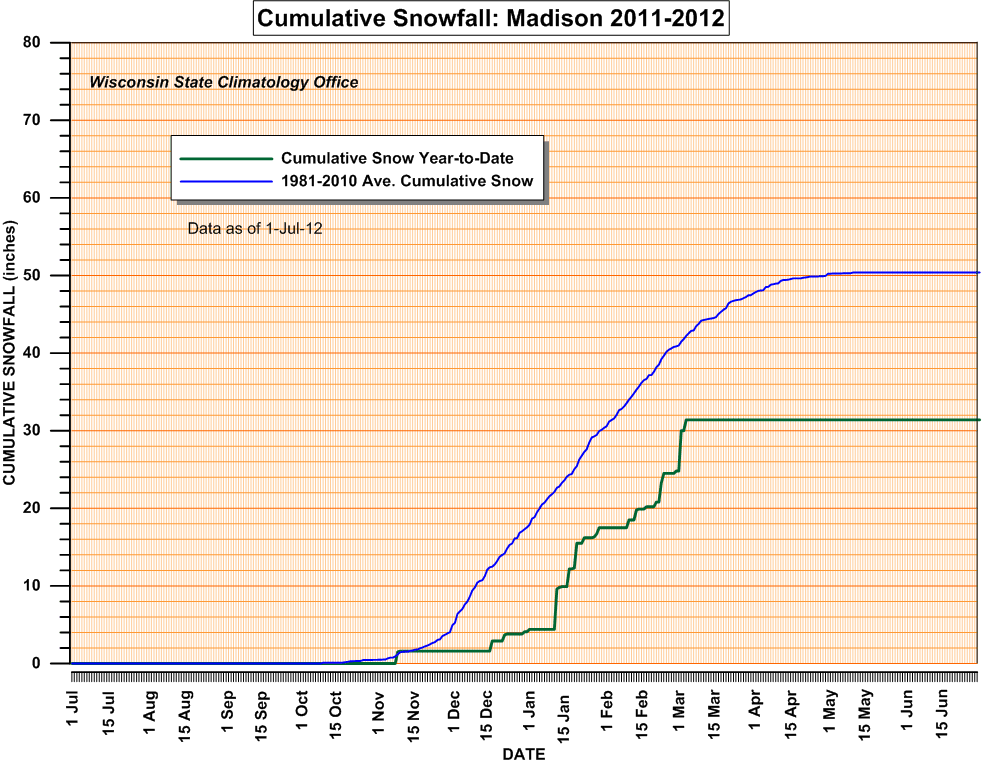
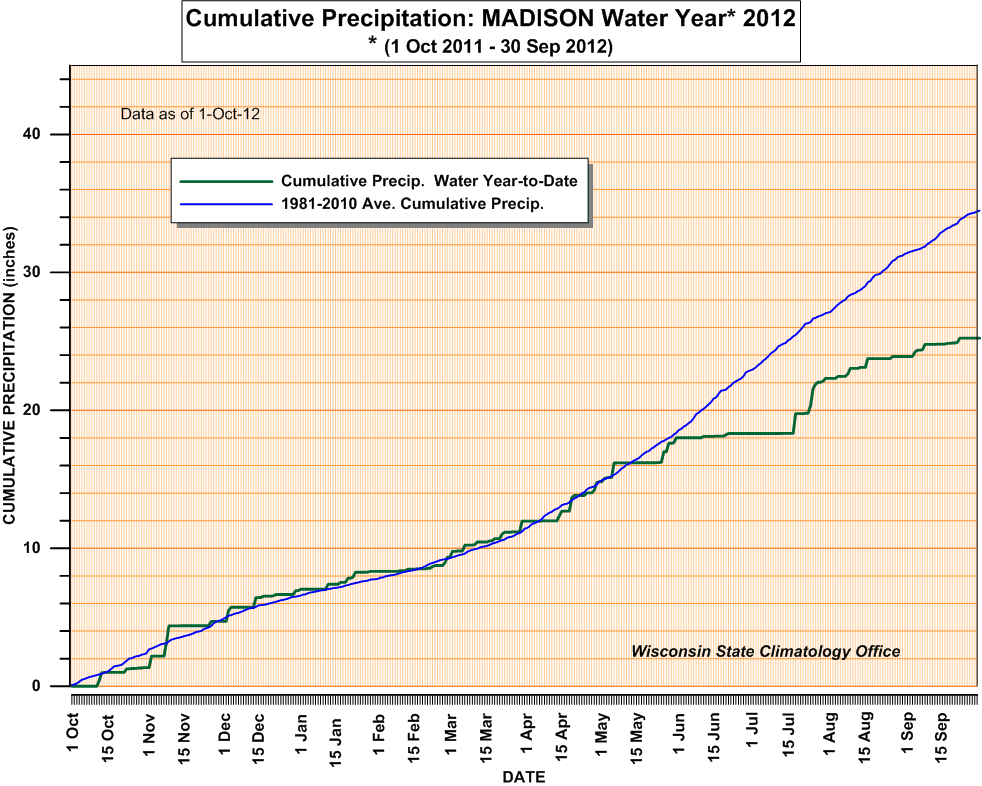
If you can find climate data... for example, in Wisconsin 2012 our snowfall looked like https://www.aos.wisc.edu/oldsco/clim-history/stations/msn/ms... and the overall water year precipitation chart was https://www.aos.wisc.edu/oldsco/clim-history/stations/msn/ms...
PBS program on the 2012 drought - https://www.pbs.org/video/wpt-presents-wisconsin-drought-201...
And what the fields looked like ... http://www.wcwcw.com/feature96.html (also has a national map, and all of Nebraska, Kansas, Iowa, Missouri, and Illinois were in bad shape - Wisconsin looked pretty good by comparison in that map).
If you've got similar data for ND... (digging) https://www.ndsu.edu/agriculture/sites/default/files/2026-05... page 2 has the precipitation chart. North west ND looks bad.
The problem is that aquifers are really cool natural filters, and only refill as fast as groundwater moves through the soil. So they're a finite resource. Instead of depleting them, people who want to farm in deserts should probably start desalinating or whatever themselves instead of assuming subsequent generations will do it.
The government made it literally the only way to claim much of the land out west[]. They require that you come up with an agricultural land including plan for watering crops on that acreage in order to claim the land. And you're required to execute the plan to get the deed.
In fact, this is the only remaining way I know of to more or less 'homestead' federal land in a way that results in a permanent deed. The rest of the homesteading type stuff was revoked back in like the 70s or 80s.
Is this relevant in 2026? Are people still claiming land via the 1877 Desert Land Act?
Yet it's still active. As a pure anecdote, I know of someone doing it right now.
https://www.blm.gov/sites/default/files/Desert%20Land%20Entr...
Is this an opportunity that opened up with this administration? Or has the BLM been quietly processing these for the last century?
AFAIK it's been available since the 1870s but after the 20s they clamped down a lot harder on ensuring you were actually irrigating it and had agricultural plans.
I'm not sure if the BLM has relaxed their discretion under Trump.
Do you think laws go away just because they're old?
The Colorado River compact came into effect in 1922 and I'm almost surprised literal fist fights haven't erupted over it during the modern negotiations.
I think laws become less relevant over time for many reasons. There are entire books written about silly and obsolete laws, e.g.:
https://en.wikipedia.org/wiki/The_Trenton_Pickle_Ordinance_a...
The age of a law or regulation is likely a strong indicator for its relevance in modern times, especially if it’s regarding something quite niche.
These laws are neither silly nor obsolete. That's a distraction.
So is the age of the law, for that matter; courts don't waste one second on the topic. Settled law is settled.
I’m no lawyer, but according to my perusing (sourced directly from the BLM), the 1877 Desert Land Act is very much obsolete.
The age of a law does not matter with regards to its validity, you are pedantically correct. But it very much matters to its relevancy, which was my argument. Laws regarding horse traffic in Manhattan may still be valid, but a lot less relevant than they were hundreds of years ago - assuming they haven’t been repealed.
Regarding the “Colorado River compact”, I would say my qualifier of “quite niche” is important. Ownership and water rights over the second largest watershed in the US by affected population is far from “niche”.
On the other hand, how settlers can claim public land in the desert (which happens incredibly rarely now, by design) is quite niche.