England Runestones
en.wikipedia.org79 points by cl3misch 4 days ago
79 points by cl3misch 4 days ago
The voyages and sagas of the vikings are very interesting, but something I find to also be fascinating is the economic and cultural history that brought about the viking age and then several centuries later ended it. It does seem kind of sudden; there was a niche that suddenly caused vikings to travel everywhere, and then it was just over.
I think mainly it was, that they became civilized/baptized and christians were still free to plunder and enslave non christians, but not fellow christians.
So the vikings did not just stop, but rather became crusaders:
"In 1107, Sigurd I of Norway sailed for the eastern Mediterranean with Norwegian crusaders to fight for the newly established Kingdom of Jerusalem; the kings of Denmark and Sweden participated actively in the Baltic Crusades of the 12th and 13th centuries"
https://en.wikipedia.org/wiki/Vikings
(But otherwise of course many factors contributed to the rise and fall of the vikings and there indeed seems to have been a niche, with a temporary weakness, no christian nordic fleets etc.)
King Sigurd is a bad example for two reasons. One being that you are implicitly conflating Scandinavians with Vikings, when the latter were a subset of pirates largely disjoint from the aristocracy to which Sigurd belonged. The second is that Sigurd and his men did in fact attack and plunder fellow Christians on their way to Jerusalem when they stopped in Galicia in the winter of 1108. You can read about it in the Historia Compostelana.
> they became civilized/baptized
How are civilized and baptized comparable concepts? The vikings surely had a civilization before christianity took hold and ascribing sone kind of higher ethics to christianity is also quite a stretch.
They had their own culture and technology, but that's not the same thing as being civilized. It also includes being, well, civil. Raiding and pillaging their neighbors is not civil.
> ascribing sone (sic) kind of higher ethics to christianity is also quite a stretch.
This is subjective. Even if you disagree with Christian ethics, and even if they were frequently violated, becoming Christian still could have reduced Viking violence against their neighbors. Shared culture would improve trust and encourage alliances and trade.
"Civilization" is ill-defined anyway. What's certain is that long before they embraced Christianity in a form other European Christians would recognize as such, they admired Europe. Europe had great buildings, castles, cathedrals, palaces, walled cities, places of learning, markets, unlike anything in Scandinavia at the time. They wanted those things. And they could only get so far as pirates and slavers.
Interesting that you see it as a higher ethics to be OK with only enslaving non christians, because I really did not mean anything like that, as I do not see it as a higher ethic.
And like the other commenter pointed out, civilization is ill defined. I was mainly using it here from the christian point of view, where pagans are not civilized by definition. Not that the norse had not a complex society themself.
I do not think that stacks up as an explanation. The crusades were not financially remunerative - the crusaders mostly lost money. They might have made money if they were hired as mercenaries though - the famous example of that being the Varangian guard.
I do not think its entirely true to say Christians were "free to plunder and enslave non-Christians". Even against non-Christians war required justification (OK, you can make something up, but there is an extra barrier) and slavery (and slave trading in particular) was increasingly discouraged (until its revival in early modern times, of course).
One of the big examples of a formerly Viking people participating in the crusades was Norman Sicily which was one of the most enlightened (religious freedom, for example) societies of its time.
The Normans also settled down in Normandy and England and stopped raiding.
"I do not think its entirely true to say Christians were "free to plunder and enslave non-Christians""
Well, I am not a historian, but was there any war against pagans, that was stopped by the church or individual priests?
(talking about medieval times, modern christianity is a bit different, but the old tradition seems to get a revival in certain circles)
The most I know of, is individual priests who for example criticize the acts of the conquistadores. But crusades to "spread" christianity were rather pushed as a sure way to get into heaven as far as I know.
"The crusades were not financially remunerative - the crusaders mostly lost money."
That is probably why they stopped doing it. Before christianity they had all the coasts of europe to blunder. After their kings turned christians who made treaties with the mainland christian empires - that was not possible anymore and raiding, even under the disguise of crusade, much harder and therefore less attractive (apart from that I did not claim that my explanation is the explanation, just a contributing factor)
> Well, I am not a historian, but was there any war against pagans, that was stopped by the church or individual priests?
I recall reading a priest or monk influenced Charlemagne to stop/moderate his persecution of pagans. I very much doubt this was the only example, just one I have read about.
> But crusades to "spread" christianity were rather pushed as a sure way to get into heaven as far as I know.
In very specific cases, most notably the liberation of Jerusalem, not in general.
> That is probably why they stopped doing it.
Crusades went on for about 400 years if you count things such as the Reconquista
I also find it hard to believe they could not find profitable wars. It was not difficult to find an excuse for war. Being Christians did not prevent either Harald Haraddra or William the Conqueror from invading England.
> The most I know of, is individual priests who for example criticize the acts of the conquistadores
It was more than just scattered individuals voicing criticism. It was a movement that lead to action and legislation: https://en.wikipedia.org/wiki/Protector_of_the_Indians
"Crusades went on for about 400 years if you count things such as the Reconquista
I also find it hard to believe they could not find profitable wars."
Well, sailing from norway to england, do some raiding then come back before the winter sounds way easier, than sailing from norway to the middle east and back. So it has been done, but apparently was not so worth it.
https://en.wikipedia.org/wiki/Protector_of_the_Indians
And here thanks for the link, I know little of that time, but I am not so sure if it counts as protecting pagans, or protecting baptized pagans who are christians.
Both I think.
If you are interested in the conquistadores the Rest is History podcast series on the conquest of the Aztec and Inca empires is excellent, especially the latter.
The runestone fad was kicked off by Harald Bluetooth's runestone, featuring a picture of Christ and a boast about making the Danes into Christians, and half these runestones (all emulating the Bluetooth one) mention God. But at first the politically expedient religion was just a performance, I guess, until later on they started to mean it. They probably still wore hammer amulets and so on.
> But at first the politically expedient religion was just a performance, I guess, until later on they started to mean it.
Why do you think so?
I read it somewhere, years ago. So I can't remember where. I think it was an academic paper about the interactions of traders with missionaries, where by claiming to be Christian the trader wins a sale (a conversion, you might even say). But I just did some searching, will this do?
https://norse-mythology.org/the-vikings-conversion-to-christ...
> Surely some cases involved genuine religious convictions; it would be superficial and reductionistic to assume otherwise.[18] However, it seems that the majority of conversions occurred largely, and perhaps entirely, for the sake of the tangible, practical advantages that the new religion brought with it.
> [...] the Norse seem to have become convinced of the might of the Christian god largely through more down-to-earth political and economic means.[21] Viking rulers – who, as we’ve noted, were generally the first to formally convert to Christianity – wanted to forge alliances with the powerful Christian kingdoms to the south so as to consolidate their own power. The kings of those southerly kingdoms, in turn, were happy to oblige, as this enabled them to turn former enemies into pacified friends.[22] Viking kings also found that “the document-based church administration was unsurpassed and utterly useful to rule and administer a kingdom.”[23]
The dark ages had a power vacuum that made pillaging more profitable than trading.
I think the vikings were actually among the last of their kind, the last to become christianized and part of the European trade network. And that might be why they're so fascinating.
Depends on how you're using the terms. Norsemen/Danes were the people, Viking was a job. The viking raids of the summer months were replaced by longer term settlements/political agreements (eg Danelaw, London, Dublin, med coast, Seville) but that still necessitated plenty of waterborne travel.
Trade was more profitable than raid.
Look into the Hanseatic League. Pirates (to go a-Viking was to go a-pirating) became shopkeepers. But they kept up "walk softly and carry a big stick".
States got strong and organized enough that they could consistently defeat the raiders. Castles, feudalism, better lines of communication, bigger and more professional armies.
I noticed that Futhark the programming language is also on the front page.
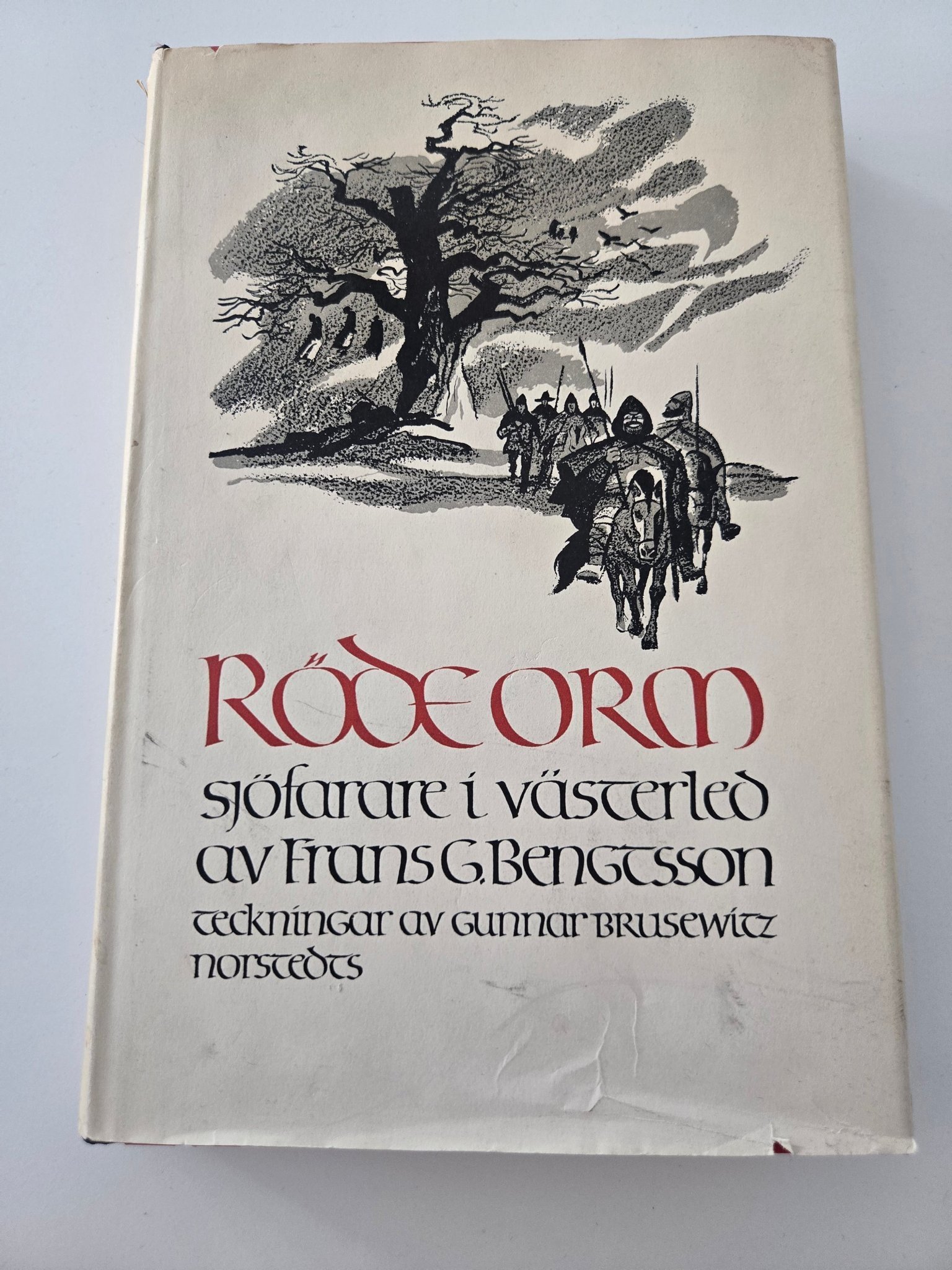
Just reread this[0] classic piece that captures Viking life. It holds up so well.
[0] https://www.amazon.com/Long-Ships-Review-Books-Classics/dp/1...
The cover with the viking in a horned helmet does not hold up so well for me. The text is more historically accurate?
That's just poor taste by the publisher of the translation. I think this is the original cover of the first part from 1941, which is a bit more subtle: https://img.tradera.net/images/363/614895363_bd12c6ee-75d3-4...
It's a great book, I highly recommend it.
That’s the international publisher’s mistake. The text is famous for being similar in style to the preserved Icelandic originals. It’s quite authentic.
Wikipedia is amazing. The Swedish articles are even longer.
I agree — but I was expecting actual runes to be shown, not just a transcription into Latin characters.
Like on https://en.wikipedia.org/wiki/Jelling_stones (ᚼᛅᚱᛅᛚᛏᚱ᛬ᚴᚢᚾᚢᚴᛦ᛬ᛒᛅᚦ᛬ᚴᛅᚢᚱᚢᛅ etc).
It's very interesting how fascinating the Vikings still are to many people. They did a lot of amazing things, and a lot of horrible things.
Hard to judge when most reports about the Viking raids are coming from Christian monks though, those reports were not exactly unbiased. The vikings most likely were not any more or less horrible than any other band of roaming thugs at the time, the main difference was probably how quick the Vikings could appear and disappear.
[dead]
[dead]