GitLab announces workforce reduction and end of their CREDIT values
about.gitlab.com475 points by AnonGitLabEmpl 11 hours ago
475 points by AnonGitLabEmpl 11 hours ago
GitLab could be the perfect case study on AI-powered efficiency improvements. I have never interacted with a piece of software that, for every single problem I found, there was an open issue always at least 4-7 years old that was just being shuffled around by managers adding and removing random labels.
Surely with all of these ridiculous developer productivity gains enabled by AI, they should finally be able to fix all of these ancient issues quickly and clean up the backlog.
Nope, “workforce reduction” thanks to AI again. This charade is getting boring.
I'm certain that if they would start doing that, without a proper strategy / workflow when it comes to QA, it will be GitHub reloaded. You'll be able to watch the decline in real-time.
https://www.google.com/search?q=gitlab+stock shows their stock price was ~$52 a year ago and is $26 today, so down 50% in 12 months. It's quite possible this is because they weren't making enough noise about their AI strategy.
If investor fears are that AI makes GitLab's business less valuable, including this in their "GitLab Act 2" announcement makes a whole lot of sense:
> The agentic era multiplies demand for software. Software has been the force multiplier behind nearly every business transformation of the last two decades. The constraint was the cost and time of producing and managing it. That constraint is collapsing. As the cost of producing software collapses, demand for it will expand. Last year, the developer platform market used to be measured in tens of dollars per user per month, this year it is hundreds/user/month and headed to thousands. Not only is the value of software for builders increasing, but we believe there will be more software and builders than ever, and we will serve an increasing volume of both.
Wrote a bit more about this on my blog: https://simonwillison.net/2026/May/11/gitlab-act-2/
> It's quite possible this is because they weren't making enough noise about their AI strategy.
That's how I interpret the move, too.
Lots of interesting information here:
>The agentic era affords GitLab the largest opportunity in our history as a company, and we're making the structural and strategic decisions to meet it
>Operationally, we grew into a shape that was right for the last era and isn't right for this one
To meet their largest opportunity ever, they believe they need less resources. I'm not sure I understand how that follows.
>We're rewiring internal processes with AI agents, automating the reviews, approvals, and handoffs to speed us up
Is this also in the list of "we create code twice as fast and the bottleneck is review so YOLO no bottleneck?". I've yet to see a convincing justification for this. If anything, if you're going full throttle all the more reason to watch the steering wheel, no?
That said, 8 layers of management is a lot of management, and every line of the message seems like leadership truly believes they are sinking in bureaucracy. Let's see how unneeded those 3 layers they're cutting were.
> 8 layers of management is a lot of management
Seems like a fair assessment. Maybe they should start by getting rid of the people who put that structure in place?
Didn't they do that? Staples only came in as CEO at the end of 2024, and I assume he has been working on a plan to restructure the company since then. Because their financials are not great, and they have been losing money every year since 2019.
I don't know about gitlab, but tech companies (Meta and Grab) tend to hack off the bottom of the management chain, instead of cutting off the top (aka as the people that created the 8 layer system).
bottom level teams are merged to form larger teams.
Yeah, they never fire the VPs and SVPs in this process. Just a bunch of the hard-working line managers who are actually involved in the day-to-day engineering work
8 layers of management???
At gitlabs team size, that means every manager has 2-3 reports? Yeah, I'd be cutting layers too.
https://handbook.gitlab.com/handbook/company/structure/
> GitLab has at most eight layers in the company structure (Associate/Intermediate/Senior, Manager/Staff, Senior Manager/Principal, Director/Distinguished, Senior Director, VP/Fellow, Executives, Board).
> [...] You can skip layers but you generally never have someone reporting to the same layer (Example of a VP reporting to a VP).
So they're counting the board of directors as a layer above the CEO.
I'm speculating, but they probably also have an unbalanced tree - you'll often see the IT security chief reporting directly to the CEO (because it's important to keep on top of, and they need authority to do their job) but only having 50 people below them in the org chart.
In some corporations you also sometimes get almost-nonexistent ranks created to smooth over a reorganisation. If a level 5 bureaucrat decides to merge the departments of two of their level 4 bureaucrats, they could demote one of them. Or they could make one into a level 4.5 bureaucrat.
They have 2800 employees with 5-10 reports per manager.
At 8 layers of management (so 9 layers total, with the bottom rung being non-management), 3 reports per manager comes out to 6561 employers on the bottom rung. At 5 reports each, that 8 layers would give you over 300k at the bottom, an 10 each would give you 100m at the bottom.
> We’re flattening our organization because eight layers is too deep
Eight layers total
So... That's the assumption that would give you 300k employees with 5 reports per manager. Sum of 5^x for x in [0, 7] is ~300k.
The GP miscalculated it.
Mathematically that would work out to a lot less than 8 layers of management.
I wonder if they have 5-10 employees per manager at the bottom of the org chart, but a lot of middle managers and manager-like titles mixed through the middle.
If its anything like the other tech companies, you'll have a bunch of overworked low-level managers with 20+ reports each, and then somewhere up the chain you'll find directors and VPs chilling with 1-2 reports
That's a really crazy number of employees considering they have one product that barely seems to change and is at best on par with similar products created by comparatively miniscule teams (Phabricator, Forgejo).
I'm on board with your gut that this feels more YOLO than careful but to be fair, in the engineering world fly by wire is very much precedented. I'm specifically thinking of the B2 bomber where it's essentially unflyable without a computer between the inputs and the outputs. Partially just keeping the plane from turning into a frisbee by reacting faster than a human possibly could, but also treating the controls inputs as the intent and manipulating the control surfaces programmatically in order to make that work. It's not quite the same thing of course but I think there's some carryover.
Still. Not a huge fan of this announcement or the general ways the landscape is evolving these days.
GitLab never ceases to amaze me in terms of just how bad their product roadmap is. Practical things like CI improvements are put off over UI rebranding on unicorn colours. Yet, good tooling is exactly why people used to pay for GitLab. For better or worse maybe this finally can change and we can get more customer oriented roadmaps again
The new UI is terrible, and the most important change they've done this year is ... drum roll ... renaming merge requests as "work items", because reasons.
Having said that, UI gripes aside, it works fine as a less complicated replacement for github.
After CVE-2023-7028 (account takeover via password reset, IIRC you just had to add a semi-colon between the correct email and the attacker email and it'd email both) was exploited against my cluster, the boasting about fully-automated changes and reviews scares me. I hope I'm far from the only one that hasn't forgotten issues like this.
I'm aware that the defective code was not written by AI but nonetheless, GitLab is what stands between many small organizations and their most precious resources. I was fortunate that 2FA stopped the damage, but what's going to happen the next time? What if my organization is permanently damaged because we taught the machines to go fast and break things, too [1]?
[1] VPN is an option but we're a non-profit with a number of non-technical users, so admittedly we're caught in a balance between making it harder to do things. As much as WireGuard is awesome, there's still a barrier.
> [1] VPN is an option but we're a non-profit with a number of non-technical users, so admittedly we're caught in a balance between making it harder to do things. As much as WireGuard is awesome, there's still a barrier.
I would love to help a non-profit and so, I am curious but what are your thoughts on authentik/authelia and others, can they might help in any use case to what you are suggesting, I would love to have a more in-depth discussion!
Also thanks for working at non-profit, although I am not entirely sure what is about but thanks to your non profits and all the other hard working people working at non profits for a better world once again!
With it’s current AI setup GitLab still couldn’t make anything that could be called great in UX so I can’t wait to see what they can do by eliminating the remaining human factor. Can’t personally wait seeing tickets like these [0] open for months with bots telling you that everything will be alright.
[0] https://gitlab.com/gitlab-org/gitlab/-/work_items/588806
Small aside, if they're dropping their transparency company value does that mean that issue won't be visible anymore? Is that the future for Gitlab?
This is quite an aggressively optimistic vision for the future of the software industry to tuck into a "workforce reduction" announcement:
> The agentic era multiplies demand for software. Software has been the force multiplier behind nearly every business transformation of the last two decades. The constraint was the cost and time of producing and managing it. That constraint is collapsing. As the cost of producing software collapses, demand for it will expand. Last year, the developer platform market used to be measured in tens of dollars per user per month, this year it is hundreds/user/month and headed to thousands. Not only is the value of software for builders increasing, but we believe there will be more software and builders than ever, and we will serve an increasing volume of both.
Also notable that the workforce reduction they describe doesn't appear to target engineers - they're "nearly doubling the number of independent teams" in R&D and "removing up to three layers of management in some functions".
> hundreds/user/month
What is this based on? The only thing I can think of is AI coding tools but only a few companies do it properly. I don't see gitlab capturing any of that spending
Also the whole "removing layers". Today's prof g market video was about the topic. Afaik it was the Coinbase CEO telling the same. Do these people get together to discuss their talking points? Or are they signalling to investors?
Presumably based on the fact that the OpenAI/Anthropic $200/month plans are selling like hot-cakes, and it's not often that a new software category comes around which attracts those kinds of per-seat prices.
Is the underlying assumption that gitlab will see new paying users because more people are buying coding agents?
If gitlab thinks they are as famous as github i don't know what to say. They should have atleast positioned themselves as a better github alternative
The average value an individual software is lower but the volume is definitely higher, if github imploding regularly is any indication
GitLab is a great example of a lifestyle company that should have never become a public corporation.
So much this. GitLab’s values and ethos were completely incompatible with becoming a public company. Sid is always seen as the good guy but it was his narrow minded greed that led here.
Is this the best move for the customer or the investor?
The fact they can't capitalize on the current trainwreck of GitHub speaks volumes. If they had the right product people would be throwing money at them.
Brother there’s nothing to capitalize on. They really don’t want an avalanche of free users bringing their shit down too I think.
companies using paid github are in same spot. Tho I'd imagine many already moved over
Most companies signing up to the idea that GitHub will fix their issues, rather than going through operational pain of migration. Everyone that I know jokes about GH downtime, but have zero internal talks about migration. Obviously small data point, but GitLab going this route shows not a lot of people are switching.
Unless you pay for enterprise then you are on the Enterprise Cloud Instance: https://us.githubstatus.com/posts/dashboard
I've never actually seen that status page before, and I'm not clear what it's measuring. My company pays for Enterprise Cloud, and we see all the same downtime as what gets posted to https://www.githubstatus.com/
That is the ghe.com status page, which it seems like no one actually uses, hence the good uptime. Most Enterprise Cloud customers don’t use it.
https://docs.github.com/en/enterprise-cloud@latest/admin/dat...
A lot of the conclusions they're drawing in this post about the "agentic era" seem quite misguided and some don't really seem to make sense.
I have no doubt GitLab has too many employees and can benefit from being a more focused company, but it's tiring reading these layoff posts so chock full of buzzwords. I guess they're desperately hoping if they prognosticate about AI enough it will placate the investors.
Let these people keep betting their companies, futures and net competency on text autocomplete. The future is bright for me and everyone else that isn't falling for it.
Calling it text autocomplete is played out and really just makes you look bad at this point.
It's literally text autocomplete. You can dress it up however you want but it takes input text and outputs the most likely next sequence.
Reminds me of when microwaves first came out. Investors decided to go all in on "vibe cooking" (lit. cooking with vibrations) complete with microwave ranges (no conventional oven), until the public wizened up to the fact that there was in fact no cooking (Maillard reaction) involved in their vibe cooking. Took about 15-20 years but microwaves finally took their rightful place as a utility appliance rather than what they were touted as (a centerpiece). Pick up a microwave cookbook from the 50s for some laughs.
I sure hope you're not mocking the classic "Microwave cooking for one" book!
The mallard reaction is very possible in microwaves, but they use microwave-specific crockery. I think the vision was possibly killed by people not wanting to maintain a second set of crockery.
See here for a fun write-up: https://www.lesswrong.com/posts/8m6AM5qtPMjgTkEeD/my-journey...
That book came out much later than what I am talking about, when many workarounds like turn tables (and indeed, specialized crockery) were made available. This thing [0] for example, did not even have a turn table, and yet was created in an "all in" form factor for the American home. It was in production for nine years.
Perhaps we can liken these auxiliary advances to agents and harnesses in the analogy. In the end, despite the unbridled optimism from certain backers, we never solved the fundamental issue with microwaves: that they use electromagnetic waves for cooking, and that electromagnetic waves have certain undesirable properties for this application.
[0] https://americanhistory.si.edu/collections/object/nmah_10880...
But I think the argument that microwaves are basically for heating things up and for essentially steaming a lot of vegetables. (I'll do one ear of corn in the microwave with pepper and spices.) I do have a thick microwave cookbook from the 70s or 80s but I've mostly only ever used it for vegetable cooking times. And probably less since I started roasting vegetables in the oven a lot of the time. I have cooked some of the other recipes but not for a very long time.
Understand that a lot of people don't have a lot of choice but I use mine (actually have a 4 in 1 when I had to replace the old one after it burst into flames and that's somewhat useful as a second oven).
And same as vibe coding, microwaves just reheat old stuff and create bland food.
This is a very good comparison, I'll be using it.
It just made me realize why I don't have those found memories of my mom's cooking. When we got our first microwave she went full on the vibe cooking and took years to realize how dumb it was.
I hope my kid doesn't get the same kind of memories about my weekend projects.
There are still cooking functions on microwaves! And they still come with recipe books!
I like this analogy. Maybe microwaves put a few line cooks out of the job, but it didn't replace traditional cooking at all.
“But they’ve added RL so…!!!”
You are obviously right and I see examples of it everywhere.
E.g I asked Claude opus 4.7 (the latest/greatest) the other day “is a Rimworld year 60 days?”. The reply (paraphrased) “No, a Rimworld year is 4 seasons each of 15 days which is 60 days total”.
Equally, it gets confused about what is a mod or vanilla since it is just predicting based on what it read on forums, which are clearly ambiguous enough (to a dumb text predictor).
Maybe there was more in the context before that question? I just copy-pasted that question into Opus 4.7 and it replied:
Yes. A RimWorld year is 60 days, split into four 15-day quadrums (Aprimay, Jugust, Septober, Decembary), each corresponding to a season.And that is the reason why it is only autocomplete. You probably had less context than the poster before, so it could not mix stuff up. The poster before either had more memory or the search searched through more topics. And btw it’s really hard to only give access to some things.
Calling the technology "text auto complete" is not productive to the discussion. Less than a decade ago the idea that a computer could take a fuzzy human-readable description and turn it into executable code was science fiction, but now it's common place. As is the ability to write long form text, and be so hard to distinguish from real that placing an em dash in your text will cause an uproar on this forum. You can describe things by their fundamental functions and make many things sound elementary but I find it counter productive given the capabilities we've seen from this technology
> Calling the technology "text auto complete" is not productive to the discussion.
If pointing out the flawed approach to making something more productive isn't productive, then what do you consider to be productive?
> Less than a decade ago the idea that a computer could take a fuzzy human-readable description and turn it into executable code was science fiction
Cobol was sold to people on the idea that anyone could create something with fuzzy human readable description that would result in executable code. That was back in the 60s.
What lessons did we learn?
1) Leaving things to the people who make fuzzy human readable descriptions turns out to be a terrible way to have things implemented.
2) Slowly and deliberately thinking things through before, during, and after implementation always leads to better results.
It's a lesson that keeps needing to be re-learned by people who don't/can't look at things through a historical lens.
It was the same with cobol, as it was with programming in spreadsheets in the 80s, as it was with the nocode movement in the 00s, as it is now again with LLMs in the 20s, and it will be again with a future generation in the 40s.
---
> As is the ability to write long form text, and be so hard to distinguish from real that placing an em dash in your text will cause an uproar on this forum.
Long form text generation that is hard to distinguish from human authored text also goes back to the 60s.
That's when we got the first instances of the Eliza effect.
> You can describe things by their fundamental functions and make many things sound elementary but I find it counter productive given the capabilities we've seen from this technology
The capabilities we've seen are:
- Text prediction/generation
- Inducing the Eliza effect
Your house is literally just a box. You can dress it up however you want but it has 4 walls and a lid.
Mine has like, 8 walls, but sure. It's a box. Crucially, it was sold as a box. Not a thinking machine.
Your attempt at an analogy will make sense when someone tries to install a house as middle management at some company.
The secret to woodworking is that everything is a box. The secret to AI is that everything is token matching.
Is "text autocomplete" supposed to be an insult? To text auto-complete a physicist I would have to understand physics as well as them. To text-autocomplete your words I would need to model your brain.
AI is a text autocomplete. This is tge best AI definition i heard and agree with 100% Thank you.
It's literally how they work. I think the magic that none of us really expected is that our languages, human and computer, are absurdly redundant. But I think it makes sense, in hindsight at least. When we say things it's usually not to add novel or unexpected information that comes out of nowhere, but to elaborate or illustrate a point that could often be summed up in 5 words. This response is perfect sample of such.
> AI is a text autocomplete. This is tge best AI definition i heard and agree with 100% Thank you.
To believe that first you would have to ignore tool calling, ReAct loops, and the whole agent feature. That would be silly.
> To believe that first you would have to ignore tool calling, ReAct loops, and the whole agent feature. That would be silly.
How?
It all still functions with text prediction
> It all still functions with text prediction
Wilful ignorance can't be fixed. As the saying goes, you can lead a horse to water but you can't make it drink. I can point you to ReAct loops and tool-calling and agent-based systems. If after being pointed those you still choose to be stuck on the "it's just text prediction" then that's a problem you are creating for yourself, and only you can get unstuck on a problem of your own making.
> I can point you to ReAct loops and tool-calling and agent-based systems.
Those literally work with text prediction.
If you take the text prediction out of it, nothing happens.
You stick a harness around a text predictor which then triggers the text predictor.
If you think I am missing something then please do point it out.
Your comment was also completion.
This retort doesn't make any sense. Take humanity back perhaps 40k years ago and language did not even yet exist. Our token base was 0. Put an LLM in that scenario and it will endlessly cycle on nothing and produce nothing, stuck in a snapshot in time. Put humans in that situation, and soon enough you get us.
This is like saying that somebody speaking Chinese is just playing the Chinese Room [1] experiment. The only reason it's less immediately obviously absurd here is because the black box nature of LLMs obfuscates their relatively basic algorithmic functionality and let's people anthropomorphize it into being a brain.
And what would that make yours?
I think, therefore I am. You parrot, therefore you are... ?
By design. At least until we move away from attention being at the core of LLMs
It's not attention that's the problem, it's how we train networks offline with backprop.
LLMs are the most successful form of neural network we have, and that's because they are token prediction machines. Token predictors are easy to train because we're surrounded by written text - there's data nicely structured for use as training data for token prediction everywhere, free for the taking (especially if you ignore copyright law and robots.txt and crawl the entire web).
We can't train an LLM to have a more complex internal thought loop because there's no way to synthesize or acquire that internal training data in a way where you could perform backprop training with it.
Even "train of thought" models are reducing complex thoughts to simple token space as they iterate, and that is required because backprop only works when you can compute the delta between <input state> and <desired output state>. It can't work for anything more complicated or recursive than that.
Sufficiently good text autocomplete is indistinguishable from intelligence to an impartial observer, and that's the only honest criterion for intelligence.
Your brain is also an autocomplete at this point. Notice how you write each word, one after the other, flawlessly
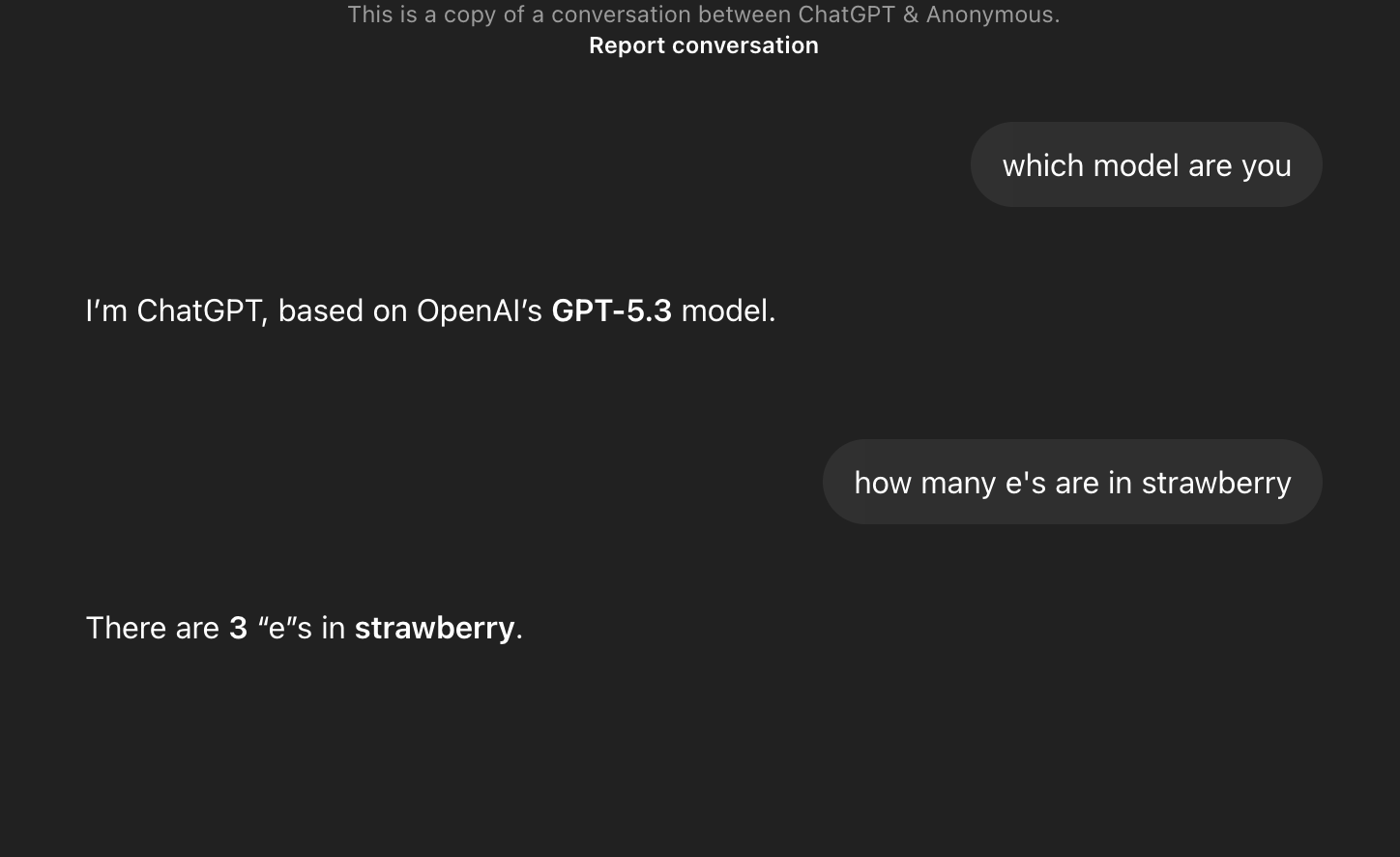
For a good reminder for people on the limitations of AI (or well OAI gpt 5.3 default model for non paying users), I did an experiment recently (Just a week-ish ago): https://smileplease.mataroa.blog/blog/how-many-e-are-in-stra...
image: https://mataroa.blog/images/b5c65214.png
but it says that there are 3 e's in strawberry ;)
Now this is literally something which occurs because of it being text autocomplete and the inherent issue of token based Large language models. So you are literally right :D
My point is that AI can have its issues and it can have its plus points (just like text autocomplete but some suggest its on steroids)
The issue to me feels like we are hammering it in absolutely everything and anything, perhaps it should be used more selectively, y'know, like perhaps a tool?
Yes, AI should be used as a tool for very specific things. Ones it’s trained on everything it’s completely useless. Anyone who is trying to use it for everyone will fail. I predict by 2030 (if not much sooner) ai bubble will burst. The only good outcome will be all this hardware used will be lequdated for pennies. Mark this prediction it will happen ;-)
I definitely hope you're right
> Mark this prediction it will happen
But this historically is a very strong predictor of a poor prediction
If you’re so sure just make a leveraged bet and become a millionaire. Put your food where your mouth is if you’re so convinced
Grok auto: 1 “Strawberry” has only one “e”. S T R A W B E R R Y
Gemini: There is *1* "e" in the word "strawberry".
Seems fine
They meant to say the letter "r".
See: https://fediverse.zachleat.com/@zachleat/116529994444529036
So you have subscriptions to all the hyperscalers and make them vote on what's the correct answer?
> It's literally text autocomplete. You can dress it up however you want but it takes input text and outputs the most likely next sequence.
Last year this level of ignorance and cluelessness was amusing. Nowadays it's just sad and disappointing. It's like looking at a computer and downplaying it as something that just flips switches on and off.
Gitlab is looking to lay off people like him. All major tech companies are currently raiding to fire such employees.
> Gitlab is looking to lay off people like him. All major tech companies are currently raiding to fire such employees.
Gitlab has been strapped for cash and desperately seeking a buyer to cash out for years.
If anything, the LLM revolution represents an opportunity that Gitlab is failing to capitalize upon. They have a privileged position to develop pick axes for this gold rush, but apparently they are choosing to dismiss themselves from the race altogether.
Gitlab's decision is being taken in spite of LLMs, not because of them. Enough of this tired meme.
Yeah they all want to fire the guys who can make sense of the mess the vibe coders are doing and try to stop it.
It will be interesting in the next few years. Assuming we won't be in the 3rd world war thanks to the USA and will have much bigger concerns.
> Yeah they all want to fire the guys who can make sense of the mess the vibe coders are doing and try to stop it.
You're grossly inflating the level of contribution from your average software developer. Are we supposed to believe that the same people who generated the high volume of mess that plagues legacy systems are now somehow suddenly exemplary craftsmen?
Also, it takes a huge volume of wilful ignorance and self delusion to fool yourself into believing that today's vibecoders are anyone other than yesterday's software developers. The criticism you are directing towards vibecoding is actually a criticism of your average developer's output reflecting their skill and know-how once their coding output outpaces or even ignores any kind of feedback from competent and experienced engineers.
What I see is a need to shit on a tool to try to inflate your sense if self worth.
I've seen which developers became vibecoders. They were the people I'd have wished to get rid of.
The ones who never acknowledge a mistake even if the process is crashing; the ones who put "return true" in a test so that the test doesn't execute and will insist that you broke their code if you remove the return true and when the test actually runs it fails; the ones who read a blog post about some new thing and decide we need to do like that; the ones who will write code that fails and then be nowhere to be seen when there is customer support to do.
Ahh, are we there yet? Has non-deterministic computer use eroded your mind so much that you are starting to question the binary system? You know, the insight that computers are something that flips switches on and off is rather old, and I have heard it uttered (although slightly humorously) several times already, nobody ever raising any eyebrow hearing it.
I've used this text autocomplete to autocomplete me a Python setup and to autocomplete automatically running it.
It that scrapes Hn it works. Ironically, it's why I'm here.
What makes you think you're anything more than a 'text autocompleter'? You are justing auto completing someone's comment
If you seriously cannot tell what is the difference between a human being and a LLM and think they are both "autocompleters", you know very little about both humans and LLMs.
This thought that “maybe we are just next token predictors too” is not particularly clever. Most of us have thought about that, but a bit of experience with LLMs make it obvious that’s not what’s going on here. I think it’s a bit like listening to a recording of a person and swearing there’s an actual person in the recording device because the audible output is indistinguishable from the real thing. Why would you do that? You wouldn’t unless you have no idea how a recording device works, in which case it seems like magic.
A one-way audio channel is indeed too weak for a person to distinguish a person from a recording, but a bidirectional audio channel is easily strong enough: the person can verbally ask the person-or-recording a question and see if it is acknowledged.
I claim that a modern frontier LLM can be given simple instructions that make it impossible for a person to reliably distinguish it from a person over a bidirectional text-only medium.
> a bit of experience with LLMs make it obvious that’s not what’s going on here
I feel like that overstates the point quite a bit. There's a lot that's similar: neurotransmitter release is stochastic at the vesicle level, ion channels open and close probabilistically, post-synaptic responses have noise. A given neuron receiving identical input twice doesn't produce identical output. Neither brains nor LLMs have a central decider that forms intent and then implements it. In both, decisions emerges from network dynamics, they're a description of what the system did, not a separate cause (see Libet's experiments).
Now pretty clearly there's a lot that's different, and of course we don't understand brains enough to say just how similar they are to LLMs, but that's the point: it's an interesting thought experiment and shutting it down with a virtual eyeroll is sad.
Insane to see this kind of comment on Hacker News. I suspect it's satire!
there’s a familiar saying “Markets can remain irrational longer than you can remain solvent.” i think that applies here as well. everyone (customers) want AI; investors demand it. it may eventually calm down but i’m sure many companies will be left behind and ultimately fade away if they don’t keep up until then.
I don't think anything is going to calm down.
Models will only get better with time, not worse.
Demand will keep raising.
Of course they're not going to get worse. That would be absurd. The rate of progress will slow down though.
I don't think it would be absurd for them to worsen. If LLMs cause discourse to worsen, but also grow and change, then the trainers are in a conundrum of ignoring new training data or losing track of the zeitgeist.
They might get worse for 2 reasons:
1. AI free training sets no longer exist. This might degrade quality, although some claim that it will not.
2. Cost. Right now they are burning a lot of money to convince people it's good. But they might not be able to keep it up forever and need to increase prices (which few will want to pay) or degrade the quality to save money.
The memo also says they're eliminating a lot of middle management tiers which has been a theme for a lot of companies recently. It's also been a theme historically. Really has nothing to do with AI. It's just the classic executive view that they are paying people who sit in meetings and write emails instead of writing code. Blissfully unaware that meetings and emails are how big organizations function.
> Blissfully unaware that meetings and emails are how big organizations function.
I don't know, I've seen more big organizations that have a dysfunctional amount of middle management and "meetings about meetings" than ones that truly benefit from that culture.
Your argument doesn't make sense. They literally explained why they are doing it. They are looking to remove who can't or won't keep up with ai. That can be managers but also engineers. That's what most companies right now are doing.
Right but naturally that's not actually why they're doing it. In actuality, it's a layoff - they did not go through and analyze which employees are "keeping up" and which aren't, don't be so naive.
This, like virtually all layoffs, is for economic reasons. Of course you can't say that because that reflects poorly on your growth and makes your investors uneasy and yadda yadda yadda. But what do investors like? Hm? AI!
Oh! Oh!!! This is strategic, you see, so we can use even more AI, yes yes that's right mhm.
And people wonder why there is so much push back against AI. The last thing leadership should do when laying off people is use the term AI. It's the most tone deaf thing you can do.
We don't live in the same world as they do. Saying AI out loud makes line go up, not down. Investors are still eating this shit up, for now at least...
While hosting internal services for 4 years, Gitlab was the only service that ran hybrid. Wish they could get their act together and focus on actual engineering again.
If anyone at Gitlab management is reading this; getting your microservices to run fully stateless in a Kubernetes cluster should the #1 goal. No disclaimers about potential risk. It's been 5+ years. Get it together. Stop bolting on minor package management features no one is going to end up using anyways.
Wow gitlab. Right when everyone was looking to see if you could lead with all the fails at github, you basically said "We're going to throw our source at ChatGPT and see what happens"
Right? I was seriously considering migrating everything in our company from GitHub to GitLab. Now I'm seriously considering self hosting our git instead.
I find these takes funny. One day you will leave or get let go and someone will be like “finally we can move to a proper system”
Times change, maybe at this point there will be a 'proper system'. Unlike Github and GitLab now...
Self-host your git, take this as a sign.
Forgejo is great.
There are a lot of downsides to self-hosting your git as well. Especially if you need to deal with high availability, scalability beyond a single server, and/or being open to the public Internet.
I'm not saying you should never self-host your git server, but it's not for everyone.
Good thing Github suck at availability and scalability much more than your friendly local sysadmin...
These days even without trying I get more nine than GitHub.
Arguments against self hosting have to change as our SaaS overlords are decaying in front of our very eyes.
Forgejo is fantastic! Just wish there was an easier way to implement CI/CD pipeline runners.
Using Tangled for my stuff now, it's alpha, but it's a bit fun to host your own Knot and Spindle servers but still connect to a full social graph.
Its VC funded too, so I wouldn't bet too much on it. Try out ngit or radicle, or codeberg if your code is open-source
You'd be surprised how far you can get with self-hosted Gitea.
Can highly recommend it. Gitea issues, PRs and actions all work as expected.
My bar for self-hosting something isn’t “these base standard feature works”, they had fucking better.
I get self-hosting got for security, compliance, and retention reasons, but for almost everything else it seems questionable for any use I would consider normal.
I self-host because I'm not training some model for free with our and our customers' proprietary code.
I just look at the pricing and really start thinking about is it really multi hundred euro a year per seat product... Frankly as consumer those pricing levels just seems like distanced from reality.
I don't know if that really solves your problem if the main trunk of development for gitlab is being run through several AI slop machines before they push it to what they call stable, then you download that (or use a debian, redhat package for gitlab which originated from it) and self host on your own machine the results of the AI slop fest.
Oh well, they really do their best to alienate people as well. They just completely overhauled their UX, and after that update, people at my company were so confused, they couldn't even open new issues anymore, because everything was somehow renamed to "work items". I kid you not, literally two decades of UX people were used to, just thrown out the window, it's absolutely mind-boggling. The feedback to this is devastating:
> Our transparent restructure process creates uncertainty that is real and it's hard, and I'm not going to pretend otherwise. I ask that you reflect on the why, what and how and engage your manager in a real conversation about the work, the questions and concerns you have, and what the next chapter looks like for you. Your manager may not have all the answers, because they too are going through this period of uncertainty. The conversation still matters and your input shapes how we land as a team.
Setting aside the whole "I'm not going to pretend otherwise which reads suspiciously like Claude, I don't understand how this is supposed to make employees feel any better. No one knows what's going on and through talking we'll figure it out? Mmmmmmhmmmmmm.
"talk to your manager" is code for "don't straight go rant on SNS over this"
For some people it might actually be worth it, not to solve anything but to talk to someone. It still sucks anyway.
Layoff something something AI.
Yeah, sure. A couple of years ago it was Covid overhiring.
You know the one thing that is never ever going to be given as a reason for layoffs? The growing salary-productivity gap.
Their old CREDIT values: Collaboration, Results for Customers, Efficiency, Diversity, Inclusion & Belonging, Iteration, and Transparency.
New values: Speed with Quality, Ownership Mindset, Customer Outcomes.
In other words, work harder, not smarter, and no more DEI.
There's a 'github down' post here every other day.
The ball is right there, bouncing alone in front of the goal, and they just have to position themselves as "we're the stable ones" to score that market when the exodus inevitably happens.
Nope, full throttle and stimulants, just because.
This is what happens, when decision makers are out of touch.
So many things they could be doing, to make people buy into their services. For example they could simply run campaigns about how they promise to never use customer and user repositories for AI training. Or they could show better uptime statistics. Their CI language is better than Github's too.
If anyone gave me a choice between Gitlab and Github, I would go with Gitlab. But if I had additionally the choice to use Codeberg, I would choose that.
Maybe they are just not looking to grow. If they made such a statement, that would actually be a pleasant surprise. No hunger for "infinite exponential growth", just to impress investors? Great! That's a fat plus in my book!
I was on gitlab up until nov last year. I don't really miss it; have yet to experience issues with github.
Gitlab pricing was bonkers. It always felt like their sales team were trying to play gotcha with us over the years with pricing schemes that would milk us for money.
Why do decision makers become out of touch?
Founded by engineers writing code every day. Today, led by suits who don't. It's the most acute with developer tools like Gitlab.
> The ball is right there, bouncing alone in front of the goal
Their pitch is not to you, the dev. But, to the investor class. We are in this funny place in the market where you can make more money by catering to the investor class than to customers. In other words, an upside down world.
I, for one, am hard-pressed to think of the "Industries" where this wouldn't also apply.
That would be any industry where investors expect you to mostly give them money rather than vice versa.
The big thing on their roadmap is rearchitecting for something that can handle the increased load, though. Like, they're clearly paranoid that if they don't move fast, they're going to be just as busted as Github.
TBH the open source nature of gitlab means that any sufficiently large and clued-in hosting company (think: servercentral/deft/summit, whatever it's calling itself these days, or one of its competitors) could put up gitlab instances for people to use and meet more nines of uptime than github. It doesn't have to be the gitlab company itself running servers with the httpd and back-end database.
I understand the meaning, however, in that they're well positioned by having the company name and domain name, same general way that non-technical people will pay wordpress.com to host their blog/small website because it's very easy, rather than DIYing it or paying a 3rd party.
GitLab isn't open-source. It's "open-core". Third parties hosting GitLab instances don't have access to the same range of features that GitLab-the-company does.
Yes, copy and pasting from the gitlab site:
"Editions There are three editions of GitLab:
GitLab Community Edition (CE) is available freely under the MIT Expat license. GitLab Enterprise Edition (EE) includes extra features that are more useful for organizations with more than 100 users. To use EE and get official support please become a subscriber. JiHu Edition (JH) tailored specifically for the Chinese market."
Personal opinion, but I think a great deal of the people who are presently overloading github with one person created vibe coded projects would be just fine with the "CE" feature set.
GitLab was never going to be the ones to take the mantle GitHub left on the ground. They’re a “clone” company and have very few original ideas of their own.
They did it better. I’ve never met anyone who has used both GitLab CI and GitHub Actions and thought they were remotely equivalent.
To be fair to GitHub, "GitHub" Actions is just Azure DevOps Pipelines wearing a mask. Which I think explains a lot about it's quality as a feature. It was brought in as a rushed copy-paste of the existing Azure DevOps feature very quickly post acquisition.
I have to regularly use Azure DevOps and the whole platform is painful, and now is rotting on the vine. I hear there is internal strife at Microsoft between Azure DevOps and GitHub products.
Gitlab CI actually came befor Github Actions, but both were heavily influenced by Travis CI.
GitHub was already pretty much perfected years ago IMHO. I’m not convinced we need that many original ideas here
To build good software you need to think for yourself rather than aimlessly making a pastiche, derivative work never produces good art.
To build good software you need to take the time to make your existing features work well, and improve or prune the ones that don't. In other words, it is craftsmanship.
The American corporation and its values are anathema to craftsmanship. You can ******* a **** all you want, it's never going to turn into gold, but your hands will be covered in crud.
Better CI and better search are the two things that are still missing from GitHub
GitHub had good search but it's been terrible for years now. More recently I think it's only returned results when logged in.
But you know you can move quickly and purposefully when you have 60 fully independent teams each with full ownership and all moving at top speed.
Yeah it’s “the world is becoming machine coded” and “we’re reducing by 30%” at the same time, like they don’t believe in their own words
I still have gitlab pegged in my mind as the company that rm -rf'd their production database TWICE separately and lost pull requests.
I hear you my friend.
We've all heard the joke about two people running from a bear and only one has to be less eaten than the other.
This is a race to the bottom. We shall see who winds.
It’s there, at the end, -ish:
> Interpersonal excellence: individuals who are good humans, embrace diversity, inclusion and belonging, assume good intent and treat everyone with respect
I'm not even sure it even means "work harder, not smarder and wach yor seplling." In my experience it's more of a shibboleth to the new masters to let them know they're down with creating a top-down organization where information flows only one way.
Were I to have crafted this post, it would have included things like
"We ask our employees, customers and investors time to prove ourselves to you again as we re-commit to listening to our stake-holders and ensure our organization is properly re-positioned to execute our continued plans to deliver the best possible service..."
But instead it comes across as "someone read an article about Amazon's two-pizza team rule and we figured there were worse things to try."
Also no more Transparency.
If they're asking you to do more for less pay and with fewer coworkers to help, don't feel bad if the company code turns into unmaintainable, unintelligible garbage. They can't really stop you. It's just AI. Something is going to have to give.
Every IC ought to use the present day as the opportunity to build a nimble competitor to their old employer (or whatever industry incumbents they want).
They're literally setting themselves up for this.
"Speed with Quality"
Having been in some of these values meetings, I really imagine it went like this: someone wanted speed, and someone else wanted quality. Sorry, I mean Speed and Quality. Many people said there is a tradeoff between those two things, and only one thing can be first.
Some brilliant businessman: "I know, we'll combine them. We want Speed _and_ Quality." Thus, "Speed with Quality." Tada!
Values are a tradeoff: only one thing can be first. Trying to duck that is stupid.
The funny thing is you absolutely can do things which improve both speed and quality at the same time (basic good engineering), but they're like 3 or 4 orders of effect removed from those outcomes and impossible to do when you have someone breathing down your neck asking "does this make us go faster" at every step of the way.
Also "our velocity is 3x higher than it would be in the imaginary invisible universe where we made worse decisions 6 months ago" is impossible to measure, whereas "we cut a bunch of corners and shipped a piece of garbage on an arbitrary deadline" is very measurable.
Speed-Quality-Price.
Let's pick: Speed-Quality
Errrh... Let's forget about: Price
Don’t worry, the price is on you now. Do everything while maintaining the same salary and shut up or well can you and replace you with Claude.
> Ownership
I've noticed that the more a company pushes on ownership the more difficult it is to actually execute it.
Whenever someone at work tells you to take more ownership, the correct response is: "Sure, I'll take more RSUs". Of course, that's never what they mean. Ownership for me, responsibility for thee.
There seems to be a massive push against DEI over the last few years in the tech industry globally, despite it being one of the industry's greatest strength.
Does anyone know what caused this?
I think you need to make a case for DEI being “one of the industry’s greatest strengths”. It’s not obvious to me.
How well would the tech industry do if they fired all the autistic people for "not being team players"? How many dev teams are there without at least one furry, trans person, or socially awkward geek?
> How many dev teams are there without at least one furry, trans person
Very weird to include social awkward geek in there. But my guess would be like 99% of dev teams do not have a trans or furry.
You are imagining that the opposite of DEI is discrimination, whereas most see the opposite of DEI as merit.
The irony is that DEI promotes merit by forcing companies to justify hiring beyond basic “cultural fit” vibes.
I’ve been in the business and seen a ton of hires on vibes. DEI actually asked people to expand the talent search, not hire anyone unqualified (which is what the anti-DEI folks are desperate to have us believe it did).
I predict some major EEO lawsuits will eventually bring the pendulum back in the other direction because my sense is that the return to vibes hiring (and RIF-ing) is resulting in very actionable discrimination cases.
> my sense is that the return to vibes hiring (and RIF-ing) is resulting in very actionable discrimination cases.
The enthusiasm for disparaging DEI combined with a lack of articulation of how they plan to quantify 'qualifications' in a non-biased manner. My sense is that they don't plan to do this at all, they don't have a plan, and they are going to blunder into patterns of discriminatory practices that DEI frameworks were protecting them against.
Who is “they?” All employers?
With respect, it seems like the hiring managers you were complaining about above weren’t the only ones operating mostly on vibes.
If you're not a team player I'd expect you to be on the chopping block regardless of underlying race, mental, culture, ...
It’s not like we have a term like “individual contributor” or anything in the industry.
I’ve worked with several excellent “just leave me alone” sysadmin types.
> It’s not like we have a term like “individual contributor” or anything in the industry.
Perhaps I'm missing something here.
To me "individual contributor" means anyone who is NOT: A (technical) "Lead", "Chief", "Architect", or (possibly) "Staff" anything, and has no management or team-leader responsibilities.
Yeah, it doesn't mean a 1-person-team, it means your job doesn't include supervising someone else.
I'm not saying there can't be very clear counter examples, I guess the overall sense though is that "being a team player' is generally considered an attractive quality in any employee. If A is a team player and B isn't, and they're otherwise equivalent, you're probably going to take/keep A.
It's not like (most) hiring managers put "not a team player" in the pro column.
Alas, I’ve learned that while everyone wants to hire them to fix their hideously fucked systems, they really don’t enjoy being told that their systems are, in fact, hideously fucked. They’d much prefer you quietly put out fires while biting your tongue about how they aren’t actually fixing any root causes.
The problem is that people are being cut for not being perceived as a team player, because they don't exactly fit the narrow perspective avoided by the dominant social culture. That doesn't mean they aren't team players.
For example: someone not always looking into your eyes while talking can be perceived as "rude". Same for wearing noise-canceling headphones in a talk-heavy environment. Oh, you don't drink alcohol during the "optional" Friday-afternoon company mixer? That's just weird. Want to have a day off for Eid rather than Christmas? Wellll, you did ask for it six months in advance and we did approve it already, buuuuut Dave planned a last-minute meeting which conflicts with the mandatory team meeting, so we moved the mandatory team meeting onto your day off... We'll just pay the hours you spent doing first-line support during Christmas in cash, okay?
Socially awkward geek isn't dei
Including them is.
Not if they are straight and white, which is a disproportionate amount of socially awkward geeks
It’s easy to make an objective case for how ‘D’ is a strength, however E and I are imo more values which intend to attract diversity.
there do exist objective arguments for the pursuit of diversity. there do also exist objective arguments otherwise.
https://onlinelibrary.wiley.com/doi/10.1111/padr.12641
heres an article that discusses how inflated diversity could possibly be a cause of social tension. the article's abstract concludes with a shrug ('too many factors!') but it does provide links to research papers arguing both for and against this case.
on the surface it seems pretty clear to me. behaviour is encoded in genetics. if one were surrounded by the same group for a few thousand years, they would share a common base of encodings, therefore social behaviours could be assumed to a higher degree. reference behavioural encodings drastically diverge across cultures (as embodied by religious value sets, or at a different meta level, the idea of low trust vs. high trust societies). based on this drastic divergence, predictions made about one's neighbour scale downwards in accuracy relative to increased cultural diversity.
so i see that jacking up societal entropy leads to lowered societal cohesion. but thats just my stance and id love to hear yours.
I couldn't disagree more. "predictions made about one's neighbour scale downwards in accuracy relative to increased cultural diversity"? I feel like this is just a fancy way of saying that you're uncomfortable with people being different from you. The social tension you're describing is in your own head. Even the article you're citing doesn't even agree with what you're saying.
your post is an ad hominem without substance to back the personal accusations within. i said there were arguments both in favor of and against diversity. the article i posted showed arguments both in favor of and against diversity. obviously some contradictions will present when looking at both sides.
diverse, millenia old, genetically encoded behavioural structures exist in our shared reality. id love to discuss this idea and the exact types of behaviours that can be encoded, down to the generational timespans required for encoding. that way we can talk about my idea in objective good faith.
'its all in your head' isnt objective good faith. applying the golden rule, you clearly accept bad faith ... man you couldnt tolerate a dissenting idea even momentarily before bringing out social ostracization and logical fallacies! sounds pretty similar to the behaviour of a racist, were you projecting?
that was said facetiously. im not trying to accuse you of anything, rather to show how it feels to be accused. to conclude i think its pretty easy to predict what my neighbours are eating for dinner at home and pretty hard in the city so youre gonna have to try a bit harder to convince me that the evidence of my eyes and ears is wrong.
Human populations dont share enough genes when they do share culture for this argument to make sense, people identifying as X culture but with Y genetics don't magically act like Y - saying "genetically encoded behavioral structures" is usually just code for "black people are dumber than white people" so you should understand why people are assuming bad faith.
If your product is used bya cross-section of society, then having a cross-section of society build it should lead to a better product no?
If a qualification for the role is "appreciation for certain less represented cultures/ideas/..." then sure. Otherwise, for a backend c++ engineer the benefits are significantly less obvious, to the point it's really hard to make a case for why DEI concerns should trump traditional evaluation metrics for skill.
The goal should be to hire the best team for the use case, regardless of gender/race/culture/background.
> why DEI concerns should trump traditional evaluation metrics for skill
It was never trumping skill. This is just a willful rewrite of history perpetuated for some political goal.
The goal was always to ensure that skill had adequate opportunity to be displayed without bias.
Appreciation isn't always enough, lived experience provides a lot of value as well.
See all the Falsehoods Programmers Believe About Names/Addresses/Birthdays/Phone Numbers/Time Zones/etc, for example. Do you want a backend engineer who designs a 64-character ascii text field for legal name and have everyone nod in agreement, or would you rather have one who knows that it isn't going to work for their cousin "Pablo Diego José Francisco de Paula Juan Nepomuceno María de los Remedios Cipriano de la Santísima Trinidad Ruiz y Picasso"?
> it's really hard to make a case for why DEI concerns should trump traditional evaluation metrics for skill
It doesn't. The goal of DEI has always been to attract a diversity of perspectives, all else being equal. Nobody ever proposed choosing a woefully unqualified diverse candidate over an obviously-qualified Generic White Guy. The only people who would oppose that would be the unqualified Generic White Guy who just happens to be the nephew of the CEO's golf buddy.
I don't know why someone with a cousin named Pablo Diego José Francisco de Paula Juan Nepomuceno María de los Remedios Cipriano de la Santísima Trinidad Ruiz y Picasso is that much of a better hire than someone named Jón Bergþóruson, 王小明, Sukarno (with no surname), גִּדְעוֹן בֶּן־גּוּרְיוֹן , or Karl-Theodor Maria Nikolaus Johann Jacob Philipp Wilhelm Franz Joseph Sylvester Freiherr von und zu Guttenberg. None of whom would classically qualify as diversity hires.
Hiring someone in the off chance that their ethnicity gives them some unique critical unknown unknown that will pop up half a decade down the line resides in the same mental space as a programmer writing `if (5 == i)` in case a future programmer accidentally deletes an =. It's just speculative defensiveness whose efficacy is simply not well established by actual research. And, in my view, just works to confound actual signals that, evidently, gitlab and other employers feel get unfairly overshadowed when emphasizing explicitly pro-diversity hiring policies.
Just like people are judged by a jury of their peers, planes should be designed by your peers.
We should just get a representative sample of the population and give them equal say in the design of the plane, engines, etc.
McKinsey has studied this extensively had has repeatedly found that diversity is financially beneficial to companies. They've had at least 4 reports on the subject.
https://www.mckinsey.com/featured-insights/diversity-and-inc...
Landing page:
https://www.mckinsey.com/featured-insights/diversity-and-inc...
It's obvious why this is the case if you sit down and think about it. Echo chambers of like-minded individuals can't understand customers as well as a workforce of people who represent the diversity of those customers.
This isn't just diversity of race or gender, it's also diversity of thought and background.
Also critical and under-emphasized: the E and I in DEI, equity and inclusion. Power distance and lack of inclusion can railroad companies into giving the people with the most power the most influence on decisions, rather than giving the best ideas a chance to breathe.
In business a classic example might be "men designing women's clothing." How are you going to understand your customers if none of your employees and leadership resemble those customers? Perhaps you can figure it out and make some decent products but your competitor who has more diversity in their workforce is likely to outperform you, which is exactly what McKinsey's studies have demonstrated.
I will also point out that the only reason anyone started questioning this obviously true business concept and changing opinions into being against DEI is because the Republican Party's strategists figured out that they could appropriate and leverage the term "DEI" and attach it to the latent reactionary racism that much of the US still holds dear.
You can get away with saying "I don't like DEI" in public but if you say "I don't like black people" or "I don't think women should get hired for important roles" [1] that is obviously not acceptable, even though a large percentage of Americans feel that way. Right wing media twisted a largely innocent term into a useful dogwhistle.
[1] https://journals.sagepub.com/doi/10.1177/1532673X251369844
Not to agree or disagree, but the McKinsey has been heavily criticised as bogus. For example https://econjwatch.org/File+download/1296/GreenHandMar2024.p....
Those McKinsey/HBR studies are trash. They privilege the hypothesis, overlook the obvious ecological fallacy at play and add in a bit of a sampling bias for good measure. The fact that East Asian Economies are all booming and exporting globally with ~0 diversity and unique cultures ought to refute this notion. I'm sure there is some no true scotsman line you can play here about how the true meaning of DEI, and I would agree that the stated goals of DEI are all laudable. But in practice these initiatives often amounted to unprincipled discrimination and venal power grabs, which is why they are so widely despised.
The teams in the Manhattan project, the Apollo project, the inventors of the transistor, the guys who designed the Hoover dam, who wrote Doom, etc. etc. etc. etc. were not very diverse.
You might not like it, but this is what peak performance looks like.
They were "not very diverse" teams but actually did have minorities in them, and those ones truly deserved their positions.
United States domestic "politics" and just about everything adjacent to a certain well known public figure..
Yes, MONEY. Companies and their management couldn't care less about DEI, they care about pleasing whoever in in power in order to get benefits and make as much money as they can. You could literally have Hitler in power now and you would see what companies would do for their survival.
I think the industry's greatest strength is actually outsourcing bulk of the work to culturally homogeneous, cheaper labor countries of Eastern Europe and South [East] Asia.
Big Tech CEOs having a front-row seat at Trump's 47 inauguration should give you a decent hint: they bribed the right people, so now they get to enjoy the kickbacks. There's no risk of being regulated to death right now, so there's no need to pretend having the same values the Democrats pretend to have.
Corporate DEI was never real. There's no "push against" it, simply because there was never a genuine push for it. Large companies don't have moral values - if they did their CEOs wouldn't be billionaires.
> There seems to be a massive push against DEI over the last few years in the tech industry globally, despite it being one of the industry's greatest strength.
Okay, I'll bite. Why is it a strength, and why is it the greatest strength?
All people are equal, so it shouldn't matter if you have an all Asian team, an all black team, or any mix of all races.
> so it shouldn't matter if you have an all Asian team
When there is a team like that, there is invariably sniping about how "X only hire their countrymen".
Groups formed of people with similar life experiences have a greater tendency to fall into group-think that misses out on both giant errors and giant opportunities compared to more varied groups.
And all people aren't the same, you want a mix of minds and skills for most types of work. I'd totally hire someone that couldn't really do that much directly but was fun to be around and connected introverts that have some (potential) synergies in their ideas and generally made the group more productive over all.
Especially in business, the actual (not the managerial) judgment is the collective judgment on the whole groups output and actions by the market. Forging a high performing group out of different people is not the same as maximizing the median metric on some individual test of skill. Like quality, it's a bit undefinable, tho unmistakable when you experience it.
industry's greatest strength? where did that idea come from? hiring a bunch of didnt earn its based on race or sex? would you want your brain surgeon to be dei or do you want someone who is really good at the job?
What if they’re diverse and good?
It’s not like all surgeons and astronauts were white males for a long time out of inherent superiority.
Most DEI programs at big companies ended up setting goals based on things like race and sex. Zealots in HR departments then started implementing programs to change hiring and promotion and compensation to implement progressive identity politics at work, under the DEI label. These things happened in secret, because the companies didn’t like to highlight how being the wrong race or sex means your career is worse off.
That’s totally illegal and discriminatory but companies were not facing consequences for it under the Biden administration. The constant injection of DEI politics all over society - at work, in movies, in ads, etc - led to a backlash and personally I think it is one of the things that led to someone like Trump being re-elected. And this administration is very against DEI ideology. That’s one reason corporations quickly abandoned it - they didn’t want to face legal scrutiny now.
Another is that DEI culture produced no positive results, as expected. Companies already had incentives to hire the best employees they can. If you change that with other incentives thrown in, it’ll make things worse. And ten years after DEI began to appear everywhere, it was obvious it produced no benefit at best, and led to worse teams at worst.
Another reason is simply that a lot of the activists pushing this type of ideology grew out of the activist age group. And I think many of them likely don’t hold those beliefs as strongly anymore. But either way, younger people are different. Especially young males who are more conservative.
All of that and other things has led to DEI being removed or at least de emphasized.
[flagged]
>when you're used to privilege, equality feels like oppression
Tell this to the people enjoying unearned privilege under DEI policies.
I keep seeing this term “earned” ITT; what does this mean to you? Did you earn something which you were denied when a less-experienced other person got a job? We all have two brain cells and understand there’s a tradeoff being made here, and it sucks being on the other side of that, but i struggle to see what privilege you believe you have or should have.
[flagged]
Tell yourself what you want.
But you don't have to dislike yourself to recognize systemic unfairness that you benefit from and want to help change it.
Well under this administration even if you believe in DEI best not have it written anywhere
It’s a game of chicken, and we know the president folds like a soggy tortilla (aka TACO). It’s just that some executives are even soggier.
Costco[1] is doing just fine.
1. https://fortune.com/2026/02/13/costco-defies-trump-on-dei-bu...
DEI or not, retail employees weren't known for being the brightest of the bunch anyway.
> Ownership Mindset
Every company I've worked at hammers the "ownership" idea and I hate it so much. It's how they drive a culture where employees are expected to invest themselves into "owning" a problem space that can be taken from them at any moment. It's how they trick you into doing extra work that's not in your job description.
Unless you're ACTUALLY an owner, don't be fooled by an "ownership" value.
Another term for it is "accountability laundering" https://fortune.com/2026/03/05/mobile-world-congress-account...
It's the norm at Big Tech these days. Directors and VPs take all the glory if it goes well while ICs, team leads, and people managers get all of the blame if it doesn't. When the charlatans get exposed, they bounce on to the next company with their charlatan friends. Rinse and repeat while swapping RSUs for index funds, retire with >$10m before 50. If we stopped allowing this to work in our industry, it wouldn't be such a common thing. Unfortunately, with how everything is these days, these people are getting hired on vibes and bravado.
Ownership implies both accountability and agency. In practice you often get all of the accountability, none of the agency.
I almost lost a job once because I explained to the boss that only a fool would accept responsibility without authority.
The part I'd missed was that as middle management he didnt have any real authority himself... you live and you learn I guess.
> I almost lost a job once
How? Did the bozo get butthurt over being exposed?
Ownership means just that, owning the company. The people pushing to place additional burden on workers are the actual owners (the investors and C level execs). Quite the hubris to create a fake class of "ownership" that only extends to taking responsibility and being held accountable but carries none of the benefits of actual ownership.
Conversely, you have "full ownership" and have the ability to decide the direction, as long as it's the same direction as your higher-ups have decided.
All the responsibility is still yours though.
All the talk about higher-ups taking the big paychecks for "carrying so much responsibility" is in most cases just complete horseradish. When something goes wrong or doesn't run well, suddenly none of the higher-ups are taking the responsibility. Hmmmm it's strange, innit?
They carry the responsibility of collecting the paycheck. Stop complaining, there’s another night incident – no sleep for you today.
Yeah that's the rub. You have the responsibility for the thing you "own" but not true choice or control. Responsibility without authority. It sucks.
"Speed with quality" combined with that says a lot. Sounds to me like it will be the base expectation that their remaining developers slop out features in record time. Any failures will be theirs to "own" personally.
"And that ownership will of course automatically mean that they will work extra hard to ensure quality! Man, what a great idea! Yo, why we didn't think of that before?!"
One must really wonder, if they ever try to hear themselves talking or read their own prose. Maybe they do, but simply don't care at all?
Heh, tell me about it. This "ownership" thing is some Grade A bullshit. I see at workplace, all the autonomy on deciding any part of technical solution is taken away but on the other hand I have to take ownership of all consequences of their half-assed decisions.
I think same group of management consultants do a round of industry and in short time every company is using same duplicitous language of ownership, design thinking, customer first mindset, cloud first, cloud native, AI native, enterprise 2.0...and on and on it goes.
I read this and often think, yes, yes we know, but then I hear juniors at work taking these ideas at face value without considering things like stock splitting and preferred shares.
Owner is the one who gets the added value assigned to. At least according to the Das Kapital. So the check is easy - do you see the added value flowing onto your account or not.
I thought that the GitHub degrading would be an opportunity for them to be an alternative more focused in stability and a customer centric approach . But it's just more slop
Investors actually want slop-branded AI on everything right now, so it checks out for companies to maximize for it. We are so fucked.
Why would they want to become the target for free users vibe coded slopware? I don’t think many of them are converting to paying customers.
They don't need to be.
GitHub is already the main platform for random open-source projects, and that's unlikely to change any time soon. GitLab's selling point is essentially "Github, but not by Github". They would do Just Fine offering a highly-restricted free account for the handful of hobbyists who care enough about leaving GH but don't care enough to go to Forgejo & friends and for the people doing evaluations, offering free credits to the few high-profile FLOSS projects who accidentally end up on GL-the-SaaS instead of self-hosted GL, and for the rest just focusing on paid corporate customers.
They could easily impose usage limits for such no cost users, which disable abusive usage.
Basically "screw any part about employees working together do what I say fast". What a shame. I love the AI bros who think utopia is coming, 4 day work weeks, etc. more like "get screwed, work more, for less, in worse environments".
> I love the AI bros who think utopia is coming, 4 day work weeks, etc. more like "get screwed, work more, for less, in worse environments".
Where do you find those, seriously? That might’ve been the case a couple of years ago, where they’ve gaslighted people and played on their feelings, but now gloves are off. AI bros are literally posting about lack of sleep, dopamine hits, vibe coding on a toilet/walk/watching TV, FOMO is through the roof everywhere, prophesying doom of SE, etc.
The code and product will turn to shit, and the company won't be able to extract itself from the mud.
Employees tasked with doing 10x more work with less help don't even have to feel bad about it happening. It'll also create employment opportunity in disrupting their old employer.
These companies are willingly signing up to become IBM.
It looks like they are switching to ai only code review. It will go to shit for sure lol
AI code review with code ownership is fine. If people have to build working software, they'll do that, or you hold them accountable. Modern software dev at most organizations has far more code review than is needed outside of soc2 purposes.
Of course, once you have a big incident, then the value of more human review becomes obvious.
It's an important touch point for other code owners. I guess if no one is looking at the code anymore why even do an AI code review. It's kind of theatrical?
I seriously don't know how people are working like this now. I'm on my ass looking for work and in the last month it feels like everyone has completely lost their minds.
Tranparency is also missing from the new values. Can't say I'm terribly surprised,but I am disappointed.
I thought GitLab was a bit more respectable than this LinkedIn style slop. I cringe less at horoscopes than this.
Yeah, I had thought so as well. Lots of big Linux projects use them. Very brand damaging post in my opinion
I don't understand why companies are abandoning DEI so quickly and so decisively. What happens if/when a Democrat president is elected that mandates DEI and ESG all over again, are they going to add them back into their core values as swiftly as they abandoned them?
At least companies like Coinbase made principled stances against forced DEI and employee activism earlier than everyone else. Doing it now seems weird because if it does become mandated again, they're going to look so phony.
It always was unprincipled: regardless of whether someone's a fan of DEI or not, these companies are short-sighted, profit-driven, and at best reactive to trends. The only reason any person thought otherwise is that they were either desperately looking for a victory or desperately looking for an enemy to be angry about.
>What happens if/when a Democrat president is elected that mandates DEI and ESG all over again
Mandates? There is this weird revisionist history that DEI was a Biden era invention that all these companies were forced to roll out in January 2021. These programs were simply the latest evolution of prolonged and steady cultural shifts. I remember attending events trying to promote diversity in the computer science department when I was in college 20+ years ago. Killing DEI isn't wiping out four years of progress, it's attempting to wipe out decades.
You mean decades of regression.
The obvious decline started around 2010; coincidentally also the era of the rise of SJW-ism and nontechnical derailing drama. Once the diversity quotas started appearing, the inevitable results were obvious.
I never used the word "Biden" once in my post. You should correct your biases.
Whether or not you are left or right, the objective truth is that a Democrat added DEI mandates and Republican removed the DEI mandates. I didn't say anything about whether or not that is right or wrong, but the fact that companies seemingly embraced DEI and then once a Republican removed it, then they abandoned it so quickly means they really didn't care about DEI at all and it was all phony. It just goes to show you that when they start praising themselves for being "moral" it's not because they actually care, it's because they are forced to and they don't give a shit about anyone.
Why is this even a question? Of course they would, they're just companies, they go chase profits and cannot have real values, don't anthropomorphise your lawnmower, yada yada yada.
Trump’s entire administration is all, 100% DEI hires, he is a DEI King (DEI by its pure definition is someone getting a job while many other people are more qualified for said job)
SQOMCO?
It was just buzzwords from the beginning, so at least now it's less pretending to make any sense
I'm firmly not in Trump's anti-DEI camp but I have seen what can happen when you make it one of your core values. You can end up with a lot of people talking about it a lot, lots of meetings and initiatives rather than doing actual work. And usually those don't go anywhere because the people doing it don't have any power to actually change things. It's unlikely that a company like Gitlab really needs anything changing anyway.
It doesn't make sense for it to be 40% of their values, especially if they're losing money (or very close to it).
Places I've worked that actually seem to have inclusion as a core value are great places to work and seem to have high functioning teams. My impression mostly though is more that it was never really a value for management but they wasted a bunch of time talking about it. In general any mismatch between stated values and actual values has been awful to deal with and is a red flag for places to work.
> Places I've worked that actually seem to have inclusion as a core value
I am not sure if you had implied it but that would align with my experience as well: places that tout diversity were the worst places to work (as someone who is seen as 'diverse') while the ones that treated everyone the same and had the expectation everyone pulls their weight.
I absolutely despise people treating me differently because of who / what I am rather than doing good work. I will take mildly inappropriate good-nature jokes over head pats every day of the week.
I love wildly beyond mild inappropriate jokes as they are a litmus test for a thinking person. The people that take things way too sensitive are a net drag and buzz kill for doing the grinding required. It goes both ways too. I love it when people are agressive with me. So, by freedom of association, cliques form and I have no problem with nepotism because the ultimate currency in life is trust.
> I love it when people are agressive with me.
I highly doubt it considering that you can’t even spell it right you incompetent pillar
Embarrassing.
I lost shame a long time ago. I am not even sure what reality is. Like, am i a computation within this meat brain? Or is the brain a two way transceiver to the real dimension and this body is just an avatar a mech that im piloting for a few years. It seems like a cosmic joke. And then think about the sheer obsurdity of sex ... yeesh
That's the thing - you can have it as a lived value, or you can have HR run programs. Very few places have/had both. Given the choice, I'd pick door #1.
(Saying this as a strong advocate for diversity and inclusion, lest there's confusion)
You don't ask HR to go out and push some value if you already have it. You only ask when you want to change or want to pretend to change.
That said, some management people say it's important for a large company to write down the values that they actually practice. I can see several reasons why it's good, but I haven't ever seen anybody go and do it, so IDK.
HR run programs are costly and applied to either mandated trainings or things the org has issues with.
DEI isn't mandatory, so an org heavily invested in DEI training probably had serious issues in the first place (whether they end up on the other side at the end of the trainings being another question)
That's different from putting it as a core value though. Most companies have some kind of "make more money with less resources" stated value, and I don't think we see it as an issue ?
There are two ways to do diversity - the first is to put a brutal skill filter and take everyone that passes it no matter their skin color, body weight, religion or politics. The other is to reduce people to their demographics and push for (in)visible quotas. One of them leads to crappy results.
I just want to be clear that these are not the only two ways to do diversity. Even if you're just focused on hiring (which is a myopic way to view diversity, even at the most simplistic level you need to think about retention) hiring is complicated and I've seen people try a variety of things to get a wider pool of qualified candidates in the pipeline (offering remote work, better paternity/maternity leaves, outreach with local women in engineering groups, etc). This isn't at all my area of expertise and I've seen a lot of things outside of the dichotomy you described.
Also, idk why people view quotas as all of "diversity". I've literally never worked at a place that considered this but I see people mention them all the time on the internet.
The meritocratic delusion is that you would be in the "have" pile, rather than sitting in the back of the bus with the rest of the "have nots".
Of course, its statistically most likely that any individual would belong to the much larger latter group but stats like that only apply to other people, right?
Worse, its a zero step thinkers solution. Step zero is a merit based system, step one is for the people with motels on Boardwalk and Park Place to ensure they can never lose again by rigging the system to ignore merit in favor of capital.
> any individual
I'm not a random variable, I'm a specific human. Predicting future outcomes need to take into account my personal traits. Otherwise you get into absurdities like "statistically speaking, when you join a family reunion, 15% of the people you see there will be Indians, and another 15% Chinese".
> You can end up with a lot of people talking about it a lot, lots of meetings and initiatives rather than doing actual work. And usually those don't go anywhere because the people doing it don't have any power to actually change things.
Someone I'm close to is going through this right now. They work at a place that officially highly values "inclusion", and their employer's website is dripping with virtue-signaling language related to it. But that someone is disabled, and in fact there's nobody at the organization who owns accessibility issues. Disability accommodations are haphazard, and often not timely. Why? Because no one owns them. They just get punted to an internal employee affinity group of disabled people who don't have a real chain of command, a real budget, or even a real prerogative to do accessibility work, let alone meaningful power— many of its members are routinely chastised by their bosses whenever they dedicate any time to solving access problems within the company. "That's not what we pay your for", "that's not your job", "I need you on this other thing", etc.
Meanwhile the organization receives public accolades from meaningless business press organization as a "great place to work" or even "great place to work for people with disabilities".
I think it's fine for companies to value diversity, and to value it publicly. A little virtue signaling is fine, as a treat; it may actually repel nasty people, encourage good behavior, or make employees feel more welcome sometimes. That stuff is good.
But there's also a real possibility that a company making diversity an explicit value results in lots of energy going into activities that let that company's executives pat themselves on the back about how good they are without actually doing much for inclusion. I wouldn't take any sizeable company's stated values too seriously, including that one.
On the one hand, yeah, you should respect people who are different from you. On the other hand, this is really so obvious that I doubt elevating it to a “core value” makes much of a difference. Are there marginal people who wouldn’t respect diversity unless it was a core value?
Then again I don’t even know what it means for something to be a core value. What is the practical upshot of “collaboration” being a core value of a company? Were people not collaborating before?
I will push back on what you are saying here. I think this idea that DEI becomes "yet another annoying meeting" has been amplified by political media. This political media has successfully grown the seed of this idea in our heads that DEI is just useless nonsense, and it's associated with those "liberals who want to take your freedom and guns and tax money and jobs."
Essentially, what's happening here is that this right wing political media saw an opportunity to latch onto resentment of employees whose companies were just trying to change employee behavior for the better.
Companies are well aware that implementing DEI successfully will financially outperform other companies who don't. McKinsey has found this to be true repeatedly. But of course, people don't really want to hear these kinds of things and a lot of socially conservative people don't like being told that they need to learn how to interact with that queer looking person they'd rather just avoid. When Jim and Bob want to hire a new employee they just want to hire another Jim or another Bob and be left alone.
You know how your company puts meetings on your calendar where they preach about wellness and exercise and stuff like that? Just because they are annoying meetings doesn't mean they're wrong. You should focus on your wellness and exercise. Same deal with DEI: it's obviously beneficial to everyone, but America has a whole lot of people who really don't want it.
We are within the same lifetime as full blown segregation, redlining, of women being disallowed from opening bank accounts without spousal approval. There are people still alive from that era. Your great-great-grandparent may have been alive during legal racial slavery.
I think "inclusion" is fine as a value. "Diversity" is not, because it is an outcome and not an action one pursues. What matters is that all have equal opportunities to participate, and perfectly fair opportunities can create unequal outcomes through no fault of anyone's. Moreover, I think that fixating on the demographics of who joins the company is morally misguided. I want my teammates to be capable and enjoyable to work with, not to check someone's "we must have X number of minorities checkbox". Diversity initiatives always turn into the latter in my experience.
[flagged]
[flagged]
Are you replying to the wrong comment?
you say suck it fascist in response to DEI being removed, i say DEI would get canned by communists and fascists both, autofill the rest of the argument with some prose
> you say suck it fascist in response to DEI being removed,
Re-read the thread. They made a joke about acronyms.
initial comment - 'gitlab no more dei'
secondary comment - 'suck it fascist'
third comment - 'fascism and communism would both get rid of dei'
whereabouts did the room get misread?
No DEI is a good thing. People should be hired on merit, not to meet an arbitrary diversity quota. Not sure how anyone can disagree on that point.
I say this as a person that qualifies for these DEI programs (a disability at birth). I wouldn't want to be hired based on something so meaningless. It would be insulting.
So much of the kerfuffle about DEI has always been around the fact that people don't understand what DEI means.
Also, in the current environment, I don't see how anyone can look around and argue that merit-based hiring is a norm anywhere. Even at hotspots of anti-DEI, "merit" often means "friend of a friend" or similar.
I think the idea is that each letter in there is considered a merit, hence why it's always discussed under the "core values" section. That is to say, they're properties that they supposedly value, next to technical excellence, team fit, being a spitfire, whatever.
And that the discussed-to-death diversity hiring quotas are not its entirety, or even necessarily a part, of it.
Merit not being a threshold but a range in actuality probably also plays a role (along with how utter theater the typical job interview really is).
> I wouldn't want to be hired based on something so meaningless.
But that's kinda the point of it all, isn't it? That it's supposed to be empowering the disadvantaged / marginalized. If your background does not put you at a disadvantage, there's nothing to compensate for, then it would indeed be meaningless. But if there is, and you made it, then that is by definition extraordinary. So it is meaningful.
There's definitely a question about whether they'd be stealing your thunder by this, but I'll leave that to an actual aficionado of the topic. Not exactly the expert on all this.
[flagged]
For someone whinging about torturing language, you're the one asserting that compensating for racism is racism [0], while also proudly exclaiming that since your background was reasonably alright, other people from your ethnic class shouldn't be helped, so as to not hurt your precious little ego.
Tough crowd.
[0] and funnily enough, I agree! I just also think that if you believe there's a way out of this that isn't racist, you're a moron.
[flagged]
> It's worthless talking to whites. I am convinced racism is hardcoded into your genetics and culture.
I don't know, looks like you're quite the natural yourself. You both manage to be ashamed of your ethnicity, and hate another.
Why don't you assume my fucking gender before assuming the contents of my mind?
Is this how fucking retarded the MMIWG2SLGBTQQIA+ [0] is these days, where you can't assume the man with a big swinging dick is a man, while you divine the contents of other people's souls without pause?
Go to hell, bigot.
[0] https://www.cbc.ca/news/politics/gazan-mmiwg2slgbtqqia-pushb...
> Why don't you assume my fucking gender before assuming the contents of my mind?
What for? You seem to be enough of a victim already.
Or sorry, do you have a preferred slur?
---
It's incredible how far culture war has rotten the North American mind. I literally just joined in to offer my understood perspective to the guy, which I don't even necessarily find right (as I explicitly highlighted), but I do appreciate facets of.
But oh no, John Convenient-Idiot-Illiberal saw the right trigger words and had to spiral into a tirade with their sob story. You sure showed us dude. Hope that middle class money affords you a therapist. You sure could fucking use one.