BYD overtakes Tesla and Kia as the best-selling EV brand in key overseas markets
electrek.co203 points by doener 3 hours ago
203 points by doener 3 hours ago
BYD has to me become an icon of US decline vs Chinese expansion. It’s just one example among many of China charting the way forward and innovating while the US recedes further into backward-looking, protectionist policy. See: US politicians on both sides trying to ban BYD imports rather than incentivizing stiffer competition from US automakers.
Another example: massive growth in Chinese renewables while the US opens up national parks for drilling and cancels solar/wind projects. You occasionally see a heartwarming post: “California adds solar panels over a canal” and it just looks cute and kind of sad compared to the massive, ambitious, and technologically superior build out of Chinese renewables.
This is to say nothing of the CCP and their record on human rights and free expression. But anyone paying attention can quite clearly see that China is winning and the US is sacrificing their global superiority at the altar of fear, ignorance, and religious nationalism.
I was glued to the window while flying over southern China recently. There is so much infrastructure you can see from the air, even in fairly rural provinces. So many bridges. So many wind turbines. It is visibly a country on the move, a country that believes in itself and its ability to do things. The Chinese Century is increasingly palpable, for better or worse.
I have two chinese-born coworkers (who spent 20-30 years here in the us) in the same room. When we talk about china's expansion, I am always jealous of the public projects, infrastructure, housing, etc. They always point out the huge unemployment of young people, declining birth rate, and other social ills.
They say they're worried when the building stops. Even more people will be out of jobs. And when the nation ages all they built will be used and maintained by fewer people
I've never been to china so it's interesting perspective from people with family there and go back 2-3 times a year
I always take these views with a grain of salt, many immigrant's view of their home country is ossified at the time of emigration.
In the same vein, it’s reasonable to take a foreigner’s view with a grain of salt. For all its impressive progress, China doesn’t show off its problems.
The “West” had the same problem many times during the first Cold War, where things in the Soviet Union seemed really great from the outside. Only after the collapse did the truth become clear.
Now, I don’t think China is even remotely similar, but never forget that it is not a free society.
In the US it's practically a right of passage to be a young adult and very vocally hate the country, hate the government.
In China you don't have a life in front of you if you do that.
>In the US it's practically a right of passage to be a young adult and very vocally hate the country, hate the government.
Well, unless ICE shoots you at a protest for expressing your hate of the government's actions.
>In China you don't have a life in front of you if you do that.
That's very much not true. China isn't North Korea like Westerners imagine. Unless you riot, take to the streets, or become a professional agitator or dissident, Chinese government actually does allow some controlled escape valves for regular people to vent about problems, no issue with that. This isn't Stalin's reign of terror.
You'll only get disappeared if you end up becoming a big fish to threaten the CCP, like Jack Ma, but otherwise the CCP don't end disappearing every schmuck who complains about the government.
You might not know this, but as a nation, you don't get very far economically, academically and technologically in the long run by consonantly oppressing your people under a culture of permanent fear of their government. And China got where it is because, due to its successful policies from the last half-century that brought prosperity and lifted millions of of poverty, it's government has earned a certain level of "buy-in" from the majority of the population, meaning the people are more likely to be cooperative and work with the government towards a common set of goals, rather than wasting their energy trying to mass emigrate out of the country or to topple the government.
Sure, but in this case it seems spot on. China really does have a disturbingly high youth unemployment rate, along with a population that's aging and shrinking. I have no idea if they're headed for a major economic crash, but the track record of command economies controlled by a paranoid aging dictator don't have a very good track record.
For all the things China does well there are plenty of reasons for Chinese people to be concerned about their future.
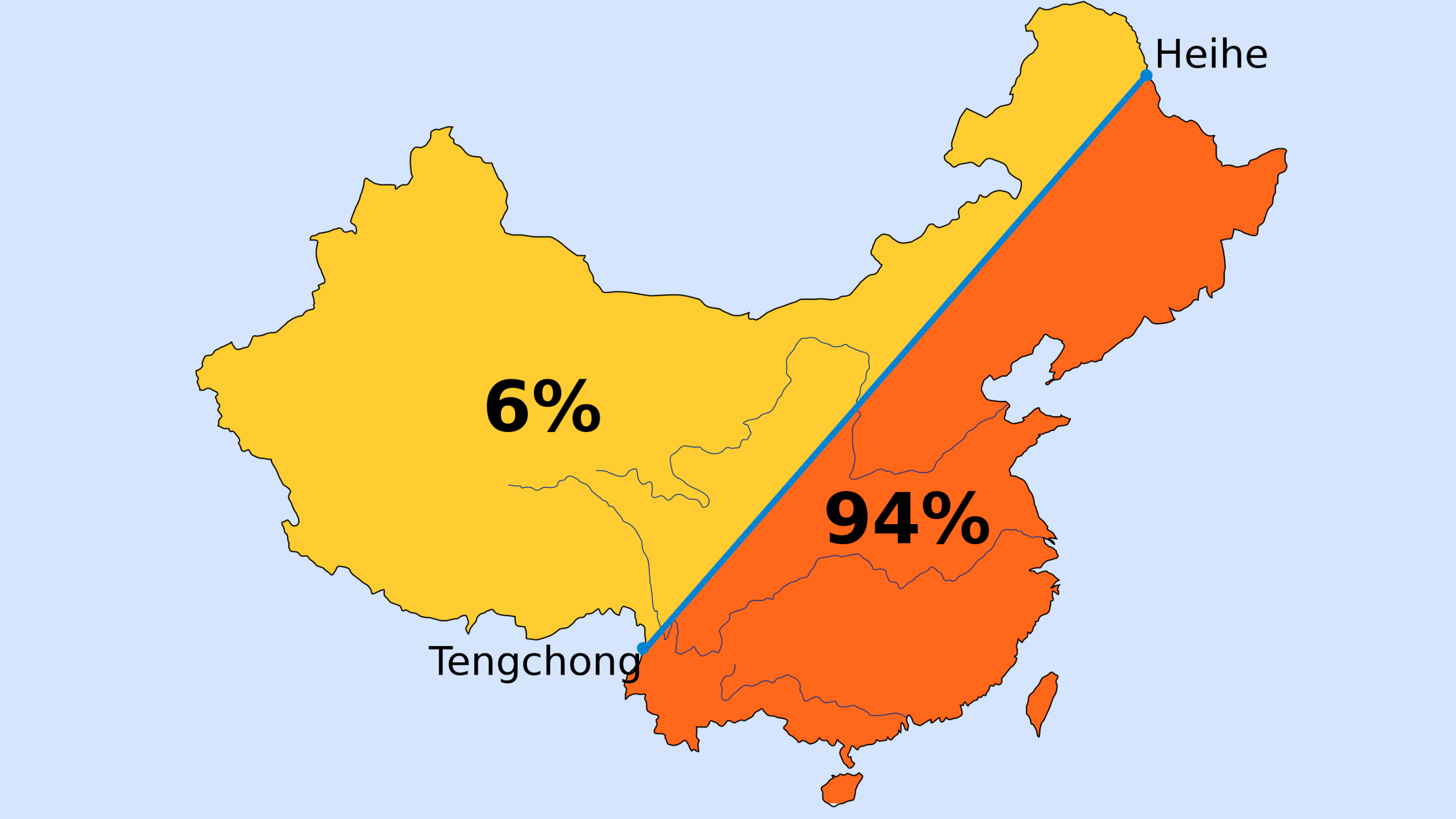
Why is that a problem? Most of the people in China live in about 1/3 of the country. Imagine if everyone in the United States lived in just 1/3 of the United States even with 350 million people that would be crowded , but China has 1.3 billion people living in an area the size of the United States from the Atlantic Ocean to the Mississippi river imagine 1.3 billion people living just in that area.
Building infrastructure for a civilized society is never bad and when I say that nothing is perfect. There are downsides. I would rather have the infrastructure and I wished the United States still had that can-do attitude. The rail system across the country needs to be upgraded desperately.
The Chinese have even taken the lessons of Oak Ridge, Tennessee, they have built two Thorium reactors and refueled one without turning it off, and they appear to be right on schedule to have that larger second reactor online by 2030.
> Building infrastructure for a civilized society is never bad
If only. Everybody loves cutting the ribbon on shiny new infrastructure, but the cost of maintenance is very real and never ending.
As a simple example, rezone some agricultural land as residential and sell it to developers. Yay, free money! But only once, and now you have a bunch of roads and plumbing etc etc that you need to upkeep forever. If there's people living in the houses and paying taxes, that's fine, but if there aren't or they go away, you now have a very big, very expensive problem. Japan is deep into feeling the pain of this and demographically China is only a decade or two behind.
> Imagine if everyone in the United States lived in just 1/3 of the United States
Take a 100 mile strip down the east coast and the west coast. Add Chicago. That's pretty much everyone.
Are these not the same things people are complaining about in the West, though?
I'm passively curious how the long-term maintenance of this all ends up. You don't just build a bridge, you have to keep it up when the natural strain of the world impacts upon it. Given provinces already have debt problems [0], how the hell will all of this infrastructure look in 50 years?
[0]: https://www.scmp.com/economy/china-economy/article/3254680/c...
This is the structure of catabolic collapse. When the mere maintenance costs over run the capabilities/resources of the civilisation.
Funnily enough it may turn out that those nations that just muddled along could have the best long term out comes. Yes, they never got the really good stuff but they also won't have a harder decline.
"You cannot fall out of bed if you sleep on the floor" - Turkish proverb
China will likely become the go-to place for immigrants within couple decades. Just like any other developed economy had.
I do wonder about this. With demographic collapse coming for almost all nations, or with a notable trend line for it to come, what would happen if other nations basically prevent emigration? Better to keep their people than lose them. Alternatively, those with large populations can use this as a bargaining chip in trade negotiations.
The coming decades will be interesting.
I don’t think so. They have a massive working population and foreign entrepreneurship is hard there.
That would be quite the change, considering they don't really allow any outsiders to become citizens.
This has yet to happen in East Asia and probably never will.
America and countries that engaged in worldwide colonisation are the exception not the rule.
I doubt it because the Chinese are very protective of their homogeneity and see what has happened in Europe as a massive cautionary tale. So my guess is that they will be very picky and control both quality and numbers tightly.
>>and see what has happened in Europe as a massive cautionary tale
As a European - what has happened to us, exactly? I'm curious what kind of thing you think is happening to Europe that is such disaster that even China should be afraid of it.
European GDP per capita has not grown since the crash in 2008. Ever since we have heard that immigrants are being imported for jobs, yet the economy only gets worse, house prices increases due to supply and demand and crime rate is not equal among groups. Yes some people are just white supremacists but also, immigration hasn't solved anything in Europe in recent times. It is not like the US where you have a massive startup scene and get an Elon Musk from South Africa to create jobs and add meaningful value.
>>Ever since we have heard that immigrants are being imported for jobs
You do realize that most of European migration is internal, right? Polish workers going to Germany, that kind of thing? It would be like complaining that American migration is crazy because of all the people moving from Kansas to take jobs in California.
>> house prices increases due to supply and demand and crime rate is not equal among groups
As compared to....?
>>It is not like the US where you have a massive startup scene and get an Elon Musk from South Africa to create jobs and add meaningful value.
I'm like, honestly not sure what to say to that. I could maybe start listing successful businesses started and/or ran by immigrants in the EU if that helps? Or is the fact that none of them are as famous as Elon Musk a dealbreaker?
Mass immigration in Europe and its effects. In China and neighbouring countries it is seen as crazy and something to absolutely avoid.
>>Mass immigration in Europe and its effects.
Can you name a few of these effects that China sees as crazy?
Not hard to find the evidence of tofu dregs. Start being envious when they stop using ewaste as filler for concrete roads and buildings.
Visit if you can, and take some bullet trains! We had a blast last year there.
Shanghai was great in the 2010s. Seems like a different place today.
Are the bullet trains making enough to pay down construction debt yet? My understanding is that that has been a struggle, which is going to be a problem when they get past being new and start having more and more maintenance expense on top of paying back construction debt.
They dont have to, they are reqired to make the country work. Its like trying to make us roads profitable.
Or having some silly notion that the post service should be profitable.
Public services generally provide public good that outweighs their cost. Trying to quantify and charge for that cost is a useless exercise.
I've been living in Shanghai sinze 2010, with some time in between in Shenzhen. Shanghai is much better now than in the 2010s.
I traveled to Wuhan twice a year for business for much of the last decade (until the pandemic).
China was a growing country that clearly knew how to build infrastructure. In Wuhan, they built an entire development intended to employ 100,000 engineers (Huawei + our US company's 50). They built a subway system in a decade that's bigger than New York City's. I took the high-speed rail to Beijing and it was superb. They replaced an old, shabby international airport terminal with a new one with the widest concourse I've ever seen. They subsidized regular flights between Wuhan and San Francisco on China Southern airlines. The Hyatt Regency there was one of my favorite hotels I've ever stayed in (cheap and high quality). In a big commerical district, they had the largest screen I've ever seen that had a Blue Screen of Death :-)
Dazzling yet I'm not bullish on China due to its demographics, among many other reasons.
What’s wrong with their demographics? Population decline?
It has been called the 4-2-1 problem. 4 people had 2 kids. Those 2 kids had 1 of their own. This means there ends up with a more elderly people with far fewer young to support them. That doesn't look like a recipe for social stability. This is why they are going in so hard on automation nowadays, they are trying to do what Japan attempted in the 90s/2000s but hopefully with more success.
This was originally a side effect of the One child policy, but now it is continued due to difficult living situations. This is not a uniquely China issue.
Whenever the topic of Chinese infrastructure comes up I am reminded of a 2016 Wired documentary about Shenzhen. It was positive portrayal of hacker culture in Shenzhen. But one thing really stood out to me. They had demarcation line separating the city and “urban village”. It looked like lots of poor people lived in the urban village. The guide mentioned that the urban village will be torn down completely in 3 months to expand the city and people had to move. It sounded like gentrification. The host was impressed by the efficiency.
But it made me question how many countries can actually be that “efficiency” because matters of uprooting large swath of population will take years not months and run into significant legal challenges as well.
To be clear use of eminent domain and gentrification happens even in US but I doubt it can be as “efficient” as a technocratic government. It’s not a knock on Chinese government, just something I always wonder.
On the move to where? Massive unemployment amongst youth and population collapse is on its way.
You are projecting a fantasy.
A Chinese person who was here in the US as a foreign student once commented to me that he was so surprised that the United States was like the country side. He didn’t realize how rural the country was.
This was at UCLA which is in LA which is the second biggest city in the US.
West LA isn't like a Chinese city, but no one in their right mind would call UCLA rural
People are also surprised how rural much of China is.
https://bigthink.com/wp-content/uploads/2021/02/origin.png
Posting the map in case anyone hasn’t seen it.
Russia, US, Australia, Canada are all like this. Probably many more. The world is a very small place when you look at where most people actually live.
When friends visited NYC and we drove around a bit they said “it’s like everything is half finished”
Is that just because of the scaffolding on everything? IIRC that's due to some legal or tax bullshit.
Did he ask about all the bricked up windows in London?
You get what you incentivize.
Presumably referring to population density? People like the low density in California.
I'd say it's a country that builds a ton of infrastructure, at the expense of living standards of common people. The money from infra has to come from anywhere, and an all-powerful central government can just redirect the stream from consumer spending into building out infrastructure. Whether Chinese are happy about it, you'd have to ask them.
The US is not building infrastructure at the expense of living standard of common people. Ask Americans if they're happy about it.
That's certainly a take. China just has this decades long history of targeting foreign industries, flooding the market with that product, and then being the only one left standing.
The idea that we should allow cheap vehicles to flood the domestic market because that will "cause the US auto manufacturers compete" ignores the wholly uneven playing field at work here, and the government backed goal of one side. Just the cost of labor alone makes that not an approachable thing to do.
On the reverse "bad" US side, we have more and more international auto manufacturers building and investing in factories in the US every year. Strangely, this decision involves billions of dollars and years of work to make happen. It's not based on internet vibes.
And the "renewable" growth is really kind of misleading. They're also building more coal power plants than the rest of the earth, combined, each year. They represent ~50% of the worldwide coal power in use today and produce roughly one third of the total CO2 in the world now, almost 3x that of the US.
But I guess the future is government funded undercutting of international competitors, using technology stolen by the government from those competitors, in order to destroy those competitors, while using very dirty and cheap energy to do so? Is that the lesson we're supposed to learn from them?
The US auto manufacturers could compete, they just don't want to.
They've played their own regulatory capture games here and have all but abandoned the concept of affordable small cars & EVs. They've decided to go all in on $80k luxury EVs and enormous trucks (while being protected by 25% tariffs on light truck imports), and the stupid CAFE footprint loophole.
Maybe if they'd stop flooding our streets with ridiculously sized vehicles and actually tried to compete, it would be a different story. They aren't even trying.
We are just as capable of offering subsidies, if thats what it takes, to make small affordable EVs.
It's what the USA did during its industrialisation, it's what Japan did during its industrialisation. If you are looking to history to find ways to make your country prosper and industrialise, wouldn't you take those examples since they panned out pretty well?
The US, via a wide reaching, decades long government policy stole technology from other countries, passed that along to chosen domestic companies, and helped flood the market with the stolen/cheaper goods by supporting the companies doing so to produce goods to be sold at below cost?
There's a lot of data around that in the history of the US and Japan?
For the first part, yep. Samuel Slater (known as the "Father of the American Industrial Revolution" in the US, but "Slater the Traitor" in the UK) was the most well known example, but was also simply one piece of a large policy of ignoring European parents and encouraging people to come with 'stolen technology' to the US and make a competing company here.
https://en.wikipedia.org/wiki/Samuel_Slater
Also, the Chinese are absolutely making a profit on their exports, so I'd question your "below cost" broad characterization.
See Doron Ben-Atar, Trade Secrets: Intellectual Piracy and the Origins of American Industrial Power. Concern for IP tends to come _after_ a country develops.
American car manufacturers have extremely small market shares outside N.A., and many (all?) of them required multiple government bailouts over the past few decades.
If you think that keeping China is good for the consumer, you'll have to present a stronger case than "we must protect our companies".
> If you think that keeping [out] China is good for the consumer
It would be excellent for the consumer, in the rather short term, to not keep them out. Cheap cars! Cheap goods flooding our markets are great for consumers in the short term.
> American car manufacturers have extremely small market shares outside N.A
Here's a game:
One company is American. The other is not.
Company 1 Market Share: North America: 16.5% South America: 8.9% Asia: 7.6%
Company 2 Market Share: North America: 14.87% South America: 8.3% Asia: 8.28%
Now, without looking, which is the "US company without market share outside of NA", and which is the foreign company that understands how to compete?
Unfortunately, I looked, so let me add to this game, starting with the fact you omitted Europe:
Company 1: Europe ~0% (trucks & SUVs just don't sell well there it seems) Company 2: Europe 7%
Company 1: Manufactures in 8 countries, 2/3 of its factories are in North America. Company 2: Local production of cars in 25-30 countries depending on partnerships.
Company 1 data: 2025. Company 2 data: 2020 (?!)
BYD has pretty amazing tech to be honest, but putting protectionism as an argument against the US and pro BYD in the same sentence is naive at best. The CCP allowed BYD to exist and the CCP can end BYD in a single weekend regardless of any human right concerns elsewhere.
And, more to the point, BYD exists because the CCP has been aggressively protectionist of its domestic companies and has been strongly involved in growing, supporting, and protecting its domestic industry to ensure it has one. BYD is not a cautionary tale about protectionism, it's a sales pitch for it.
Well, different kinds of protectionism.
The CCP's protectionism is because China is going for a cultural victory. It wants Chinese products to be available and inexpensive and purchased around the world. It puts resources to that end.
The US's protectionism is for the enrichment of the CEO, board members, stockholders, and Executive Branch's family members. It wants to protect the domestic market from sending money somewhere other than the relatives of the people in power.
While they're both "protectionism" they're not the same policies.
It is just sad that commentary like this even exists.
I sincerely am curious of the education that produces sentences like this. On one hand it is articulate and educated, on the other hand its amazing that one can think China is doing this out of charity and not wiping out its competitors one after the other.
One protects against forein interests the other against domestic. The west is all about relative wealth building China is building absolute wealth.
To expand your fortune relatively other people have to lose. Its required.
I don't read that as doing it out of charity. A cultural victory is still a victory. China is very much playing to win.
Hasn’t the US been equally so, including the auto company bailouts, government fleet purchases restricted to US-made vehicles, US national moves to secure supply chain inputs for the auto makers, etc.?
The main difference that I see isn’t protectionism, it’s that BYD took a direction the market wanted, whereas US auto makers have not produced vehicles that were appealing to consumers who had choices.
BYD's direction was largely at the behest of the Chinese government, who were willing to demand things of BYD in exchange for that protectionism, instead of wringing their hands and saying "nothing you can do about the market" while simultaneously propping up industries of national strategic significance.
No, it is not. From mass recalls to faking sales targets and finances, BYD is actually facing serious problems. As soon as their benefits stop they are going the way of Evergrande
These aren't things unknown to other car manufacturers. Tesla, in particular, has suffered from mass recalls and faking sales. It also only really exists as a company because of government investment.
I may end up living outside the US next year (was going to be this year but it’s been postponed) and when I was investigating auto options, I’ve been severely tempted by the BYD Seal as a replacement for my Prius. All the reviews I’ve found have been positive and while I’m not a big fan of the compromises made in the display mount for the useless automatic rotation feature, it’s quite tempting. I’m torn between just getting a new Prius or spending an additional 8K for the Seal. I don’t know that I’ll drive enough for the difference in cost to add up (or, for that matter, to justify buying a car at all, but that’s a question for a different day), but I really like the idea of not contributing to the pollution in the urban area I’d be living. Option C would be the plugin hybrid version of the Seal which would be cheaper than the Prius.
> the CCP can end BYD in a single weekend
Seeing the way tech companies behave makes me think they fear Trump the same way. for example, Tim Apple certainly crawls up Trumps arse.
I don't mean to downplay Trump's strongarming of industry or the obsequiousness shown by tech leaders, but let's be real, it's not remotely the same level of control.
the government is basically subservient to him, and there isn't anything stopping it from making a company cease to exist other than the status quo. If, for whatever reason, him (or in his absence the rest of the government) decide they don't want it to exist, it won't exist. It might not be as explicit as how the CCP does it, but it will have the same result
The US has thousands of atrocities under its belt. For this aspect, the US and China tie in terms of the leaderboard.
The US can end any of its trillion dollar companies overnight. Ask anthropic how much they were looking forward to being on the receiving end of the orange gibbon's ire.
That's pretty much everywhere, especially China.
If you have ambitions that are contrary to that of the Party, well, they're going to get what they want, one way or another. It doesn't matter if you don't want to deal your AI to the military or if you'd rather not sell your home so that a highway can be built over the lot.
Some countries have stronger rule of law protections and social customs that enforce them, but the US has been on a speed run to dismantle all of them in the past year.
I think we've just been on a speed run to refresh our collective memory why we do things/have the systems we have/the rules/laws we have. I am hopeful it will cause a civic improvement long term at the expense of a very high cost that was not worth it. But we've been on a long course of removing civics/western civ classes from school/requirements so this is the alternative, to relive the reasons for why we do things the way we do.
Running a business isn't a human right. Also, I hate the conflation people have that the ability for the CCP to do something means it would. Furthermore, the party in socialist states is basically just the government. It being called a party and being explicitly ideological in function isn't, in practice, very different from the US having something called the federal government that has a constitutional ideology
Doing anything you want to do that does not harm anyone else, and helps some, is most certainly a human right.
To arbitrarily repress this most basic impulse, the one to go after a dream to make better ways to do things, is severely anti-human.
Most businesses are in this category.
the problem is that it does harm people, at least at the large scale. And china exists because of that harm
>dream to make better ways to do things
The inability to exploit other peoples labor to achieve that doesn't mean those things are denied
Many predicted it for a long time, the US will always be a great power, for structural and geographical reasons, but it won't keep the position it had for almost a century.
The good thing about China is that apart from Taiwan they have little territoral ambitions, I don't foresee huge conflicts incoming, but I am a not entirely sure the US will manage to lost its position as gracefully as the British Empire.
It could be bad news for US citizens if their currency precipitiously lose its power, and they'll look for people to blame.
> The good thing about China is that apart from Taiwan they have little territoral ambitions
One of the reasons China wants Taiwan is because it would enable further territorial expansions into The Philippines and Japan. China considers any neighboring Democratic nation a threat. Taiwan is just their first / easiest prospective target.
If you have access to PBS, there's a very good documentary that touches on this a bit called Invisible Nation.
In what world is China less "protectionist" than the US?
The world before all of the big beautiful tariffs.
It's depressing that we can't buy BYD in the USA. It's feeling more and more like being stuck with a Lada in the 1980s.
Are BYD cars specifically banned or do they just not comply with all the US regulations?
100% tariff and political threats -- implying that they'd find a way to mark them as "unsafe", despite the fact that Canada and Europe tend to have higher safety standards than the US and already have BYD presence.
You can see the political groundwork being laid here.
https://homeland.house.gov/2025/05/21/homeland-republicans-p...
If these concerns are so pressing, why do we allow any electronics at all from China?
It smells like air cover for a de-facto ban on BYD. To force US consumers to buy from politically blessed car makers instead of letting us choose the highest quality car available (at a given price point).
Some level of protectionism is in the best interest of national security. How is the local electronics industry that you referenced in the US doing? What is the ramification of eliminating the job market for engineers or discarding all of the US manufacturing know how? The CCP knows the answer to that question
The reason I called out Lada in my original comment is because it's a counterpoint to what you just said. The Lada was the result of too much protectionism. Produced from an empire that was too inward looking and feared interacting with the rest of the world on equal terms.
BYD keeps performing well in the rest of the world. If we hold US consumers hostage to prop up companies like Tesla, we risk allowing them to stagnate.
I prefer to take my chances on stagnation vs Chinese industrial hegemony
> stagnation vs Chinese industrial hegemony
I don't think we get to be stagnant and fend off Chinese industrial hegemony. It's not a symmetric bet.
what has become of America where we are now scared shitless of China... oh well, i is what it is... America our ancestors built would have been like bring it on bitches and here we are "oh please, lets not let China in, our companies are subpar and we stand no chance against such a foe...