FBI used iPhone notification data to retrieve deleted Signal messages
9to5mac.com286 points by 01-_- 4 hours ago
286 points by 01-_- 4 hours ago
Settings > Notifications > Notification Content > Show: "Name Only" or "No Name or Content"
I've had this enabled to prevent sensitive messages from appearing in full whilst showing someone something on my phone, but I guess this is an added benefit as well.
Just to clarify, this is within the Signal app settings—not the OS (iOS or Android) system settings.
Critical distinction, as merely changing OS notification settings will simply prevent notification content from being displayed on-screen.
When you put it up against each other it makes perfect sense, but I would never have thought about it in that way!
Thank you for adding this to the conversation.
Wait so if I do iOS setting notifications > never show previews it’s still caching them in the background? Unencrypted?
Yes. And technically, from a privacy perspective, it's even worse than that. What's additionally happening is they're still 'syncing' back to Apple servers via APNS (and to Alphabet servers via Firebase on Android)—even with notifications completely disabled, that's correct.
If the app generates them, the OS receives them. That's why the Signal app offers this setting.
>it's even worse than that. What's additionally happening is they're still 'syncing' back to Apple servers via APNS (and to Alphabet servers via Firebase on Android)—even with notifications completely disabled, that's correct.
Source? I don't think either OS implements notification syncing between devices, it's only one way, and as others have mentioned, the actually push notification doesn't contain any message content, only an instruction for signal to fetch and decrypt the message.
> I don't think either OS implements notification syncing between devices
Can't speak for iOS and no idea if this relates to the above functionality, but Pixel lets you deduplicate notifications across Pixel devices.
This sounds correct. When I implemented push notifications for an iPhone application, I remainder needing to obtain a store a separate token for each device a user has, and subscribing to a feed of revoked delivery tokens. Seemed like an interesting design intended to facilitate E2E encryption for push notifications.
Wait... why does Signal need to send notification content to Firebase to trigger a push notification on device? I would instead expect that Signal would send a push to my Android saying nothing more than "wake up, you've got a message in convo XYZ", then the app would take over and handle the rest of it locally.
I also didn't realize that Android stores message history even after I've replied or swiped them away. That's nuts - why!?
Signal does NOT send notification content througth APN/Firebase, their push notification is literaly a ping as you expected.
Source: https://mastodon.world@Mer__edith/111563866152334347 (Meredith Whittaker is the current CEO of Signal)
I can't link you rigth now to the actual code on their repo but it is verifiable.
If your app needs to send a notification while it's not currently a running process, it must go through Firebase on Google's side and APNS on Apple's side. There is no way for a non running app to send a notification entirely locally, this is by design of both companies.
Signal developer here. Not entirely sure what you're saying. I'm only an Android guy, but FCM messages are certainly one trigger that can allow an app process to run, but it's not the only trigger. You can schedule system alarms, jobs, etc. And the notification does not need to be provided by the FCM message. In our case, the server just sends empty FCM messages to wake up the app, we fetch the messages ourselves from the server, decrypt them, and build the notification ourselves. No data, encrypted or otherwise, is ever put into the FCM payloads.
> this is by design of both companies.
I’ll note that whatever other reasons it’s also the only way to make this battery efficient. Having a bunch of different TCP connections signaling events at random times is not what you want.
Ideally the app also is responsible for rendering rather than having to disclose the message but that can be challenging to accomplish for all sorts of reasons).
> […] this is by design of both companies.
This is more of a fundamental technical limitation of operating systems and networks; I don't think it is possible to design distributed communication between arbitrary service provider infrastructure and end-user devices without an always-online intermediary reachable from anywhere (a bouncer, in IRC terms) that accepts messages for non-present consumers.
Yes, however the fact that it is not customizable is what is annoying, you are forced to rely only on the OS makers' implementations, which I guess should be expected in the day and age.
But there is a way to do this encrypted, so that when the notification is received on your iPhone, the process itself needs to decrypt it.
Except you need an entitlement for that, because it requires that your app has the ability to receive a notification without actually showing it (Apple checks this).
Your app gets woken up, decrypts the message, and then shows a local notification.
Any idea if this works the same or differently for Hidden apps specifically?
Normally no notifications are shown for hidden apps, and even if you unhide the apps, prior notifications which were sent do not reappear IIRC. I'm curious if notifications like that are still hitting the phone into the notifications database, or get silently dropped, or something else.
With notifications disabled APNS push notifications fail for the sending app backend. The device id is rendered invalid if push notifications are disabled at any point. Backends are supposed to handle this and quit sending messages.
Signal has this setting to tell the backend how much information to put into the push message. It can tell the backend to send a simple notification saying “new message” and not send information through APNS or enable it.
I am willing to bet Signal has a notification extension to handle edge cases where there is lag in settings to scrub the message metadata before it dings a screen alert.
yes, since apple doesn't control the content of the pushes it is sent by application backends. that can only be controlled within each app
Signal should switch the default to being less verbose.
The default should be "No name or content".
Name only strikes me as a fairer compromise between security and usability.
I thought name-only was the default.
> I thought name-only was the default
At least for me, it was name and content.
Fwiw, in my Signal app on Android this setting is in
Settings > Notifications > Messages > Show
My Samsung also keeps a history of notification content. Under Settings->Notifications ->Advanced -> Notification History
However, if this is important to you then you want Signal to stop telling Android to make the notifications. If it doesn't exist nobody will accidentally make it available.
Deleting that history is good to know about after the fact, but preferably lets just not create the problem.
Disable Apple Intelligence summaries for sensitive app notifications too.
Given the quality of the summaries, you might want to keep them just for plausible deniability </s>
I guess enabling Lockdown mode might avoid this particular issue too, together with a bunch of other stuff?
Why would lockdown mode prevent this? I have lockdown mode on but that doesn't automatically make my notifications private.
Lockdown mode would prevent access to the data in theory.
But most likely (pure speculation mind you), this was a case of someone handing over the phone for review and where cooperating.
It might have been that they deleted signal some time ago, or even deleted signal and then handed over the phone.
It's notable that the data wasn't recovered from signals storage (was the data securely erased or that kind of recovery not attempted?).
It's a mode of the phone that is supposed to prevent cyber attacks, more so than "normal mode" I suppose, since it's supposed to limit features in the name of security. This seems like a variant of such attack, so seems like it should protect against it
There is a documented list of things that Lockdown Mode affects [1], this is not one of the advertised ones. There are a bunch of other (undocumented) things it affects (some of which are bugs :/), but I don't believe it has any affect on notification storage.
Mostly it seems the documentation is vague. Is there anything clearer than this?
> Web browsing: Certain complex web technologies are blocked, which might cause some websites to load more slowly or not operate correctly. In addition, web fonts might not be displayed, and images might be replaced with a missing image icon.
Just curious, how come at least once a month signal bugs me to turn on notifications? I said no for a reason, every single time - why does it keep asking?
Not implying anything evil but it feels a bit weird esp after this.
Signal developer here. It's just because notification reliability is always a top support complaint, and a lot of people turn off notifications and don't realize they've done so. Admittedly, once a month is likely too aggressive.
Is there some "no means no" additional setting that could be added where someone has to go into settings that would prevent that?
I fear that with the notifications pop up asking me this I might hit the wrong button and woops turn it on.
How about instead of prompting to enable notifications, you leave a small banner or other unintrusive UI noting that they're off, which users can tap in order to learn more about how to reenable them?
For an app that prides itself on privacy, it's kind of crazy that you're making it so easy to accidentally blow it.
> why does it keep asking?
Why does any software keep asking you to do things you explicitly told them you don't want to do? Because it's in the software developer's best interest to get you to do them, not yours. We've gotten way past the point in software where we no longer expect the software to serve the user's interest and solve the user's problems. Now, the expectation is that the user gets nagged and coerced into serving the software's interest and solving the developers' problems.
EDIT: Looks like a developer confirmed this in a sibling comment already: It nags you because that solves their support problem.
We build Signal for everyone, and that includes a lot of people who are not as technologically literate as the average tech worker. For a lot of people, they don't even know they dismissed the notification permission prompt, they were just closing boxes. For them, the reminder is helpful and prevents them from experiencing missing notifications. Striking a balance between helping these people and annoying more technologically-literate users is very difficult, with compromises everywhere. We're just trying to make sure Signal works for people, nothing more.
Thanks for the reply. I know it feels noble to do it that way, and I admit I get dogmatic over this one principle: a computer should first and foremost obey the user. It shouldn't have its own agenda. It shouldn't second guess. It shouldn't "did you mean?" I command the computer, and the computer executes that command and then waits for the next command. If I command it to not display a particular output (notifications), then I expect it to never display them, full stop.
I don't see my computers as partners or helpful assistants or eager interns. I see them as tools for reliably performing computation, and I expect them to operate that way.
I fully understand that this means that fewer and fewer developers are "building their software for me" and I find that pretty disappointing.
The Proton Drive app keeps asking me to turn on backups of photos and video. There is no option to say "don't ask again."
I guess they /want/ more storage to be used? Or is there a support issue they are trying to deal with?
They probably want to avoid situations where a customer turns off backups, then loses data and makes it the problem of support.
But it would be nice to have a "don't ask again" option regardless, even if it's hidden in settings.
Yes Google constantly asks me to backup my pictures to their platform No, I don't want this. But regularly when I go to my photos it'll pop up with a box asking and the default option is yes please back up. Sad.
"Consent" has become this mystical foreign concept to software developers. If the world of computing was a night club, "Silicon Valley" would be that creepy guy who goes up to everyone asking "Do you want to dance? [YES | Ask Me Later]".
Messaging platforms where people receive and promptly respond to messages are more successful in the long run. That's why SMS overtook email. If you own a messaging platform there isn't anything inherently nefarious about pushing people to enable notifications.
Reminds me what Whatsapp if you set up a 2FA PIN, which forces you to type it about every week to check if you forgot it. So annoying.
First, a critical setting for Signal users:
"Signal’s settings include an option that prevents the actual message content from being previewed in notifications. However, it appears the defendant did not have that setting enabled, which, in turn, seemingly allowed the system to store the content in the database."
Second, how can I see this notification history?
Not sure if it's exactly the same, but I had to add a When notification arrives with <message>, do <action> event trigger in my Crank macOS app (https://lowtechguys.com/crank) so I can show you how to do it on macOS:
      HOURS=6
      EPOCH_DIFF=978307200
      SINCE=$(echo "$(date +%s) - $EPOCH_DIFF - $HOURS * 3600" | bc)

      sqlite3 ~/Library/Group\ Containers/group.com.apple.usernoted/db2/db \
        "SELECT r.delivered_date, COALESCE(a.identifier, 'unknown'), hex(r.data)
        FROM record r
        LEFT JOIN app a ON r.app_id = a.app_id
        WHERE r.delivered_date > $SINCE
        ORDER BY r.delivered_date ASC;" \
      | while IFS='|' read -r cfdate bundle hexdata; do
          date -r $(echo "$cfdate + $EPOCH_DIFF" | bc | cut -d. -f1) '+%Y-%m-%d %H:%M:%S'
          echo "  app: $bundle"
          echo "$hexdata" | xxd -r -p > /tmp/notif.plist
          plutil -p /tmp/notif.plist 2>/dev/null \
            | grep -E '"(titl|title|subt|subtitle|body|message)"' \
            | sed 's/^  */  /'
          echo "---"
      done
In recent years, filesystem paths for system services have started to converge for both macOS and iOS so I'm thinking with jailbreak you could get read access to that database and get the same data out of it.
On android there are apps that let you see the history - i use NotiStar occasionally to see if i unwittingly dismissed important notifications. And i believe there are apps/settings that help you clear the history from the device.
But this is a reminder that these centralized notification infrastructure (FCM and APNs) store notification content (if the app is told to send content in it - signal with option enabled wouldn't send content) even if we clear local history these middleman still hold it
On Lineage Android, i see: Settings / Notifications / Notification History.
If you drop a settings widget on your home screen, it will let you choose a specific area, including notifications.
I don't know if the output is the complete database.
So I wonder about this. The quote from the 404 media article [0] is:
“We learned that specifically on iPhones, if one’s settings in the Signal app allow for message notifications and previews to show up on the lock screen, [then] the iPhone will internally store those notifications/message previews in the internal memory of the device,” a supporter of the defendants who was taking notes during the trial told 404 Media
The default setting appears to be to only show notification preview when unlocked. Will that notification still be stored unencrypted in notification storage or is it in an encrypted store because it will preview AFU?
It makes sense that any notification that previews on the lock screen would be unencrypted (including the case where it is encrypted but the encryption key is adjacently stored).
This all reads to me that this was a user induced OPSEC issue and Signal had the right defaults.
On a Pixel, I can see some history by going to
Android > Settings > Notifications > Manage > Notification History
Wasn't sure if it was the Pixel or GrapheneOS, but what a relief to actually be covered in one of these weird 0day issues.
Unrelated to the OP, but I bet the thousands of "exploits" that Claude Mythos has identified already are a lot of these kind of things that regular people would never think about.
On android its quite easy. There is a page of a protocol address that has all notifications show. I used to have a shortcut to it. It has been years since I was on android.
But it was really useful each time I did not see a notification in time.
Edit: typo
> I used to have a seizure to it.
Hopefully, you meant to write "shortcut"...
> testimony in a recent trial
Court cases are the real way to audit security.
Larping about security and complaining about companies responding to court orders only gets you so far. Its way more useful to look at what actually happens in reality.
Yes and no. Court cases certainly will disclose what capabilities various parties have come up with when it comes to security. However, there are documented cases where the government chooses to abandon prosecution for the sole purpose of preventing disclosure of some of their cyber capabilities.
I know it’s not germane to the Signal issue, but this caught my eye, “who previously pleaded guilty to providing material support to terrorists”.
The case comes with a long statement about the Antifa “organization”. Just your weekly reminder we are living under an Orwellian administration. https://www.justice.gov/opa/pr/antifa-cell-members-convicted...
The recent Trivy / LiteLLM mess was also a security thing, and seems rather different.
The problem is that, in the current environment of dishonest and corrupt states, "what actually happens in reality" isn't the same as what happens in court because of parallel construction.
So this is where we find out the one end of e2e is the phone and not the app.
Semi-related, in whatsapp reading the text in the notification doesn't mark the message as read, so the OS is kinda mitm here.
Signal creates the notification, does it not? That's like claiming `echo "my_private_data" | notify-send` is insecure.
If piping encrypted content resulted in a plaintext notification then you'd have a right to be concerned.
"However, it appears the defendant did not have that setting enabled, which, in turn, seemingly allowed the system to store the content in the database."
"[A]llowing the system to store the content in the database" on the phone where a third party, such as Apple or a government, can access it is the default
Only a small minority of users know about settings and how to change them. The vast majority of users do not change default settings. Apple knows this
If you care about security at all, you disable any previews on the lock screen. The lock screen is by definition visible to anyone without any authorization. Showing anything on it immediately destroys any secrecy. It must be obvious to anyone capable of elementary logic inference.
If you don't know how to disable it, you use your favorite search engine / LLM / knowledgeable relative to find out, and disable it.
But if you just didn't pay attention, "never thought about it", you don't care about security, and no amount of technical means would help, sorry.
> If you care about security at all, you disable any previews on the lock screen. The lock screen is by definition visible to anyone without any authorization. Showing anything on it immediately destroys any secrecy. It must be obvious to anyone capable of elementary logic inference.
With at least one combination of settings, it shows the message content only when the lockscreen has been unlocked, but not yet swiped away.
> Only a small minority of users know about settings and how to change them.
I couldn't believe this so went to look up some data on this.
Holy FUCK that is bleak. There needs to be way more computer education, not just "how2type" classes.
Original article: FBI Extracts Suspect’s Deleted Signal Messages Saved in iPhone Notification Database[0]
0. https://www.404media.co/fbi-extracts-suspects-deleted-signal...
That's unfortunately less informative if you aren't already one of their subscribers.
Kind of a wake-up call that even "deleted" messages aren't really gone if the OS is caching notification previews — makes you rethink what end-to-end encryption actually protects you from.
I wonder why Apple doesn't 'just' delete the notification data associated with the app from the internal database when the user deletes the app? It seems like asking for problems to just keep old notification content around forever.
It's one of those problems where as soon as someone notices, it's crazy that no one noticed. I can't imagine this not being overhauled going forward. It's just a bad way to operate and now it's news.
If the "database" works like most other databases (eg. postgres or sqlite), deleting a row doesn't immediately cause the data to be wiped from disk, for performance reasons. Then as others mentioned you have filesystem/SSD logic that does something similar on top of that.
If it never hits flash that might work, but if it's in flash storage then the block may not be erased by the time its dumped.
I'm not sure precisely how the NAND controller responds to requests for raw data from blocks with "deleted" data. And if this would require decapping the flash.
Some flash will happily let you see the data and delay erasing it.
Generally flash is non deterministic about when blocks even those with entirely stale data are erased . It might be years before the block is reused due to wear leveling algorithms and it might retain data that entire time.
Here's hoping the controller for phones which hold sensitive data are more active
On Android, when I use WhatsApp and have notifications for groups turned off, I can still see that they arrive briefly and then get removed (the icon top left vanishes). I wonder often, if this is a way to push all group message content into an unencrypted data trace as well - for the same use case.
If the notification has the data, then yes. It's trivial to create an app that listens to notifications; Samsung even has one themselves called NotiStar that replicates the notification history feature that Android normally has.
everyone's arguing about whether apple or the government is to blame. the actual problem is the verification methods themselves. credit card, drivers license, or a pass card. three options that each create a centralized database linking your real identity to your device. age verification is just identity verification with a friendlier name.
the verification accepts other people's credit cards and IDs. so the 'age gate' doesn't even verify the person using the device, just that someone with a credit card touched it once. it's all the privacy cost of an identity check with none of the supposed child safety benefit
To blame for what? I thought we blamed criminals for their actions, not law abiding people and companies.
Aren’t notifications supposed to be encrypted for Signal?
iOS stores the previously displayed notifications in an internal database, which was used to access the data. It’s outside of Signal’s control, they recommend disabling showing notification content in their settings to prevent this attack vector
They do control the content on the notification. It's a bit odd to put the sensitive text in the notification only to recommend disabling it at the system level.
No. They recommended disabling it at the app level. Only the Signal app can control whether the message contents are included in the notifications.
They do not. They send encrypted notifications. It’s the OS that stores them unencrypted. It’s the OS at fault here IMHO.
i think they're replying to the "recommendation" part -- if it was recommended, why isn't it the safe default?
i haven't actually seen signal or anyone adjacent recommend that previously though, idk where that claim came from
You can choose what to show in the notification and there is an option to include the message, so I'm guessing that allowed some unencrypted incoming messages to be read.
Sibling comment explains. The notification does arrive encrypted and is decrypted by an app extension (by Signal), however, if the message preview is shown, it is stored unencrypted by iOS. It is that storage that is accessed.
it seems iOS will drop previews into an unencrypted section. which, Is how I expected iOS notification previews to work without unlocking the phone
They are;
“Messages were recovered from Sharp’s phone through Apple’s internal notification storage—Signal had been removed, but incoming notifications were preserved in internal memory. Only incoming messages were captured (no outgoing).”
ie the messages recovered were 1. incoming 2. stored by the OS after decryption
i also was spooked by the headline :p
This kind of vulnerability is not tied to Signal but all apps which send notification.
As an aside, I decrypted an encrypted iPhone backup using a tool from GitHub because I wanted easy access to my Voice Memo recordings.
Photos I had long deleted were still in the backup! It's quite surprising just how much is being stored by the phone.
I thought Signal didn’t show message previews by default and you had to go in and enable it? I’ve never had message previews in my Signal and I don’t remember changing anything. Maybe when they introduced the feature, you could pick but they strongly suggested it not showing?
The opposite, actually. Signal endlessly nags you to turn on notifications, and when you turn them on, previews and content are shown by default. You cannot opt out of the nags.
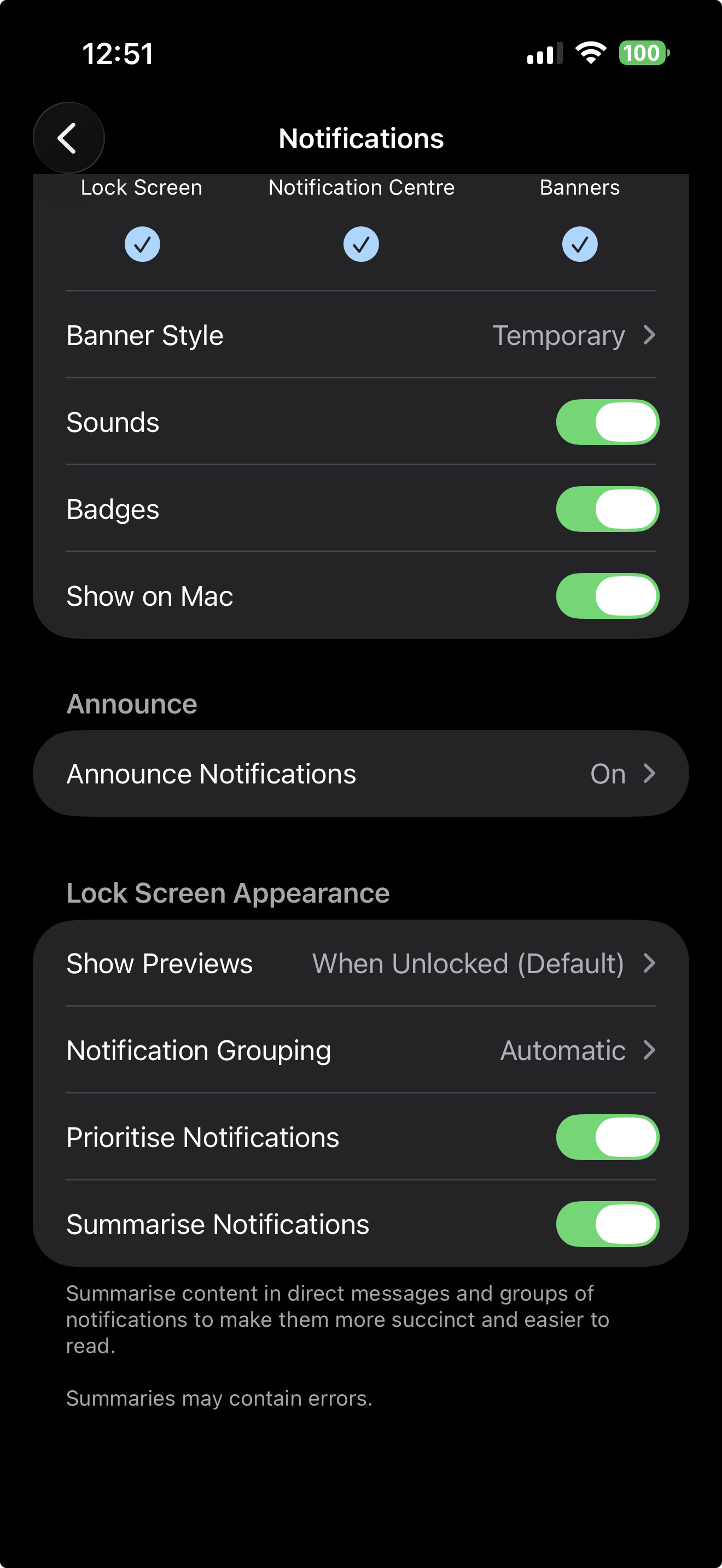
According to my setting screen the Show Previews setting is "When Unlocked (Default)".
Screenshot of notification settings page: https://files.catbox.moe/3gwjoy.png
... and I thought I'm turning off notifications for all apps just so I don't get spammed. Looks like the setting is more useful than that.
People also got charges in the same case for removing people from a Signal chat
There needs to be a bit more "group chat" control in Signal messages, wherein you could enforce certain settings for certain chats regardless of the phone settings. You could have group chats that would enforce not showing more information in the notifications, while others would still allow it.
This feels like it would run against the “I bought my device, I should control how it behaves” line of thinking.
I think it fits in pretty well with Signal. As it stands, a group chat can control when a message is automatically deleted for everyone, so everyone can rely on that being a shared setting. That's an intentional design decision. There's no individual opt-out.
An individual can disable name or content in notifications in iOS, or set "mute messages" for a chat to prevent notifications from appearing for that specific chat, but there's nothing that gives group members any assurance that other group members are doing that.
But it would be pretty well in line with the "I trust my contact with this communication, but only if they're not systematically misled to copy it to readily exploitable insecure storage" line of thinking.
Since the purposes of the program are pretty heavy on private communication, I'm inclined to think that takes precedence here, especially considering the consequences for dropping default message previews versus adding default reveal of supposedly private information.
smartphones in general runs against the “I bought my device, I should control how it behaves” line of thinking
People who NEED to hide their notifications from iOS have this already disabled.
They rest who "evaluate their threat models" can practice Spy-life-gymnastics by disabling it from Signal.
What a goofy comment.
The article you're commenting on is about people who obviously would have wanted this disabled, but didn't have it disabled, presumably because they didn't know about this issue.
[dupe] Discussion on source: https://news.ycombinator.com/item?id=47703573
Probably stupid question: why won't they e2e-encrypt push notifications too? The vector is obvious and has been open since forever.
Signal does not send any sensitive information in push notifications sent via APNs [0]. This story concerns the local OS cache of push notifications, which are triggered after E2E decryption has occurred.
I think the answer is probably stupid too: because they don't want it encrypted. Jobs used to draw a hard line with this kind of stuff. I imagine Tim Cook instantly folds whenever the Alphabet boys come knocking.
The "e" in e2e encryption is a computing device, not the device's user's brain.
Right. So I send a push notification with the "silent" flag and encrypted content; the app receives it, decrypts the text, and displays the notification locally. Google/Apple has only ciphertext in their FBI/CIA/NSA-accessible databases.
Reminder that no end-to-end encryption arrangement can do anything before encryption, or after decryption, at the endpoints.
Right. It's purely a protection against MitM snooping. The app has to have the messages in plaintext to display to you via whatever mechanism the OS uses. Seems obvious, but also not, at the same time.
I've found other ways Signal can leak information, even with disappearing messages. It's not the total install-and-be-done privacy screen that some people think it is, and requires a little effort at the user end to fill in a few gaps.
Um. Android has notification history also and I see no similar ability to hide notification content from the system ...
Good. The moment they add it, all kinds of apps will start to abuse it, for "sekhurity" (read: engagement) reasons. See e.g. all the apps that now disallow taking screenshots, for no legitimate reason.
Personally I'd be in favor of a hard app store policy, that if an app notifies you about something, all the importantdetails (like full message text) must be included - specifically to allow the user to view the important information without having to open the app itself.
[dead]
signal is security theater, and a very bad user experience
Prove it.
> very bad user experience
"To use the Signal desktop app, Signal must first be installed on your phone."
thank god whatsapp doesn't do that either. or telegram. or allo back in the day, or every single mobile first messaging app
The only one I can think of that doesn't require a mobile login is iMessage, because it's not a chat app, it's lock in and data theft disguised as software