US Job Market Visualizer
karpathy.ai311 points by andygcook 5 hours ago
311 points by andygcook 5 hours ago
Wow, I had no idea the reason my peers and I can't find another position in less than 12 months is because the market for software developers is growing faster than average!
"Than average".
There's lies, damned lies, and then: there's statistics.
You have to counter the growth in jobs based on how many new people there are to take them, the location in which they are, and somewhat weirdly other jobs.
Plenty of people feel so dejected at the current state of things that they leave computer work entirely making "openings" where there isn't actually any growth.
Like all things that you try to understand: a single datapoint, when averaged, is like trying to calculate the heat from the sun by looking through a telescope at jupiter. It will give you a far-out tiny facet of data that only makes sense when coalesced with a hundred other ones.
It's wild that there are as many jobs in the category "Top Executives" as in the category "Retail Sales Worker".
This makes sense given both automation and the US's role in the global economy, but it runs somewhat contrary to standard ideas of class and inequality.
That category has a median pay of $105,350, and includes "general and operations managers" as well as "chief executives". I assume it includes executives of very small enterprises.
I took one glance at the chart and decided the results were impossible because of that.
Apparently "top executive" median pay is $105,350 per year: https://www.bls.gov/ooh/management/top-executives.htm
Sounds plausible? Even a company with 100 employees and few growth prospects is likely to have a couple of executives, and most companies are small.
If you own a painting company with three employees you are a CEO and fall in the top executives category. You may or may not make 100k a year.
Remember that exec tech salaries are extreme outliers. I worked for an exec in manufacturing. He had full p&l responsibility for a business segment with ~150 employees, $27 million in revenue at 40% gross margins, and a production plant. His total comp was ~$300k.
Now just think of the comp levels in sectors like government, education, etc.
The number of people in the category is simply impossible for any normal person's definition of "top executive".
If you click the link it mentions "general and operations managers". They're tossing a lot of different roles into the category.
> Remember that exec tech salaries are extreme outliers.
It's the combination of tech and big or fast growing companies.
People who operate in FAANG or Silicon Valley bubbles (or who spend too much time on Blind) can lose track of what salaries look like in the rest of the world.
I often share Buffer's open salary page because their compensation is actually pretty normal from all of the data I've seen and hiring I've done: https://buffer.com/salaries
Every time it gets posted there are comments from people aghast that the software engineers "only" make $200K and in disbelief that the CEO's salary is "only" $300K.
> it runs somewhat contrary to standard ideas of class and inequality.
Can you elaborate?
These categories are extremely broad. Top Executive includes general managers, legislators, school superintendents, mayors, city administrators, and a lot of other government jobs. The name is misleading, it's basically non-frontline management.
Chief Executives is actually a specific sub-category of it and is, obviously, much smaller.
Cool stuff. would be nice to have a color blind mode. I literally can't distinguish the red from green in this visualization.
Created a temp hack for you: https://gist.github.com/ro31337/89b24edaec0a5bfbf73bc5abfbfb...
(don't forget to "allow pasting" in [chrome] console first)
Curious as someone that doesn't experience the issue but assumes that your system Accessibility settings, maybe high-contrast, would be useful instead of expecting individual sites to tailor their color palette... does that not work?
This comment prompted me to find out about colour filters for mac os. I enabled the red/green filter, which made it easier to see the differences on the site, however the downside is it affects a lot of other colors and images on other sites, so is not a feasible solution, for me at least.
If AI produces surplus where does it go? Not talking about investment backed datacenter buildout and AI labs. Talking about the results of AI work...
I think AI outcomes distribute to contexts where it is used, and produce a change in how we work, what work we take on. Competition takes care of taking those surpluses and investing them in new structure, which becomes load bearing and we can't do without it anymore.
In the end it looks like we are treading water, just like it was when computers got 1M times faster in a couple of decades, but we felt very little improvement in earnings or reduction in work.
Surplus becomes structure and the changed structure is something you can't function without. Like the cell and mitochondrion, after they merged they can't be apart, can't pay their costs individually anymore. Surplus is absorbed into the baseline cost.
> If AI produces surplus where does it go? Not talking about investment backed datacenter buildout and AI labs. Talking about the results of AI work...
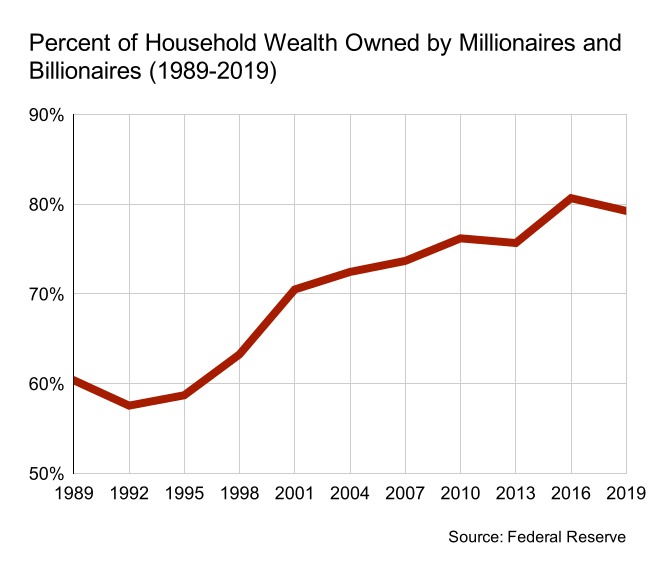
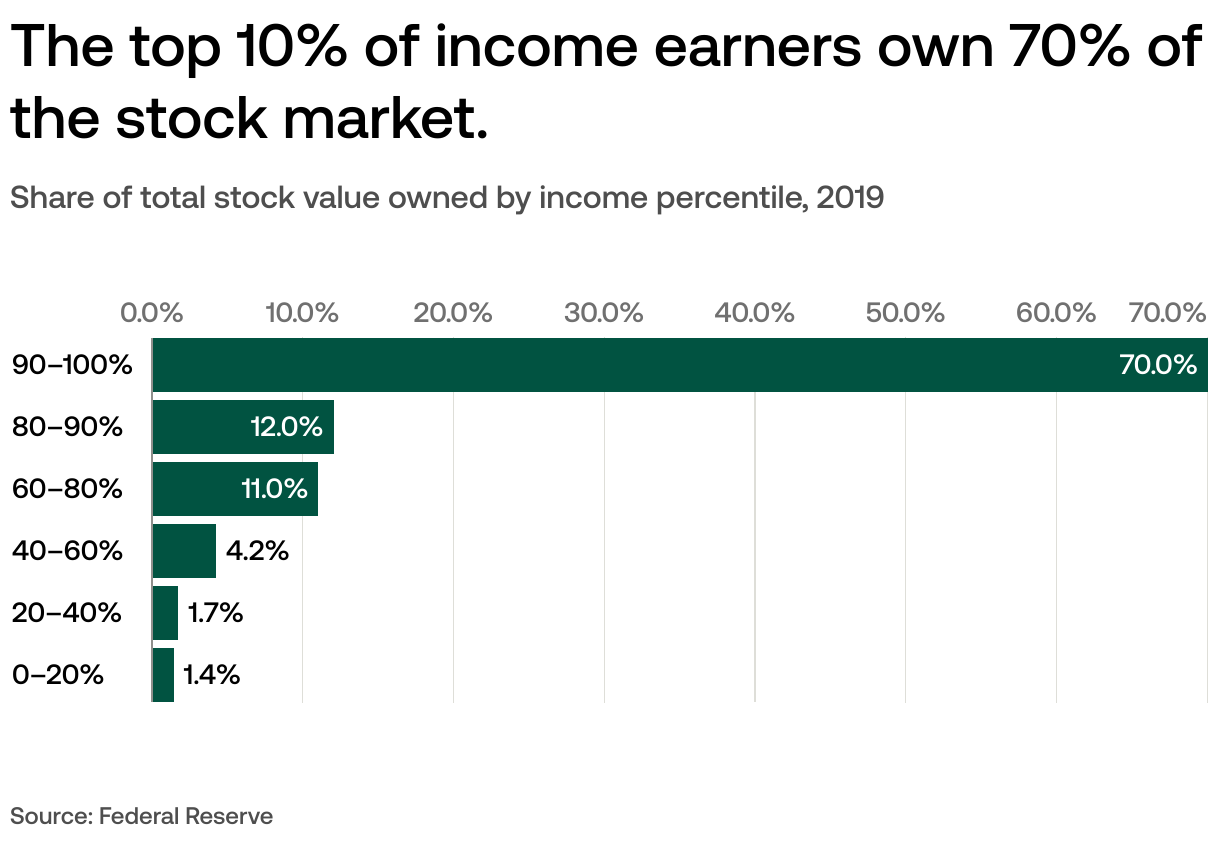
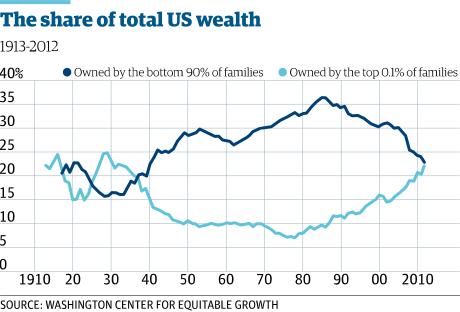
The 1% pockets, this is where the vast majority of the extra productivity computers/internet/automation brought goes to for the last 50 years: https://www.epi.org/productivity-pay-gap/
The study doesn't say it went into the 1%'s pockets. It says it went to 2 places:
1) The salaries of corporate employees 2) Shareholders and capital owners
Regarding number 2: "Shareholders" would include anyone who owns any stock at all, including a lot of middle class people with a simple S&P 500 ETF in their portfolio.
And the increase in productivity allowed more people to become capital owners, AKA entrepreneurs. The explosion in software entrepreneurs, for example.
Then why are wealth inequalities exploding? Why are we just about to witness the first trillionaire?
Because no matter what fairy tales you want to believe in your $20 "invested" in palantir won't make you a "shareholder" lmao
Wealth inequality is increasing, but the wealth isn't all flowing into the 1%'s pockets.
Lots of middle class people have graduated into upper-middle class: https://www.aei.org/research-products/report/the-middle-clas...
Wealth inequality is still a problem. But it's not just the people at the very top benefitting.
I don't think you understand what the 1% is, it's not your neighbour who has a nice house, a swimming pool and a ferrari...
https://images.seattletimes.com/wp-content/uploads/2017/12/9...
https://www.peoplespolicyproject.org/wp-content/uploads/2020...
https://datawrapper.dwcdn.net/CvQar/full.png
https://static.guim.co.uk/ni/1415721490539/Wealth_line-chart...
Definitionally the 1% is people making ~$800k+ a year.
Upper-middle class is people making ~$200k/year.
A lot of people have moved from middle class to upper middle class over the last decade. Both those categories are outside the 1%.
For my personal projects, any time saved on programming gets used up writing more ambitious programs.
For a business, the question is whether you can make more money by doing more ambitious things.
The surplus goes to the owners of the capital. Labor has been losing to capital for sometime now
It's up to business owners to decide. At the end of the day, in free market economy, goods become more affordable.
Agriculture is a good example of that: http://www.johnhearfield.com/History/Breadt.htm
If AI being a million billion zillion times more productive at doing bullshit jobs nets in very little economic gain, then that lays bare the net economic value of all our bullshit jobs.
But given that the stock market hasn't panicked, this must mean at least one of these premises is false:
1. Economic activity is relatively flat.
2. AI makes us a million billion zillion times more productive than we used to be.
3. The stock market is rooted in reality.
> lays bare the net economic value of all our bullshit jobs.
This was already obvious, the more important question is what are we (collectively, society & our governments) going to do about it?
We (should have) already known most of our jobs were bullshit jobs, especially white collar jobs. The difference is now we might have something coming that will eliminate the bullshit jobs.
But society will always need bullshit jobs or the whole system collapses. Not everyone can go dig ditches, so what do we do?
the market split from reality in 2020 for the last time. This is all just zeroes and ones, which is why they can make the real economy tank.
> In the end it looks like we are treading water, just like it was when computers got 1M times faster in a couple of decades, but we felt very little improvement in earnings or reduction in work.
I think this is a very important point. The hedonic treadmill means real gains are discounted. The novelty information cycle is like an Osborn Effect for improvements, like the semi-annual Popular Mechanic's flying car covers where there is an enticing future perpetually nearly here and at the same time disappointingly never materialized.
I think it's gonna mirror how the white collar classes, coastal elites, professional managerial class, whatever you want to call them, sold the countries industrial base to the far east. They got a little bit of money out of it but the biggest gains were the material wealth. $1 widgets instead of $2 widgets. All the people who weren't hurt by it got to live with more material plenty. Of course the nominal values of things didn't go down, but that's just inflation which is somewhat separate of an effect.
This time the jobs most in the crosshairs of AI are the jobs that constituted the paper pushing overhead of modern society, all the paper pushing jobs. Instead of $1 widgets from China replacing $2 domestic widgets it's gonna be $1 AI services replacing $2 services that require a real human.
This is hard to reason about because people tend to consume these kinds of services in big multi hundred or multi thousand dollar increments but in practice what it means is that when you have to engage an accountant, engineer, having something planned out in accordance with some standard, that will be substantially cheaper because of the reduced professional labor component.
And of course, as usual, the string pulling and in investor class will get fabulously wealthy along the way.
Data is coming from BLS. Their data lags the true state of affairs, and their growth projections are never reliable. Remember when they touted from 2000-2010 that Actuaries are the hottest growing field with the best forward looking outlook?
BLS forward looking guidance means nothing when technology revolutionizes the nature of work.
What do you believe is the true state of affairs?
lol i always wondered how actuary ever crossed the radar of my partner in college and this must have been it. hey they just finished up their FCAS cert and they are riding quite high and quite comfy. but it is for sure a very small pool of people just due to the immense work needed to get that point.
Are we assuming - the data is of high quality? If quality isn't good, it is as good as synthetic data.
It wasn't even that long ago that Trump fired the BLS Commissioner and nominated someone that would "restore GREATNESS" to the BLS.
Putting aside the slop facade place atop the data....why would we trust the data?
>Software Developers +15%
Yay!
>Computer Programmers: -6%
Oh no
Software Developers median pay according to BLS: $131,450 per year
(Source: https://www.bls.gov/ooh/computer-and-information-technology/...)
Computer Programmers median pay according to BLS: $98,670 per year
(Source: https://www.bls.gov/ooh/computer-and-information-technology/...)
Software developers typically do the following:
- Analyze users’ needs and then design and develop software to meet those needs Recommend software upgrades for customers’ existing programs and systems Design each piece of an application or system and plan how the pieces will work together
- Create a variety of models and diagrams showing programmers the software code needed for an application
- Ensure that a program continues to function normally through software maintenance and testing
- Document every aspect of an application or system as a reference for future maintenance and upgrades
(Source: https://www.bls.gov/ooh/computer-and-information-technology/...)
Computer programmers typically do the following:
- Write programs in a variety of computer languages, such as C++ and Java
- Update and expand existing programs
- Test programs for errors and fix the faulty lines of computer code
- Create, modify, and test code or scripts in software that simplifies development
(Source: https://www.bls.gov/ooh/computer-and-information-technology/...)
Still look the same to me.
In older distinctions, there were Systems Developers and Application Developers and Computer Programmers. The distinction largely was around that "Computer Programmers took the specifications from Developers and implemented them."
It feels like the intent was that "Programmers" were the ones doing the routine / lower skill tasks while the Developers were the ones that did the specification and architecture.
Those got juggled around and largely people getting listed as "Computer Programmer" is going down as the company relists them as Software Developer.
This is also part of the confusion of "Web Developer" which is also in there.
It reflects what government thought management thought title and roles were some years ago.
Ignoring the sentence that admits they can be the same ("Programmers work closely with software developers, and in some businesses their duties overlap.").
Programmers is like a translator; somebody else came up with what to do and you're doing the mechanical work of converting words into C++.
Developer involves coming up with what to do.
Hence programmers is a lower paid position.
Your interpretation seems like apophenia to me.
There's no functional difference between a 'software developer' and a 'programmer'. they're just synonyms that sometime pay differently.
May look the same as a worker but if you're a corporation hiring an H1B worker the difference between computer programmer and software developer is a notable difference in the budget bylines.
Right, I'm a Computer Programmer but any job with that title is likely horrible. But having the title Software Engineer doesn't magically make me an engineer. All word games.
I was wondering about that too. It shows 1.9M Software Developer Jobs and 122K Computer Programmer jobs.
Reason for hope
I'd chalk that up to a change in terminology over time, I could be wrong there though
The BLS classifies them as different roles. In essence: Software developers plan, computer programmers implement. Which in many cases might be the same person, but it has always been true that one person can hold multiple jobs.
I don't know?
They're saying that programmers will be declining. While Developers, and crucially, Testers and QA people will be increasing. That testers and QA become more important in the future sounds plausible to me in a future hypothetical world of ubiquitous AI.
All of that doesn't necessarily imply that the Developer class of employees will grow at the same rate as the Tester and QA classes of employees.
Am I being obtuse, or is there no license?
I'd like to use this on my website and also see if I can create variations for some of the major EU markets.
Interestingly, it seems from these statistics the median wage for individuals with a Master's is lower than a Bachelor's. I wonder if that's because of immigrants who pursue higher education for visa reasons skewing the data.
Anecdotally, many people get a bachelor's degree to check a box for job applications, whereas many people get a master's degree because they love the field and/or are afraid to leave school.
My friends and I who have a bachelor's degree in CS make more money than my friends who have or are working towards master's degrees in CS, because the former are working in the private sector and the latter are in academia making peanuts.
Other possible reason could be many or most Masters degrees not conferring additional pricing power, and those people’s Bachelors degrees also confer lower pricing power.
Edit: Another possible reason that Masters degrees were less common in the past, so the Bachelors pay statistics skew towards people with more work experience in their higher earning years, whereas the Masters pay statistics skew towards younger people with less work experience.
Masters seems to be a common theme in a few lower paying expansive fields like social work and education. I don't think that someone with a masters is typically making less in the same field all else equal.
My takeaway here: 3.XT $ of US salaries are the TAM for AI companies.
Apple, a very successful company, makes 300B/y revenue? (ish)
~10% is all you need to be Apple.
And, it can work by taking all of 10% of the jobs and collecting the whole salary (the AI employee -- dubious proposition),
or by taking 10% of everyone's salary and automating part of everyone's job (the AI "tool" -- much more plausible).
If "part" being automated is >10%, we all win in the long run, every company gets productivity growth without cost growth, etc etc.
If you add in data center costs, and multiple competing AI companies, and then expand the TAM to all white collar work worldwide, you can make everyone successful beyond their wildest dreams with a "20% of work for 20% of the cost" model. Again, how you distribute that 20% remains to be seen (20% new unemployment, or new 0% unemployment with "tools".
I formalized my thoughts here: https://jodavaho.io/posts/ai-jobpocolypse.html
The replace-work TAM is overstated because it fails to address transaction costs, which are astronomical when refactoring work and dislodging stakeholders with sunk costs. Coding is now the leading app for AI now because it had already been factored to support division of labor, outsourcing, and remote work.
It's also understated, because the real value of AI is not in replacing work, but making new products possible either because it's finally cheap enough to make them, or because -- AI.
very apt analogy - same as your other one LLMs are similar to CNC machines.
Given the state of AI (LLMs) - they still need a very human (skilled driver) to operate
Your math is missing the fact that Apple products are differentiated from their competitors. If AI becomes a ubiquitous commodity, it's not worth 300B/y.
Potable water is far more important than AI or iPads ever will be, but the world's most valuable water company only does about 5B/year in revenue: https://en.wikipedia.org/wiki/American_Water_Works
The bosses already hate their workers and are mad that they have to pay them a cent. Would they really accept paying another 10% on their wages to make their workers 10% more productive? When there is significant active competition between the providers of core models and huge pressure to reduce prices?
"TAM" = ?
Total addressable market.
Frequently seen as a big fun number in pitch decks. "The TAM for our new Coca-Cola killer is $1.6T: all humans who imbibe liquids on a regular basis. You simply MUST invest."
> You are an expert analyst evaluating how exposed different occupations are to AI. You will be given a detailed description of an occupation from the Bureau of Labor Statistics.
> Rate the occupation's overall AI Exposure on a scale from 0 to 10.
Are LLMs good at scoring? In my experience, using an LLM for scoring things usually produces arbitrary results. I'm surprised to see Karpathy employ it
The fact that the LLM appears to never assign an actual 0 or 10 makes me suspicious. Especially when the prompt includes explicit examples of what counts as a 10.
No. LLMs aren't experts in subjects. They can answer things in a confident manner, but nobody optimized LLMs to perform good analysis yet.
Let's ask the LLM to score how good it would be at scoring jobs from LLM exposure... /s
Mouse hover seems to be critical for this visualization. Not much useful in mobile.
Are childcare and kindergarten teachers really exposed to AI? In theory, we could put a class of 30 children in front of chatbots with one supervisor. But I doubt we would chose to do this as a society. If office work becomes more automated, early childhood education is actually one area I'd expect to take up the Slack. I can't imagine a situation where we have millions of unemployed former office workers but we leave them idle and let our children waste away in front of screens.
As a current parent, I assumed this was due to people having fewer kids, not AI. Additionally, with childcare centers becoming more expensive, many more families are looking to be stay at home parents or using grandparents / relatives to watch their kids during work hours.
Childcare and education requires a specific tolerance, mindset and passion to be effective though. I'd be curious how many previously-PMs or HR drones or email jockeys would be adequate (let alone thrive) in an environment where there are next-to-nonexistent budgets, and you're servicing literal babies and tiny children lol
On second thought, client service folks might do extremely well here!
>specific tolerance, mindset and passion
What you mention here is the exact thing why my earlier relationship went bust, because I didnt have any of these, then the children arrived :-X
In which theory? And if you can do anything in theory, then there is no justifiable "but" or any excuse. The only problem is your own ability to realize it or unexpected situation. A theory is a fact, a proven hypothesis, with all its parts such as formulas, laws, or a force as in the THEORY of gravitation. And no, you don't have one, and I assure you that you've never had a theory in your life.
There are a lot of education and curriculum companies pitching basically this- replace those 'expensive' teachers with aides making minimum wage as all they need to do is recite curriculum and help them log in to be evaluated.
I'd say yes. One teacher can use AI and be able to cover for more children. Thus less teachers are required.
That could work in ideal world where children behave nicely, and are eager to learn. But in reality that's not the case. Especially in high school big part of teacher's job is keeping order and being the authority figure. Good luck replacing that with LLM.
Insights from a real estate perspective: Most of the jobs that have the highest AI exposure are office jobs. Clerks, assistants, secretaries, software developers, bookkeepers, customer service, lawyers, etc. There has been a narrative the past couple years that office real estate was recovering as companies returned to office. If AI job losses materialize, it looks like there may be a second hit to that sector.
How are Top Executives 4% of all jobs?
small business is the majority of employment. Think of an indi-coffee shop, the person taking your order may very well be the ceo technically. So there's a lot of "top executives".
Question for those in the know: are IT jobs being affected the same as software engineering jobs with all the consolidation and AI?
Whats the outlook like?
Thank you!
Like, IT helpdesk? Yes. Almost all of the tickets I create as a "knowledge worker" to my enterprise helpdesk are sloved by an AI assistant - group ownership, adding me to an app, etc.
I wish there would be a color blind friendly version of this. I have deuteranopia and can’t distinguish red from green in the page.
I'm colorblind as well and what's fascinating to me is that this is the second AI created chart in a week I've seen that I can't read. Surprisingly I've found such agressively colorblind-unfriendly charts to be far less common when created by humans.
Out of curiosity, what colors (or text treatments) do you personally prefer to confer "gain" and "loss"?
It's not about preference, but about being able to see the differences in the first place, so any sufficiently contrast combination should work.
If you turn on the color filters in accessibility settings in macOS you can see what the contrast could look like to a colorblind person.
I don't have any color discrimination deficiencies, but it is my understanding that for various types of signage, the move has been towards RED=bad/danger/etc, and BLUE (instead of green)=good/safe/etc.
For color deficiencies, different lightnesses are safe e.g. dark for loss and light for gain (could be dark reds for loss and light greens for gain, but don't mix the lightnesses). Other options are icons/shapes (like up/down arrows) or pattern fills (like stripes for loss).
The general trick is you can rely on differences in color lightness, patterns, text and icons, but not differences in color hue. The page should be usable in grayscale.
Just curious, are there browser extensions that automatically can alter colors on a webpage to make them colorblind friendly?
Has some similar conclusions to my Job Quality-Adjusted Displacement Index https://github.com/quinndupont/JQADI
Nifty!
Needs
- [utility] add filter by keyword / substring match, e.g majority of visualized reports are un-labeled requiring hovering with a mouse pointer
- [improve discovery] add sort by demographic / pop impact, e.g largest block is 7m ('Hand laborers and movers') and default sorted to bottom-left
Bet on high job-growth market: Security guard for data centers.
Stand in front with a gun while mobs come to burn down the data center that took their jobs.
(I think I'm half joking).
It just comes up a black screen for me. Is this happening to anyone else?
Data in, data out. Reminder that the Bureau of Labor Statistics (BLS) has been…well, I can’t find the right word.
https://apnews.com/article/trump-jobs-firing-f00e9bf96d01105...
Does the LLM understand or consider "rent seeking"? Lot's of high-paying jobs and entire industries seem to be propped-up by those same people who already have the power.
It looks like this is using 2024 data so quite old?
Cool site and Andrej is the man. But the BLS data...
> Taxi Drivers, Shuttle Drivers, and Chauffeurs
> Overall employment of taxi drivers, shuttle drivers, and chauffeurs is projected to grow 9 percent from 2024 to 2034, much faster than the average for all occupations.
...word?
I enjoy that this visualization directly contradicts the mainstream narrative that white collar work is being replaced by blue collar work.
Almost everyone I know is limited to two areas, and of those, 90% are in one corner.
I'd like to see this but - not sure if it is already - adjusted by total pay. so # employed * average salary.
A -4.0% hit to cashiers may have less of an impact than -4.0% to lawyers or another category that is propping up the middle of the economy with spending.
It's the other way around. Cashier's spend their 4 percent, where's the lawyers probably save it. Though of course median salary for the two categories means 4 percent change is different in absolute dollars
> This is not a report, a paper, or a serious economic publication — it is a development tool for exploring BLS data visually.
I guess that was to be expected...
This (tech) career has proven to be so disappointing, and it's all the stuff around the actual work. I love working on computers.
Started my career in the decade of offshoring and didn't think we'd have anything close to an "AI" taking our jobs before we potentially unionized or had a government that would protect its labor force from being replaced by literal robots.
2020-2022 felt like the usa tech ship was finally growing into something really great. All gone now.
When I worked in devops I always worried that my job was automating away other engineers, it definitely had a "when will this come for me" feeling, because it really was, now the dev and ops are both getting automated away.
This is my first time looking at HN in practically a year. Tech is just so uninteresting to me now. Nobody is hiring SDE/SWE/SREs except for the problem makers, like Anthropic, Meta, etc. Anthropic has pages and pages of $300k-$600k roles open right now. But do you go help the rest of your colleagues lose their jobs?
I guess lets talk about kubernetes or something...
This is a surprisingly bad treemap, which is surprising given how easy it is to build a good one these days.
"Please don't post shallow dismissals, especially of other people's work. A good critical comment teaches us something."
Looks average to me. Maybe I don't know how the good ones look? Can you give some examples?
Treemaps are used to show hierarchical data. But here he doesn't even bother to show more than one-level of hierarchy. If I want to find, e.g. Police, it's near impossible, since I have to scan with my eyes (when, again, it's trivial to add another rectangle to show Law Enforcement or other).
In addition, little work is done to separate the classes. He has probation officers in the same node as teachers, completely separate from law enforcement.
Here's some much better examples:
- https://www.washingtonpost.com/nation/2022/05/04/abortion-nu...
- https://flowingdata.com/2015/04/02/how-we-spend-our-money-a-...
It's kinda cool to see a whole lot of otherwise intelligent people who are so dogmatically and ideologically opposed to anything AI that they're going to willfully dismiss anything that AI produces regardless of utility.
It's not great for them, but it's a definite advantage for people who are already in the mindset of distinguishing and discriminating information and sources on merit, instead of running an "AI bad" rubric as part of their filter.
AI has already won. It's taking over. It might be a year or two, or five, or ten, but AI isn't slowing down, nobody is going to pause, and there's a whole shit ton of work people do that won't be meaningful or economically relevant in the very near term. Jevons paradox isn't relevant to cognitive surplus - you need a very different model to capture what's going to happen.
It's time to surf or drown, because it doesn't look like any of the people in charge have the slightest clue about how to handle what's coming.
> AI has already won. It's taking over. It might be a year or two, or five, or ten, but AI isn't slowing down, nobody is going to pause, and there's a whole shit ton of work people do that won't be meaningful or economically relevant in the very near term
Maybe it was linked from a comment somewhere on HN but just today I saw a post saying “Microwaves are the future of all food: if you don’t think so, you better get out of the kitchen”
Microwaves have already won. There will be a microwave in every home over the next few years.
It’s time to start microwave cooking or drown
Re: kitchen appliance analogies, I stand by my "AI is a dishwasher" analogy.
It's annoying that the dishes still have some pooled water in them when the cycle finishes; it doesn't always get everything perfectly clean; I have to know not to put the knives or the wooden stuff or anything fancy in it. But in spite of all of that, I use it every day, it's a huge productivity boost, and I'd hate to be without it.
And other people choose to wash dishes by hand and they're fine with it and not significantly less productive. The use of a dishwasher wasn't forced on everyone.
It is significantly less productive to hand wash dishes. But that’s fine to do manually if you wish for something that takes up maybe half an hour of your own time every several days. It’s not fine if washing dishes is your job. No company is going to hire an artisanal dish hand washer that refuses to use a dishwasher.
My parents (and many boomers in general) manually wash dishes and then still put them in the dishwasher.
It is significantly less productive to do both, and yet…
I've worked in dish pit.
I can tell you that I didn't observe a single hand-wash-only holdout.
Perhaps such holdouts existed at a point, but a restaurant can only flatter the ego of their performatively-unproductive seniors for so long. Competition exists.
It's actually less productive for dishwasher-safe dishes, there's simply no question about that.
Hand-washing dishes also, from what I understand, uses more energy and water than the dishwasher does.
> Hand-washing dishes also, from what I understand, uses more energy and water than the dishwasher does.
Correct, more energy, detergent, and water. Dishwashers are more efficient than what you can do by hand because they effectively manage their water usage.
A modern dishwasher will use 3 to 4 gallons on a run. By comparison, my kitchen sink holds about 10 gallons of water on each side. When I wash by hand, I'll fill one side with soapy water and rinse each dish individually. Easily more than 10 gallons of water get used in the whole process.
Dishwashers are so efficient because they rinse everything off the dishes with about ~1 gallons of water, they drain the water, then use detergent in the second run which gets off the tougher food stains, another 1 gallons of water. Then they rinse with another gallon of water.
Dishwashers maximize getting food particulates into dirty water in a way that you can't really sanely do by hand.
Ten gallons to hand wash is crazy. I have and use a dishwasher but when I hand-wash I use maybe two gallons of straight hot water. I wash everything, give it a minimal rinse with the sprayer and then hand dry to remove any remaining soap suds or water.
If I hand wash, I wash as I go. It takes maybe 5 minutes to wash up dishes from breakfast or lunch, maybe a little more for a big dinner, maybe not.
Dishwashers let you accumulate dirty dishes for a day or two which is the real advantage in water savings. But I've noticed a lot of people pre-wash by hand and then load the dishwasher. I don't understand that, if I'm going to "pre-wash" anything I'll just wash it completely and put it away.
> It takes maybe 5 minutes to wash up dishes
5 minutes of most sinks running is 10 gallons of water. (Most kitchen sinks are 2 gallons per minute).
> Dishwashers let you accumulate dirty dishes for a day or two which is the real advantage in water savings.
I agree. If you aren't filling the dishwasher then you are probably wasting water. However, a full dishwasher is going to be a real water/energy saver. Especially if you aren't washing the dishes before putting them in the dishwasher. (I know a decent number of people do that. It's a hard habit to break).
Who runs the water constantly? I don't. I put a stopper in the drain, get some hot water in the sink, then turn the water off. Wash everything, give it all a quick rinse, then dry.