A word processor from 1990s for Atari ST/TOS is still supported by enthusiasts
tempus-word.de66 points by muzzy19 3 days ago
66 points by muzzy19 3 days ago
I wish WriteNow was similarly available/supported --- it was probably one of the last major applications written in assembly language (~100,000 lines).
XyWrite is supported in a similar fashion: https://mendelson.org/xywin.html (but I just helped folks use that, never actually found it comfortable myself).
I kind of wish all these small/tight/efficient programs could be gathered up and ported to an optimized OS for the Raspberry Pi....
The list of features is impressive even today!
Those were the glory days of word processors, I used to have something similar on the Amiga. I'd still rather write on something like this than Word, Pages or Google Docs.
At least Word has an outline mode, GDocs is the worst. A text editor with markdown support is better than GDocs.
The ST had some awesome productivity programs. Tempus Word, Papyrus, Calamus... All running on a 8 Mhz computer with 1 or 2 MB, but with feature sets that do not need to hide from today's software.
People doing DTP with Calamus on their Ataris stuck around for a long time after the systems weren't used for much else – MIDI tooling excepted, of course.
On the other hand, there you didn't have that many powerful packages on any system, besides Quark & the various Adobe tools du jour everything paled in comparison.
For word processing, being forced to use Word was/is usually worse than for DTP, though. But feature-wise, everything seemed to converge during the 90s, so "having" to use Word instead of e.g. WordPerfect was less and less of an issue.
With some exceptions of course, most famously GRRM and other people who got into things very early sticking with the first thing they learned (i.e. WordStar), or apparently some journalists being really into XyWrite.
It's not surprising that people who write professionally would learn one tool to the point it gets out of the way and then not want to change. It's not just sticking with the first thing they learned - there's a constant churn of "tools for distraction-free writing" that address some of the complaints that people that still use older word processors have about more up-to-date systems.
Once you know the pattern, every so often you'll see a piece about a writer or journalist and the funky software they use and you can just wait for it... it's going to be Wordstar, XyWrite, one of the XEDIT editors, sometimes Wordperfect for DOS. Rarely Word for DOS. Neal Stephenson uses emacs, but he's an outlier in a lot of ways. I think there was a piece linked here recently by a journalist who uses the macOS TextEdit for note-taking, which dates back to NeXSTEP. (not exactly the same thing, but consider)
Late 1990s supposedly a considerable extension on use of Macs for DTP was that Quark could get significantly automated with AppleScript, and some publishing houses had non-trivial workflows done that way to reduce time spent on preparation.
DTP? GRRM?
DeskTop Publishing - WYSIWYG design of printed matter (What You See Is What You Get) on PC(Personal Computer)s.
George R.R. Martin (No idea about the Rs), author of A Song of Ice and Fire which was adapted into Game of Thrones.
I used ST Writer which came bundled with my ST. I still have all my ST Writer files (last modified in 1993!), and quite impressively they open just fine in LibreOffice with formatting and everything preserved (unlike some later .doc files I have).
.DOC was never meant to be interoperable, even across Word versions (much), you were supposed to save "final" or "exchange" versions in RTF :)
Their non cookie popup is the perfect example how user cookies should be managed.
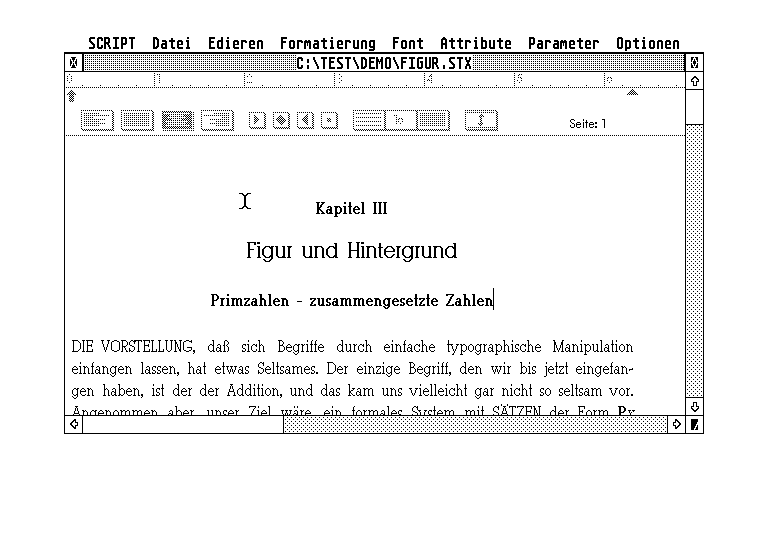
I used Application System Heidelberg's Script II on an Atari 1040STFM with 72 Hz SM 124 black/white monitor and an Epson LQ 550 24 pin printer. That was some superb publishing system for the time (1991), for a low budget.
1 MB RAM, 1.44 MB floppy drive
SM 124: 640x400 pixels, monochrome
https://en.wikipedia.org/wiki/Atari_ST https://www.atarimuseum.de/1040st.htm
The software used a special driver to get better than standard quality from the then most common 24 pin printers (laser printers where much expensive) by kind of double-printing, I forgot the details. It looked really good though.
https://www.planetemu.net/screenshots/Atari%20ST%20-%20Appli...
https://stcarchiv.de/tos/1990/11/script-2 (German)
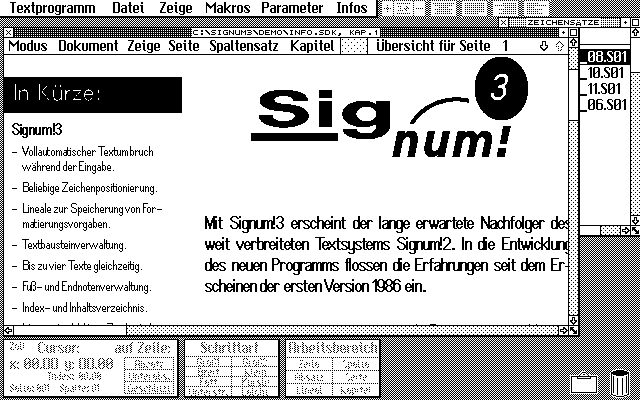
"Script" was the cheap version of their better product "Signum".
I'm curious: the "Script" screenshot looks like it's using standard GEM Desktop, while the "Signum" is some other desktop. Are these both for ST? Was Signum written using some other full-screen graphic environment?
Ah. You will also like another story that popped up here some time back.
A Canadian science-fiction writer, Robert J. Sawyer, made an Archive available complete with extensive resources on how to use it. In addition, fully text-searchable PDFs of the original manuals, totaling over 1,000 pages, were also available. He is a dedicated WordStar user.
I used to use First Word on the ST back in the day.
Wasn’t there a post a few weeks ago by the author of it?
ST Writer was freeware and did the job, but Tempus was gold standard, even better than 1st Word Plus.
Huh, 1st Word Plus was what I had! Sudden recollection of pressing a rhombus-shaped F10 key to reflow after editing ...
There is another one still alive today: https://papyrus.de/en/
I don't use it. But i tried an old version and it was fast as f...
It is written now in C++
I wonder why they don't just make it open source at this point?
Apparently they still hope to make a bit of money out of it:
"I never had a license! Well, even then you can have one - if you absolutely want to. . Depending on your bid, we will then contact you." https://tempus-word.de/en/download/index
I guess they found out they make out more that way than setting up a ko-fi account. It also insures the soft and its legacy doesn't become bloated over time. It is also possible that given it uses old tech (GEM) and probably assembly code, the software as it is would not be more easily portable than it is now using emulators.
I think that's out of date. The banner at the top of the page says "you can request a free license for version 5.4 from us." According to archive.org that was added later than the text you quoted, somewhere between 2022 and 2024.
English not their first language?