Ring owners are returning their cameras
msn.com105 points by c420 3 hours ago
105 points by c420 3 hours ago
Good. But people should not have pointed cameras into public spaces and live streamed everything to the cloud to begin with. Walking past a house with a camera doorbell makes me really uncomfortable, like I'm being watched.
I have a local one (reolink). Prompted by neighbors getting robbed unfortunately. Will this prevent crime? Maybe some but probably not all. But it would let me know if I have to file a stolen package claim or should wait on the package for a few more days. Plus it has been doubling as a trail camera for the local fauna I had no idea came by so frequently. It faces private property only as it is set up.
The local law enforcement will likely not have the time to chase individual small cases either...
Careful what you wish for, local cops have already abused cameras and license plate readers to arrest people just for driving by the location and looking similar to doorbell video, over package theft...
In Poland some moron in surveillance center visually profiled a random guy as one wanted person (by jacket color), then police took the guy to the police station and beat him to death.
Wow. What an infuriating case, again and again. Only 2 years in prison for the perps because the court decided that "excited delirium" killed the guy and not being beaten and tased 4 times.
You can always put the cameras inside the home and disable WAN access. Best of all worlds.
Not sure why you are downvoted. Reolinks work without internet and can stream locally using rtsp. I have a doorbell cam from them and it works fine. If you block it from the internet you only get video and basic doorbell functionality though, which is fine.
Here in Norway, and I assume in much of Europe, it's actually illegal. But that hasn't stopped anyone. The (little) discussion there's been on the topic has mostly centered around car sentry cams, which is very similar in nature. Sadly, the only state authority that seems to care is so underfunded that they can barely cover a fraction of these cases. And there's (rightfully) very little appetite for them to go after pretty much everyone with a relatively new car.
My armchair take is that we need to start going after those who provide the systems. If a regular person buys a streaming doorbell or a car with a sentrycam, it should be up to whoever takes his money and handles those streams to ensure that they're not doing illegal surveillance of public spaces, IMHO.
It's a mess in Europe. It's different everywhere.
In the Netherlands you can record, but only share it with the cops and otherwise you need some clear exception (e.g. dashcam images with minor accidents to your insurer). In all other cases you can either not store them, at least not publicly and all cloud falls under public, or have to inform everyone about their presence on the images, or blurr every identifiable mark (e.g. faces, number plates, names etc). Pretty sure all cloud door cams violate that. So the cops sometimes ask for people's doorcam images, and they are allowed to do that, but likely the people providing them will have recorded it illegally due to it being stored on some cloud account.
This question has already been answered by security footage videos and as long as they are overwritten withing a certain time, stored non publicly and only shared with allowed officials, it's ok.
There are exceptions, but very limited, like clear public good (e.g. whistleblowers).
Once something illegal is culturally accepted it’s very difficult to remove, it requires a cultural shift.
It’s against the law to post cctv onto things like Facebook in the U.K. but people donor all the time. Early on the law could have banned cloud cameras but it’s too late now, far too many people like to answer front their phones. So glad I no ln get deliver pizzas.
>>It’s against the law to post cctv onto things like Facebook in the U.K.
I live in the UK and first time I'm hearing about this - it's definitely illegal to record your neighbours or members of the public without permission, but AFAIK if you are recording videos of your own driveway you can post those anywhere you like since there is no privacy issue there.
Have you got any more info about this?
Edit: let me clarify - sure, there are _circumstances_ under which it's illegal to post a video on facebook, whether it's recorded with CCTV or your phone doesn't matter. But there is no blanket ban on posting CCTV footage anywhere, and your post makes it sound like it is.
It's not illegal to record members of the public without permission in the UK. The test is mostly about whether someone has a reasonable expectation of privacy, but there are all sorts of other considerations:
https://sprintlaw.co.uk/articles/can-you-film-people-in-publ...
I thought the law said it’s illegal to post footage of people without their consent if it’s publicly accessible. Which means videos of some random on your driveway or some random in a public place are treated the same, but this depends on where they’re posted. This doesn’t address the fact that this seems to be generally flouted!
Would love to hear more from a lawyer on this!
you should make sure that the information recorded is used only for the purpose for which your system was installed (for example it will not be appropriate to share any recordings on social media sites)
https://www.gov.uk/government/publications/domestic-cctv-usi...
Data protection laws are very rarely enforced though
Just a quick reminder that in the UK these websites are purely informative in nature and are not actual legislation - they are meant to summarise to the public the nature of the laws but they are not laws themselves. Another good example is the .gov website that says ebikes can have a maximum power output of 250W, while in reality the legislation around ebikes(pedelecs) says the average output measured as described in the relevant industry measuring standard over a period of 30 minutes has to average out to 250W, maximum peak output is actually unlimited. It's an example of authors of the website trying to simplify it a little bit too much so the website isn't 20 pages long. I'm not saying this page you linked is wrong - just that everything you read on there has to be taken through the lens of "this isn't actual legislative text, it's a simplified summary".
>>(for example it will not be appropriate to share any recordings on social media sites)
Again, that's not what the legislation itself says and it's not so black and white. Posting a video from your own driveway of you parking your car would be perfectly legal even if taken from your own CCTV system. Posting a video of a postie that comes to your door every day for no reason other than to identify them would be not.
> Once something illegal is culturally accepted it’s very difficult to remove, it requires a cultural shift.
I agree. And that's sensible. We don't want the law and culture to diverge too much. The former is meant to serve the latter.
But I do still think it would be possible to start going after the suppliers of the services.
> The former is meant to serve the latter.
Bear in mind europe is known for millennia of pogroms and ethnic cleansing (like, I'm sure, many other parts of the world). Sometimes the culture must bend towards the needs of a stable culture.
> Bear in mind europe is known for millennia of pogroms and ethnic cleansing (like, I'm sure, many other parts of the world). Sometimes the culture must bend towards the needs of a stable culture.
Of course. I'm absolutely not saying that culture shouldn't bend. I'm just saying the law must bend to follow culture to some degree.
And let's be clear: it wasn't a change of law that ended the millennia of pogroms and ethnic cleansing. It was culture that changed. Once culture was enough changed for enough people, the law followed and took care of the stragglers.
Goods and products must adhere to regulations banning common wrongdoings. Safety standards, health standards, avoiding financial harm, but also privacy. With this I mean, you are absolutely right! Producers and/or sellers of products violating the standards of the society must be pursued! Common people have the convenience not knowing every and all big and small regulations setting the standards of the society when going into a shop buying gadgets or goods. Those active in a specific area must know the specifics of that area and adhere the rules. Should people be aware of radio emission standards when purchasing things working with electricity and validate themselves if the specific product will adere to those when used? Absolutely no! No chance of that. We, consumers, do not need to be aware and able to tell if some food from the grocery will harm people eating it but those should not be sold or produced in the first place. Same with other products in common - product related usual - situations, other rules, other aspects (here, privacy). Producers must know and avoid specific wrongdoings for the common use scenarios of that specific product.
> and I assume in much of Europe
No. In Poland it's legal to record everything, only when you publish the recordings you need the recorded people to agree.
The core issue is that "nothing to hide nothing to fear" argument is correct as long as the government is trustworthy. Not only that, but mass-surveilance greatly improves life because it allows much better crowd management. Case in point - speed cameras. Would you support the removal of all speed cameras in Norway?
> No. In Poland it's legal to record everything, only when you publish the recordings you need the recorded people to agree.
Interesting. Thanks for this perspective. But for the sake of this debate it's still more or less the same situation.
> The core issue is that "nothing to hide nothing to fear" argument is correct as long as the government is trustworthy.
The government and everyone else who might have access to the data.
> Not only that, but mass-surveilance greatly improves life because it allows much better crowd management.
Hard disagree.
> Case in point - speed cameras. Would you support the removal of all speed cameras in Norway?
No. Speed cameras are different. They do more or less not record people who are not reasonably suspected of committing the crime of speeding. They are more analogous to a doorbell camera (or car sentry system) that only actually starts storing/sharing/streaming data when very good evidence of a crime is in progress. I would, for example, be OK with a camera pointed at a public area if the operator of the camera can prove that the data is only stored whenever say the house's burglary alarm trips (this is equivalent to speed cameras when the induction loop in the ground says that a car passed faster than the speed limit). That minute of recording that may include innocent people in public areas is something I would consider to be in the public good. It's at least very different from a system that monitors continuously.
The fact that nothing is stored in normal circumstances of course needs to be backed up by very public audits. For example the operator would need to release source code and be liable to an enormous fine if state inspectors find that different code actually runs on the device. At least that seems like the ideal situation to me.
> Speed cameras are different.
So basically your entire argument revolves around the government pinky-promising that it won't use the data from speed cameras to track innocent citizens. Because when the network is dense enough, you can tell who went exactly when and where. This isn't any different from Amazon pinky-promising that it will only use data to improve customer experience.
The bigger point I'm making is that mass-surveilance technology does have benefits to the society, and any absolutist "but but but my privacy" who fails to acknowledge them is doomed to lose the debate.
The world is going to be filled with millions of cameras using AI to analyze the video in real time.
Doesn't have to be. Here in the Netherlands it's actually illegal to (permanently) film public space, and people can and will point that out to any offenders.
There's permanent cameras pointed at the street in the red light district in Amsterdam, along with warning signs saying that photographing the women in the windows is illegal.
I think it’s only fair the citizens are allowed to record if the government does it en mass
Funny how a single superbowl ad from Ring themselves was able to do in one weekend what a thousand and one anti Ring bloggers were unable to do for the past 10 years straight. This commercial and the response will probably be studied in marketing classes.
Am I missing something? I thought it was not the ad itself, but rather the combination with the reporting on that Guthrie abduction, which claimed that although there was no subscription to the recording service, the video data was still recovered, i.e., recorded and sent to Google servers.
Regardless of how you see it, although the ad was a kind of manipulative reframing of surveillance infrastructure by using pets as means of psychological manipulation, the Super Bowl ad seems to have just been an unfortunate (or fortunately) timed ad that caused people to glimpse through the cracks in the control matrix being constructed around them.
I don’t think it will really make a difference though. It’s like wildebeest watching their compatriot snatched underwater by a crocodile, to only momentarily pause before venturing right into the same river.
It is very simple, most regular people don't read random blogs, however they do watch Superbowl.
This is to be studied by geeks, how to approach non-technical audiences.
By buying a superbowl ad?
By packing in a message that is understandble by non techies.
Agree with GP, the message by techies wasn't opaque, the choice of message broker just had a different reach.
Getting wildly and widely popular in the generic population? That's what the self proclaimed influencers try to do as well, right?
Well, you will get more people understanding the message if it comes into a YouTube short or TikTok than such blogs.
What happened?
Thanks. This is actually kinda cute. After all the shit Amazon and the company did I am surprised this should be the thing that gets people worried
If it wasn't for the ICE situation there probably wouldn't even be any backlash. It is getting people to finally open their eyes a little bit and see how this post patriot act world we've built for ourselves actually operates.
Ring ran a Superbowl ad showing their cameras being used to find a lost dog. This made people realize they can be used to track people just as easily.
Like escaped child murderers who've kidnapped your child.
Don't worry we track only bad people and if we track someone this means they're bad.
I predict 100 returns in total and then everybody forgets about this in a week. I'm not cheering for this outcome but it's the sad reality.
In their defense, Redditors returning a throwaway piece of electronics then posting about it is probably the biggest sense of accomplishment they'll get all month.
It takes a special level of delusion to think you're pulling one over on the billion-dollar company who just paid millions to advertise this capability during the Super Bowl as if everyone didn't already know.
Hasn't Ring been sharing video with law enforcement for years? Ignoring that zomg ICE is the Reddit cause du jour (these people live for this), did they just now figure out how cloud-connected cameras work?
I fully expect these to all be replaced with generic cameras from Amazon full of security holes, that upload all video to CCP-controlled servers in China.
That's one reason why being in a Reddit bubble is dangerous. Reddit always seems to be boycotting something (including Reddit itself), but those boycotts rarely led anywhere. Then news websites pick up on Reddit as a source of news and the rest is echo effect.
Any good alternatives? Preferably one that stores images on a local docker instance running within my network.
Wonder if this will still be the case now that it’s been announced they are suspending the partnership with Flock.
<adjusting my tinfoil hat> wouldn’t it be easy to circumvent this? They can easily cooperate with some other chain of shady businesses that will cooperate with Flock or government surveillance.
Ring still partners with Axon [1] as part of the Community Requests feature [2]. Since terminating the partnership with Flock is solely a PR play, the answer to your question will likely depend on if consumers en masse use this opportunity to educate themselves on the gravity of the “loss of control (of your data) in exchange for convenience” paradox of cloud services and advocate for additional changes to be made to the Ring platform, or if Amazon’s PR capability will find a way to improve consumer sentiment towards Ring products and services without addressing privacy and surveillance concerns.
[2]:https://ring.com/support/articles/uds27/Community-request
Flock was not the problem. The acts of Ring was the problem (partnering with Flock and forcing opt-in, among many). People bought Ring, people return Ring.
Stallman was right.
It's easy to be right when you live outside the boundaries of reality.
E.g. he won't (didn't?) own a mobile phone, but is okay with borrowing someone else's. He won't use Wi-Fi where he has to log in but would happily borrow someone else's.
It's not being right; it's shifting responsibility in exchange for his own personal convenience.
It's called 'setting an example'.
One might disagree with value of the example being set, but I'm not sure I would characterize his choices as in any way convenient for him.
They he should do without.
Live like the Amish in 2026 (though I assume they have phones now).
It's not setting an example. We have a word for it and it's called being a mooch.
The attitude is consistent with that famous video where RMS explains that he's "never installed GNU/Linux" because he could just ask someone else to do it for him, and suggest others should do the same.
For that matter, why own a car if we can borrow someone else's? Especially with license plate readers and traffic cameras everywhere, who wants to be tracked? Let your friend be tracked instead. That is the level of logic here.
> it's shifting responsibility in exchange for his own personal convenience.
And? That’s actually one of the strategies to counter any risk, if you can’t avoid it or mitigate it, you transfer it.
Is, he’s still with us.
Was, he said it a long time ago. He has said a lot of things that sounded kind of far-fetched and paranoid at the time, but which were later demonstrated to be true, so "Stallman was right" is reappraising the past statement.
I am just happy that the average person is now aware of the usual manipulation tactics, the ad was about “aww doggos!!” and yet no one bought it and back fired.
“You had to live – did live, from habit that became instinct – in the assumption that every sound you made was overheard, and, except in darkness, every moment scrutinized.”
– George Orwell, 1984
Ah, the time before infrared cameras... Makes one think that now we can have cameras that can see as well in what appears darkness for humans.
to get some feeling of it one can watch footage from Ukraine where drones with IR hunt soldiers at night. At the beginning of war, when soldiers didn't yet started to take it into account, there would even be whole groups walking like they would be at night feeling invisible, and that would be the last seconds before the explosion lights up the screen.
These days there is more experience with it, and for example to get "invisible" in IR one of the tricks used by the stormtroopers there is to put on an IR-protective coverall (it works to some extent and for short time) and to walk over warm asphalt.
In general even without IR the regular camera sensors these days are very sensitive, and you can pull a pretty good image out from the darkness by shifting dynamic range well down.
There's been some clips of Russian soldiers walking wearing either a space blanket or a sleepingbag to try and avoid IR. Unfortunately for them in those cases they were dealing with visual spectrum drones...
You don't even need to get so "fancy" [0] as IR cameras. "Nightvision" by way of light amplification has been around for ages. [1] Even the cheap stuff I played with decades ago lit up the night like nobody's business if there was even the smallest amount of moonlight. The downside was that bright lights made the image useless, but if you're building a robot, or running the video feed back to an operator you'd simply have another non-nightvision camera.
[0] Is it fancy if IR camera tech has been around since like the 1980's or 1970's?
[1] Since WWII if Wikipedia is to be believed.
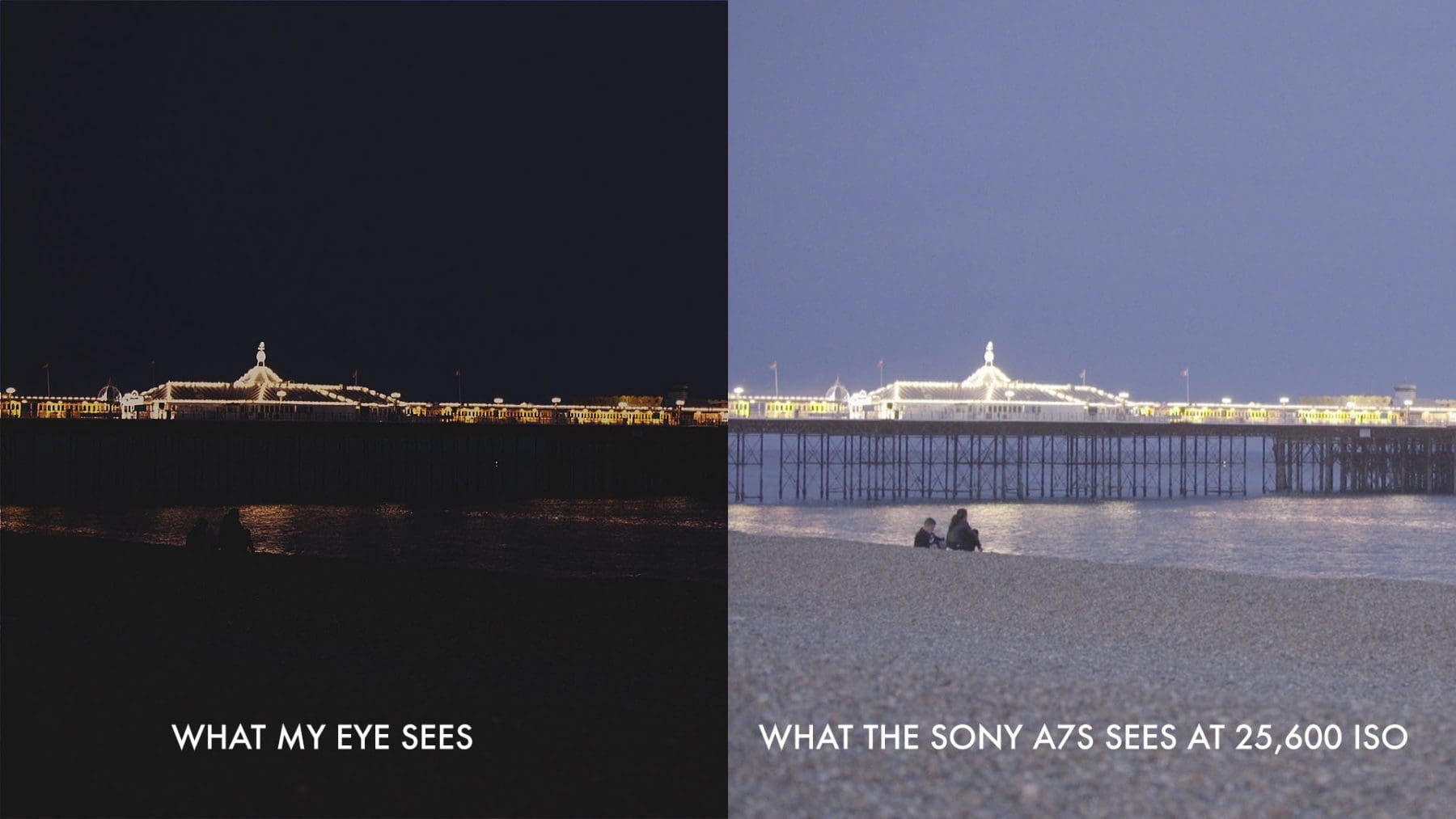
Just an example of what a prosumer camera could do 12 years ago from a Sony A7s:
https://philipbloom.net/blog/wp-content/uploads/2014/07/SONY...
This camera is capable of iso 409,600, 4 stops higher than this image. I mean this is turning night into day.
We talk about video here with requirement to have as many FPS as possible, not static pics from camera with huge sensor and lenses, fixed on tripod like in your link. Try making a night video of the same scene with that same camera, it will be grainy useless crap that any newish cheap phone can triumph easily.
Actually most real cameras had/have subpar videos to normal phones. Small volumes so hard to develop good optimizations in small teams, sensors optimized to the max for still photos. That market is basically slowly dying (I stopped using my full frame too the day my S22 ultra phone came despite lower quality of photos, tried taking it on trips few times but it mostly stayed in the backpack).
Its better now regarding video quality, but if you say travel to exotic places, more than 95% of the folks have phone only. Even those with cameras rarely pull them out unless its proper photo safari.
American surveillance is one thing. All over Europe people install Chinese IP cameras mostly from paranoic and imaginary reasons. Camera literally facing neighbour's windows and doors and their neighbour's own camera. Nobody understands that it's economically impossible to sell IP camera with a mobile app and cloud storage of video for 150 EUR. Their business model is not simply selling cameras.
EDIT. I'm really confused how you concluded that this comment is anti European. Quit whatever drugs and social media if something like this is triggering your paranoia.
All over Europe is generalisation. At least in France, Germany, Switzerland it is too much pain and paperwork to get any camera installed. If you are worried about chinese then seriously you cannot live.
In theory, in practice you can get a random one bought from Temu, and unless some neighbour calls in the authorities, no one will know.
Where is this comment coming from? Why Europe? Are those cameras not used in other places? Are they specifically made for Europe?
Are there sources?
Or is this just a fantasy story?
The usual anti-Europe narrative that is starting to be so common over here.
Weirdly yes. But why is formulated that you can tell it's an American writing text only an American could believe from the first words.
You have American voices in your paranoic brain.
EDIT. Jeez, once had such paranoic psycho as a neighbour in aparthotel in Germany. Boot it, Hans.
> Are there sources?
> Or is this just a fantasy story?
People buy them from Ali, Temu, Allegro, eMAG and install all over the place. Simply freaking take a walk and look around.
> Nobody understands that it's economically impossible to sell IP camera with a mobile app and cloud storage of video for 150 EUR.
Then maybe those cunts can sell a camera without cloud storage for once? Or the one that connects to local hub, like Chinese cameras do?