Doing gigabit Ethernet over my British phone wires
thehftguy.com246 points by user5994461 6 hours ago
246 points by user5994461 6 hours ago
Worth knowing in this context:
Telephones only want a twisted pair. Ethernet, popular with businesses for decades, also wants a twisted pair. Now, that pair must meet much stricter criteria to be suitable, such as Category 5 (for 100Mbit) or Category 5e (1000Mbit ie Gigabit) - but it really is just twisted pair cable, merely a tighter specification than your phone.
Suppose you are a sparky (electrician) and you have some jobs where you are to install telephone connections, some where you put in "Ethernet" (presumably 100baseT would be fine) and some they specifically want you to wire for Gigabit.
You could go to your wholesaler and buy a reel of Cat3 phone cable, a reel of Cat5 100baseT Ethernet, and a third reel of Cat 5e Gigabit cable, and take the right one for each job. So long as you do this flawlessly you can probably save a few pounds every year by using a slightly cheaper cable for some jobs.
Or, you can buy one reel of Cat5e and use that for all these jobs and since it's the same reel you can't have the wrong one and don't need to check paperwork to know you've put the correct cable in a duct etc. Thought that was a phone line but now the client insists it's data? No problem, they're the exact same cable, just smile and agree.
When I bought the place where I live now I wanted GigE to this desk, even though the DSL comes into a different room. I didn't love the idea of cutting holes in walls but I was resigned to maybe needing that, except there's a phone extension in this room (like the author says, we do love phone extensions) and so that room the DSL comes into has a twisted pair to here. I opened up the box, and I'm like huh, that's Cat5e, and sure enough this entire building was wired with Cat5e because like I said, why not, it's basically the same cable, why carry a separate reel?
So I changed the face plates from telephone to Ethernet, and I'm done.
I had the same thing in the house I bought, it was a nice surprise… there were 6 different phone jacks around the house in great locations for Ethernet (WiFi access points or just for a computer), and they all led down to the furnace room where they attached to a punch-down panel (basically they were all spliced into each other.)
To my surprise they were all cat5 cables. With the house being built in 2003 this was surprisingly forward-looking.
I capped all the cables that were on the punchdown panel and put a switch in there instead, and replaced all the wall jacks with RJ45, and bam, working gigabit around the house, including PoE for my WiFi access points. Still haven’t had to punch any holes in the walls.
Same; this was the nicest unexpected surprise about buying this place.
Condo built in 2006 with cat5 . Two bedrooms + living room all wired with rj11 phone jacks. Just snipped those off, wired up rj45, and attached the other ends in my utility closet to a patch panel with rj45 as well.
I don't know if it's just cat5 or 5e, but it saturates a 2.5Gbe link and in-wall cable length is about 15-25 meters.
The only problem with this is that for some god-afwful reason, anything built before the 2010s (?) placed electrical and phone sockets at hip level instead of ankle level. So you're staring at ugly sockets all day.
So sadly you still have to punch holes.
Then again, it isn't that much of a bother if all you have to do is punch a lower hole, relocate the socket and then plaster both holes up and repaint. Especially if you make it a weekend job to do the whole house at once. Or rather, the way I look at it is that it's a weekend job that will improve how the house feels for decades. Doing blind wiring (gutters) for all the ceiling lights falls in the same category.
I think electrical/phone sockets were placed at that level because many telephones were designed to hang on the wall (docking onto and covering up the faceplate) for easy access. My childhood home had one that we used this way before we got a landline.
Alas my 2009 condo conversion was wired with coax to every room instead. I've been using the coax drops to pull Ethernet cables.
Gigabit Ethernet require 4 twisted pairs i.e. 8 individual cables. 100Mb Ethernet requires 2 pairs i.e. 4 individual cables. At least in standard configuration
> Telephones only want a twisted pair. Ethernet, popular with businesses for decades, also wants a twisted pair.
This is why there are two wiring standards, T568A and T568B, with A being compatible with multi-line telephone systems:
> The T568A scheme is based on the older USOC (Universal Service Order Code) standard, which was used for telephone wiring before the advent of high-speed data networks. The USOC standard assigned the green pair to the first line and the orange pair to the second line of a two-line phone system.
* https://www.comms-express.com/infozone/article/t568a-and-t56...
> As of 2018, ANSI/TIA still [recommended] T568A for residential installations for plug-in backward compatibility with old technology like fax machines or a plug-in base station for wireless phone handsets. If you are not using any such devices, or have no intention of plugging ancient RJ11 plugs into RJ45 wall jacks like you would a “phone jack”, then it comes back to personal preference again.
* https://www.truecable.com/blogs/cable-academy/t568a-vs-t568b
* https://www.flukenetworks.com/knowledge-base/application-or-...
As long as both ends of the cable are the same, it does not practically matter which variant is used.
* https://en.wikipedia.org/wiki/ANSI/TIA-568#Wiring
There are also A-B crossover cables (though a lot of NICs can do auto-crossover nowadays):
Ah, mate. I sure wish you'd figured this out and told me about it 10 years ago. I fought with this exact same issue for years.
I live in an old stone farmhouse with my office in a stone garage across a nice poured concrete driveway. There's wires from A to B under all that, but nobody except an unknown electrician from the 80s could tell you even where they come out at either end.
Powerline kinda worked, with crap download speed and just abysmal upload (0.1mbps max), and I limped along with it for years.
When we upgraded to Fibre, that left the old phone line spare, and as luck would have it went straight from the office to the router cabinet in the house. But 80s electrician guy didn't use Cat5, so my genius attempt to use it as ethernet cable ended up slower than the powerline.
My eventual solution was a crazy powerful point-to-point wifi beam blasting straight through the 3 foot thick stone wall to a receiver in the garage below the office. It sets birds on fire from time to time if they fly through it while Helldivers is downloading an update, but it gets the job done.
Still, I might look in to getting one of these things as an upgrade.
Thanks for the writeup!
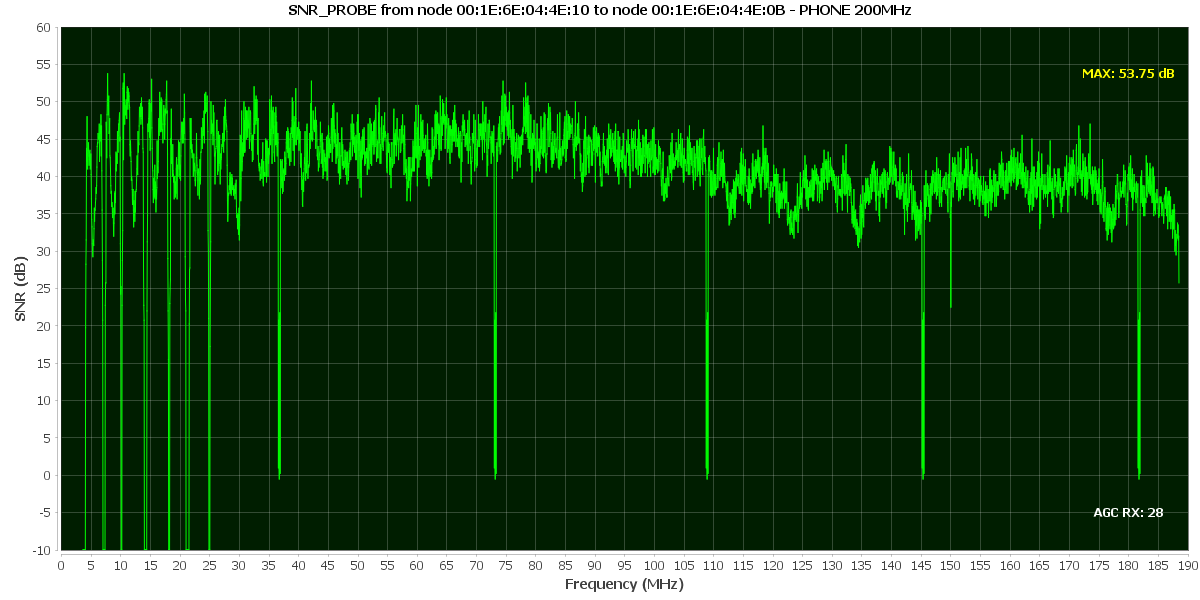
This is a fantastic result, but I am dying to know how the G.hn chipset creates the bit-loading map on a topology with that many bridge taps. In VDSL2 deployment, any unused extension socket in the house acts as an open-circuited stub, creating signal reflections that notch out specific frequencies (albeit usually killing performance).
If the author is hitting 940 Mbps on a daisy-chain, either the echo cancellation or the frequency diversity on these chips must be lightyears ahead of standard DSLAMs. Does the web interface expose the SNR-per-tone graph? I suspect you would see massive dips where the wiring splits to the other rooms, but the OFDM is just aggressively modulating around them.
A view from the the debugging tools since you asked https://thehftguy.com/wp-content/uploads/2026/01/screenshot_...
I don't think there is anything too fancy compared to a DSLAM. It's just that DSLAM are low-frequency long-range by design.
Numbers for nerds, on top of my head:
* ADSL1 is 1Mhz 8Mbps (2 kilometer)
* ADSL2 is 2Mhz 20Mbps (1 kilometer)
* VSDL1 is 15Mhz 150Mbps (less than 1 kilometer)
* Gigabit Ethernet is 100Mhz over four pairs (100 meters). It either works or it doesn't.
* The G.hn device here is up to 200 MHz. It automatically detects what can be done on the medium.
Gigabit Ethernet uses four pairs per direction. It uses the same four pairs in both directions at the same time.
1000Base-T uses two pairs per direction, actually. It's full duplex. Each port sees two TX and two RX pair.
There are four pair of wires in the cable. If you use all of them for TX, you can't receive.
> There are four pair of wires in the cable. If you use all of them for TX, you can't receive.
No, you absolutely can use them all for transmit and receive at the same time. The device at each end knows what signal it is transmitting, and can remove that from the received signal to identify what has been transmitted by the other end.
This is the magic that made 1000Base-T win out among the candidates for Gige over copper, since it required the lowest signaling frequencies and thus would run better over existing cables.
That's not true. https://en.wikipedia.org/wiki/Gigabit_Ethernet#1000BASE%E2%8...
> Basically, you need to follow the tracking regularly until the package is tagged as lost or failed delivery, which is the cue to pay import fees.
> It’s the normal procedure to buy things from Europe since Brexit 2020. It’s actually quite shocking that Royal Mail still hasn’t updated their tracking system to be able to give a status “waiting on import fees to be paid online”. They had 6 years!
Wow.
Another Brexit bonus
It’s no coincidence those that championed Brexit are those that wanted a weaker Europe and weaker U.K.
That’s why the majority of tax payers were against it, the majority of educated people voted against it, the majority of working people voted against it, the majority of people alive today who voted voted against it
Yet we still got it.
It's never to late to rejoin, we've all learned a lot about foreign propaganda in the last decade.
Someone at Davos commented "It took you 7 years to negotiate your way out, it will take you 7 years to regret and then 7 years to negotiate back in".
All while losing all goodies and setting the economy back a decade.
But the remaining wealth of the country has successfully been extracted in the form of overpriced and not-fit-for-purpose utilities, transport companies, taxes, and so on and given to corporate interests. From their perspective it's a resounding success.
Didn’t need Brexit for that - it’s been going on for decades.