Xiaomi MiMo Reasoning Model
github.com482 points by thm a year ago
482 points by thm a year ago
From the paper, I was intrigued by how they handled their RL step for Code Data. They trained against hard but solvable code generation tasks by running unit testing. Is that training step done by the other models?
> Code Data For coding problems, we curate a high-quality training set comprising open-source datasets and our newly collected problem set. We remove problems without test cases. For problems with golden solutions, we exclude those where the golden solution failed to pass all test cases. For problems without golden solution, we discard problems where no test case can be solved in 16 rollouts of advanced reasoning models. Similar to math data, we utilize an SFT version of MiMo-7B to filter out easy problems that are perfectly solved in all 16 rollouts. This rigorous cleaning process yields 30K code problems.
> During each RL iteration, we evaluate thousands of problems to compute the rewards, with each problem potentially containing hundreds of test cases. To improve reward computing efficiency and eliminate GPU idle time, we developed an online judge environment that enables parallel execution of extremely high-volume unit tests.
Is any RL done without unit testing? I would be surprised to hear that that wasn't the case, as it would imply a disregard for accuracy for other model makers, which would be surprising. Perhaps you can do this for small modular problems but not for a problem with a 200k token input?
Why are there so many English-first AI models from China? Are they not interested in serving their own population? Or is it that if they publish Chinese-first models it won't get publicity in the West?
CommonCrawl [1] is the biggest and most easily accessible legally acquired crawling dataset around, collecting data since 2008. Pretty much everyone uses this as their base dataset for training foundation LLMs and since it's mostly English, all models perform well in English.
Haven't we reached a situation where English is the de facto language of scientific research, especially AI benchmarks ?
It's clearly impossible for me to try anything in Chinese, I'd need a translation.
Correct. Lingua franca for at least the last 75 years, if not longer.
For publishing results, yes, but not necessarily for the generation part of it.
Less and less, it feels like, every year. I wonder if anybody has hard numbers on that.
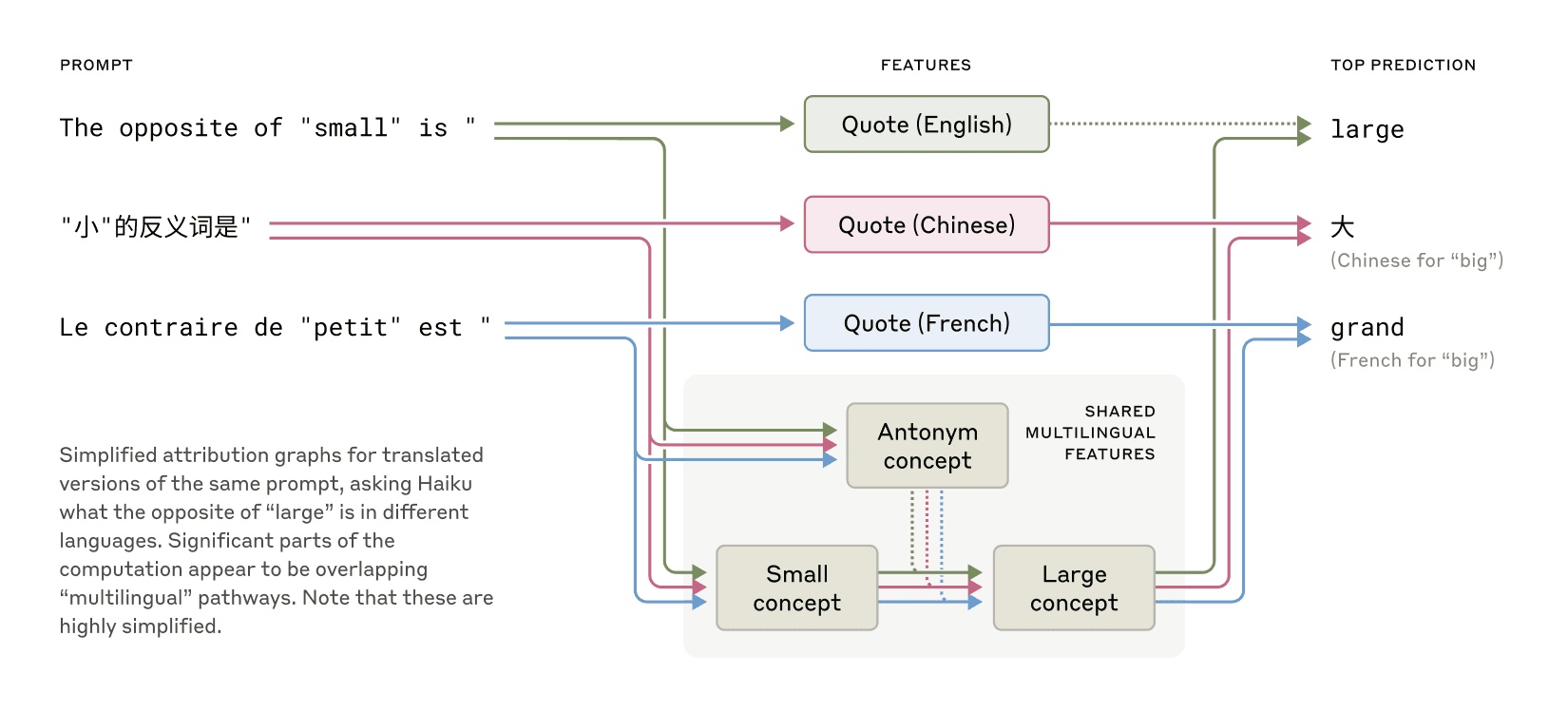
One thing I thought was interesting about this paper [1] on understanding LLMs was how the models associate words/concepts in different languages with each other in what they call Multilingual Circuits.
So the example they give:
English: The opposite of "small" is " → big
French: Le contraire de "petit" est " → grand
Chinese: "小"的反义词是" → 大
Cool graphic for the above [2]
So while English is the lingua franca of the interenet and represents the largest corpus of data, the primary models being built are able to use an English dataset to build associations across languages. This might create significantly stronger AI and reasoning even for languages and regions that lack the data, tech and resources to build local models
[1] https://www.anthropic.com/research/tracing-thoughts-language...
[2] https://www.anthropic.com/_next/image?url=https%3A%2F%2Fwww-...
I assume a large portion of high quality training material is in English
You'd be correct. The largest portion of all languages in Common Crawl (aka the "whole open internet" training corpus) is English with 43%. No other language even reaches double digit percentages. The next biggest one is Russian at 6%, followed by German at 5%.
I wonder where are you getting your data. According to wikipedia russian is #7 https://en.wikipedia.org/wiki/Languages_used_on_the_Internet
Only place where russian is in top 5 is in Wikipedia views. Russian part of internet steadily goes down, as russian imperialism crumbles.
> The largest portion of all languages in Common Crawl
https://commoncrawl.github.io/cc-crawl-statistics/plots/lang...
Thanks!
I wonder where this discrepancy comes from
probably under-indexing of non-english sources by these crawlers.
would be interesting if yandex opened some data sets!
And lots of people write on the web using English as a second language, which both reduces the presence of their native language and increases the presence of English.
yep not a native english speaker here and yet my online footprint is mostly english due to software pushing me to learn it
My guess is that reference counting at depth=1 only capture non-$LANG content which text parts don't matter a lot, e.g. photo galleries.
Chinese internet mostly consists of a few closed gardens tightly controlled by big corps. Crawlers simply don't work when each company employs an army of engineers to guard their data. Many of the most popular websites are also app only. It's impossible to get the corpus necessary to train a good LLM.
DeepSeek claims they had 12% more Chinese tokens than English, in their training corpus for DeepSeek V2, FWIW.
https://arxiv.org/pdf/2405.04434#page=12
> Our tokenized pretraining corpus contains 8.1T tokens, where Chinese tokens are approximately 12% more than English ones.
Do we have estimates on the corpus that is available? This model's repo describes "multiple strategies to generate massive diverse synthetic reasoning data." FWIW, AI 2027 forecasts heavy emphasis on synthetic data creation.
Is the lack of existing corpus just an extra hurdle for Hanzi-first models that are also leading the pack in benchmarks?
All LLMs are trained on the same basic blob of data - mostly in English, mostly pirated books and stuff.
That's wrong.
Many LLMs are trained on synthetic data produced by other LLMs. (Indirectly, they may be trained on pirated books. Sure. But not directly.)
Likely the case for established model makers, but barring illegal use of outputs from other companies' models, a "first generation" model would still need this as a basis, no?
Why illegal? The more open models (or at least open-weight models) should allow using their outputs. Details depend on license.
But yes, 'first generation' models would be trained on human text almost by definition. My comment was only to contradict the claim that 'all LLMs' are trained from stolen text, by noting that some LLMs aren't trained (directly) on human text at all.
>Or is it that if they publish Chinese-first models it won't get publicity in the West?
This is a large part of it. Kai-Fu Lee's company (https://www.01.ai/) has been publishing open source Chinese language/market focused models pretty early, but the entire conversation around Chinese tech just isn't available to you if you don't speak Chinese, in particular these days given that good English language reporting on the Chinese tech sector just seems very scarce.
They are not "English-first". Deepseek-R1, for example, reasons in Chinese when you ask it a question in Chinese.
I've seen one of the ChatGPT models produce the occasional Chinese phrase even when otherwise reasoning in English about a problem given in English.
One reason is that there is no "good" search engine in China. The most popular one, Baidu, is like garbage compared to Google search. The most useful training data in Chinese would likely be from the social media and video sharing platforms, which I guess is much more difficult to crawl and clean up.
A few thousand years of literature ain’t nothing…
Peanuts compared to the discourse available on the internet.
The literature that survived thousands of years are cream of the crop; you won't find lots of random unimportant dialog between people thousands of years ago, but you find that on Reddit.
Given premodern population sizes and literacy rates, historical texts probably don't exist in anything like the quantity that internet posts do. Even if they did, the information may not be relevant to the modern world.
> The most popular one, Baidu, is like garbage compared to Google search
It must be very bad when you see the walking turd that Google search has become over the years…
It is. In Chinese speaking countries where there's google available, no one is using Baidu
There's only ONE* Chinese speaking country, at least if you only count those that have a Chinese speaking majority population, or uses Chinese as the official language.
* for various interpretations of one.
Do any of those countries have a good relationship with China and/or countries from there?
Singapore has a pretty good relationship with China (with all Chinas, actually). And we have plenty of Chinese speakers, too. I'm not sure how prevalent Baidu is, however.
I was under the impression that we just see the English stuff given that we're using English news channels.
I wonder whether English text having fewer characters provides an advantage somehow.
Why are so many American models multi-lingual, supporting hundreds of languages not commonly spoken in the United States?
Could it be that being multilingual results in a larger pool of human knowledge on the technical side compared to training on just a single language or 2. And on the business side, supporting more languages results in a larger TAM (total addressable market). Using english-language dataset for training LLMs is the default, not the other way like you insinuate.
That's clearly a different question. It'd be possible for these models to be Mandarin-first while still supporting other languages, like American models are English-first while doing the same, but that's not what's happening.
> That's clearly a different question. It'd be possible for these models to be Mandarin-first while still supporting other languages
What would a hypothetical "Mandarin-first" model look like to you?
I challenge the notion that the current models are "English-first" - that is an unsubstantiated opinion not supported by fact. I bet, dollars to donuts, these models are SoTA in Mandarin as well. When framed that way, asking "Why are they marketed as English-speaking models outside of China" or "Why are they really good at English" are simply not interesting questions - they have obvious answers.
> What would a hypothetical "Mandarin-first" model look like to you?
Given a language-agnostic prompt like "12 + 89", any explanatory text it outputs could be expected to be in Mandarin most of the time.
According to this test, Xiaomi's MiMo-7B-RL is an English-first model.
"12 + 89" uses the latin alphabet and is in no way language-agnostic in this context. I expect borrowed constructs to appear relatively more frequently in the language they were borrowed from.
Now I'm curious how Mistral models would respond to a "language-agnostic" phrases like "Rendezvous" or "coup d'etat"
You may think of these symbols as "Latin" because they're how people writing in Latin script happen to write mathematical expressions, but the exact same symbols are also used by Mandarin speakers, as well as in numerous other scripts. Writing math in Chinese characters is literally as uncommon as someone writing "twelve plus eighty-nine" in English.
In contrast, your examples would be spelled « rendez-vous » and « coup d’État » in French, i.e. easily distinguishable from their English descendants.
> You may think of these symbols as "Latin" because they're how people writing in Latin script happen to write mathematical expressions
No need for scare-quotes, Latin script is a proper noun and a technical term with precise meaning wrt text encoding - not "what I think."
> the exact same symbols are also used by Mandarin speakers, as well as in numerous other scripts. Writing math in Chinese
Which unicode code points do the Mandarin speakers and "numerous other scripts" use to write "12 + 89"? Could it be the very same code points as Latin script, which then are tokenized to the same vectors that the LLMs learn to associate more with English text rather than CJK in the latent space?
> i.e. easily distinguishable from their English descendants.
You're making broad assumptions about the tokenization design here that do not apply universally.
Precisely because the exact same codepoints are used for digits and mathematical symbols, there's nothing script-specific about them and their linguistic association is determined by the training data mixture. A model trained predominantly on text scraped from Chinese websites would learn to associate them more with Mandarin than English in the latent space, since that would be the context where they most often appear.
English won. The Chinese youth struggle to write their own calligraphy characters they can read now. Typing favors English.
Source?
This smacks of "I saw a headline once"-itis. Especially the fact that you refer to the Chinese characters as "calligraphy characters", as if that were the general term or something.
These are probably the headlines they're thinking about,
https://www.globaltimes.cn/content/747853.shtml
https://www.bbc.com/news/blogs-china-blog-28599392
Or more recently this one about character amnesia
https://globalchinapulse.net/character-amnesia-in-china/
None of these really mean that English has won, though. Rather that phonetics-based writing systems are easier to remember and use, especially in conjunction with digital systems that make it easy to map sound and context to symbols.
I wouldn't be surprised if characters are faster to read though. In English we have all these subconscious shortcuts like looking at the shape of the word, first and last letters, etc. But I think symbology can convey more at a glance. Thus the popularity of emoji
Ah no, I know myself that there have been headlines here and there.
I'm pretty sure there was some controvery in the linguistic blogging community even at some stage over the last couple of years, with someone writing an essay claiming the Chinese character system was in some sense less advanced and maybe on the way out, and this leading to a serious response or two, the usual fiery academic affair. I can't locate it this instant though.
I moreso meant for OP's low-effort dramatisation to not go unanswered. Framing it as "winning" some sort of language battle is particularly silly.
Your musings are interesting though, and the topic certainly is a fascinating one. Languages that use morphemes for writing are wild. Symbology is a cool word also - surely there has to be a lisp blog somewhere with that word in the title.
The pendulum already turned back. The current generation under 20 grew up with touchscreens. That obseletes input with pinyin; many don't care if the device has no keyboard.
Input is so interesting in China, basically a sorta t9 but just single letters and picking the right characters, with common/frequently used characters first, using pinyin. For example to say “ How are you?” You just type “nhm” (Ni Hao Ma) and 你好吗 shows up as suggestion/autofill. You can make surprisingly long sentences using this method.
> That obseletes input with pinyin
Uh? Pinyin input is by far the most popular input technique in China. I rarely see anyone using handwriting input.
That being said, it has nothing to do with English winning. It's just a Chinese input technique that uses the latin alphabet. English fluency in China is not very common, especially spoken English.
My father-in-law here in China uses handwriting input, but everyone else I've seen here uses Pinyin, and it's totally fast and natural for them.
And very true about the English. With some exceptions (of course), folks here maybe know a handful of words at best, and even then, pronunciation is usually pretty rough. People here really aren't using it; they are perfectly comfortable with their Chinese, and why wouldn't they be?
Anyone saying otherwise clearly hasn't been here to see it firsthand.
Just like German is written with almost the same alphabet as English, but that doesn't give you English fluency.
If only Unicode decomposed Chinese characters on a per basic stroke basis: it would be so much easier to have keyboards following that.
This has nothing to do with Unicode and everything to do with input methods, of which there are a variety. Some methods are indeed shape-based like you suggest: https://en.wikipedia.org/wiki/Chinese_input_method#Shape-bas...
By the looks of it, Pinyin (a phonetic one) won by a landslide, which I suspect this is the result of a long effort by the Chinese government to install Mandarin as the official language of China, above regional dialects (different regions would write similar characters but pronounce them differently, and defaulting to Pinyin has this "nice" effect of having people "think of how it would be pronounced in Mandarin first", even when the result are characters that would be read by a Cantonese speaker).
Nearly everyone in the urban areas of China spoke some English when I visited way back in 1995. It's a bilingual society.
This is not true. I was in Beijing around then and never met a single person who spoke English if they hadn't learned it for professional reasons (they worked in tourism, international business, etc.).
It could not have been further from a bilingual society.
I suppose you probably were visiting some university districts/CBDs where people likely to have received higher education. Elsewhere, aside from basic "hello"/"how are you", locals in general are not able to communicate in English.
I lived in Beijing and Shanghai for 9 years (2010-2019) and this is NOT my impression at all.
Not sure which part you were in, but this is just not true in my experience. I've been to Beijing, Shenzhen, Guangzhou, and some others, and Mandarin really is a must if you want to even have a chance of communicating. I can't imagine how I'd function here if I only had English.
I've not yet been to Shanghai, and while I would expect the English-speaking percentage to be a bit higher, it would still likely only be in the single-digits by my estimation.
The mandarin language models obviously exist, but what would you do with them if they provided access to them? And what knowledge would be in them? What is the body of knowledge encoded in Mandarin? What does that look like?
Sad reality is that not many outside of China have the facility with Mandarin to use those models. Even non-native Mandarin speakers who claim to be "fluent", are often messing up intended meaning in text. Or making literal translations that wind up making no sense.
Inside of China, llm use will be Mandarin based. Outside, it seems to me English is the natural choice.
Irony of Irony, probably the best way for a non Mandarin speaking layman to test a Mandarin based model would be to use another LLM to translate prompts to Mandarin.
It's a sad future we're looking at.
Or a brilliant one.
Time will tell.
For it to be brilliant, AI needs to be a benevolent tool all the time. It would take just a few malignant actors to turn our world upside. I suspect it'll follow the same Internet and social media path. Great at first, grow markets, bring us together and then take a turn.
You’re right of course. That’s why these open source / weight releases are so critically important.
> Even non-native Mandarin speakers who claim to be "fluent", are often messing up intended meaning in text. Or making literal translations that wind up making no sense.
Happens with English as well, but non-native speakers of English still benefit from these models.
This is incredibly strong coding performance for a 7b. I use Gemini Pro 2.5 which got 67.8 and this got 57.8, very close to Gemini 2.5 Flash which got 60.6.
I've become pretty skeptical about eval results given what we've heard about llama4 so we'll see where this lands on the closed evals but very impressive to see.
GGUF version (for LM Studio, Ollama, etc): https://huggingface.co/jedisct1/MiMo-7B-RL-GGUF
When you guys use gguf files in ollama, do you normally create a modelfile to go with it, or just hope that whatever default ollama has work with the new model?
https://github.com/ollama/ollama/blob/main/docs%2Fmodelfile....
One of the core design goals Georgi Gerganov had with GGUF was to not need other files. It's literally bullet point #1 in the specs
>Single-file deployment
>Full information: all information needed to load a model is contained in the model file, and no additional information needs to be provided by the user.
https://github.com/ggml-org/ggml/blob/master/docs/gguf.md
We literally just got rid of that multi file chaos only for ollama to add it back :/
Most of the parameters you would include in ollama's ModelFile are things you would pass to llama.cpp using command line flags:
https://github.com/ggml-org/llama.cpp/blob/master/examples/m...
If you only ever have one set of configuration parameters per model (same temp, top_p, system prompt...), then I guess you can put them in a gguf file (as the format is extensible).
But what if you want two different sets? You still need to keep them somewhere. That could be a shell script for llama.cpp, or a ModelFile for ollama.
(Assuming you don't want to create a new (massive) gguf file for each permutation of parameters.)
If you ollama pull <model> the modelfile will be downloaded along with the blob. To modify the model permanently, you can copypasta the modelfile into a text editor and then create a new model from the old modelfile with the changes you require/made.
Here is my workflow when using Open WebUI:
1. ollama show qwen3:30b-a3b-q8_0 --modelfile
2. Paste the contents of the modelfile into -> admin -> models -> OpenwebUI and rename qwen3:30b-a3b-q8_0-monkversion-1
3. Change parameters like num_gpu 90 to change layers... etc.
4. Keep | Delete old file
Pay attention to the modelfile, it will show you something like this: # To build a new Modelfile based on this, replace FROM with: # FROM qwen3:30b-a3b-q8_0 and you need to make sure the paths are correct. I store my models on a large nvme drive that isn't default ollama as an example of why that matters.
EDIT TO ADD: The 'modelfile' workflow is a pain in the booty. It's a dogwater pattern and I hate it. Some of these models are 30 to 60GB and copying the entire thing to change one parameter is just dumb.
However, ollama does a lot of things right and it makes it easy to get up and running. VLLM, SGLang, Mistral.rs and even llama.cpp require a lot more work to setup.
Sorry, I should have been clearer.
I meant when you download a gguf file from huggingface, instead of using a model from ollama's library.
ollama pull hf.co/unsloth/Qwen3-30B-A3B-GGUF:Q4_K_M and the modelfile comes with it. It may have errors in the template or parameters this way. It has to be converted to GGUF/GGML prior to using it this way. You can, of course, convert and create the specific ollama model from bf16 safetensors as well.
Yeah when I do this, the modelfile has only FROM and TEMPLATE. No PARAMETERs:
  ollama pull hf.co/jedisct1/MiMo-7B-RL-GGUF:Q4_K_M
ollama show --modelfile hf.co/jedisct1/MiMo-7B-RL-GGUF:Q4_K_MPretty sure the whole reason Ollama uses raw hashes everywhere is to avoid copying the whole NN gigabytes every time.
Maybe I am doing something wrong! When I change parameters on the modelfile, the whole thing is copied. You can't just edit the file as far as I know, you have to create another 38GB monster to change num_ctx to a reasonable number.
The parameters (prompt, etc.) should be set only in the new modelfile (passed to `ollama create`), using a FROM referencing the previous ollama model. Parameters in a Modelfile override the hard-coded parameters from the GGUF itself (which are sometimes buggy); in fact from elsewhere in the thread it sounds like Mimo is missing proper stop tokens, or maybe templates in general; I'm not an expert).
This will show a separate entry in `ollama list` but only copy the Modelfile not the GGUF.
Alternatively, if you use the API, you can override parameters "temporarily". Some UIs let you do this easily, at least for common parameters.
I’ll typically use the defaults initially and then use a Modelfile if it’s something I plan on using. I think you can dump the modelfile ollama uses to have a template to work with.
Its funny to see benchmarks where they omit the top performing models like O3 (Which is the best model in many benchmarks currently) and Gemini Pro/Claude 3.7.
Those are much much larger models, and they are proprietary. Those model providers just don't have the distilled versions identified and available.
Notice most of the models they are comparing with are 7B models. The exception is also an open weights model (Qwen-2.5-32B-RL-Zero). Even with 32B parameters the MiMo-7B outperforms it.
I believe the goal here is to compare them against similar models that are being optimized to run offline or on mobile hardware.
MiMo-7B claims to outperform larger models like Qwen-32B and match OpenAI o1-mini on math/code benchmarks — all with a 7B model trained from scratch. Is this a sign that pretraining + RLHF optimization is finally outpacing scale? Or are we just getting better at benchmarking narrow capabilities?
The README says "RL" without specifying what kind of RL is used. Researchers: I know you are busy, and I know good writing takes time, but please don't skip this kind of detail.
The technical report does go into a lot of depth about how they use RL, such as the modified GRPO objective they use. As far as the README, I imagine most people active in the field understand the implications of "RL" for a reasoning model.
I assume they mean "Reinforcement Learning", and it's been a decade since I studied AI in university, but isn't it perfectly valid to just say "RL"? What kind of specificity are you looking for, whether they used Q-Learning or some other algorithm?
I wouldn’t phrase it as a matter of “validity”. I would phrase it as a question of transparency.
Putting a model out in public without clearly explaining how it works doesn’t meet my bar for a proper scientific exchange of knowledge. Perhaps they are being intentionally vague for competitive reasons.
RL is a generic term that can be mixed and matched with various other methods. In the context of LLMs, often some variation of RLHF is used.
But the authors don’t even say “RLHF”, much less explain their methodology. Understanding this isn’t just a matter of academic interest; it has implications for understanding and using this work.
I’m often concerned by the writing quality of ML/AI papers but this strikes me as particularly disappointing.
It is increasingly important to have confidence that the creators of AI systems are thoughtful and thorough. I want to see their reasoning. I want to understand the trade-offs they make and why.
If you put it like that, I absolutely agree with you, except that I suppose I don't really consider this an exchange of knowledge but more like the release of an open-source project: the only thing they need to publish are instructions on how to use it. I don't think they’re really interested in anyone improving their model by themselves or reproducing the work. It would be amazing if they did, though!
I wonder if they will use this model for their AI assistant on their Xiaomi 15 series phones. They most likely will. I'm not really sure what to expect from it.
These benchmark numbers cannot be real for a 7b model
The smaller models have been creeping upward. They don't make headlines because they aren't leapfrogging the mainline models from the big companies, but they are all very capable.
I loaded up a random 12B model on ollama the other day and couldn't believe how good it competent it seemed and how fast it was given the machine I was on. A year or so ago, that would have not been the case.
exactly, it seems to validate my assumption from some time ago, that we will mostly use local models for everyday tasks.
yeah especially that this simplifies e.g. doing mobile app for 3rd party developers - not extra cost, no need to setup proxy server, monitoring usage to detect abuse, don't need to make complicated subscription plan per usage.
We just need Google or Apple to provide their own equivalent of both: Ollama and OpenRouter so user either use inference for free with local models or BringYourOwnKey and pay themself for tokens/electricity bill. We then just charge smaller fee for renting or buying our cars.
Not just local models but bespoke apps. The number of bespoke apps I've created shot up dramatically in the last 6 months. I use one to do my recipes/meal plan every week. I have one that goes through all my email addresses and summarizes everything daily. I just finished an intelligent planner / scheduler for my irrigation system that takes into account weather forecast and soil moisture levels. If something is annoying and there is no commercial solution or open-source solution that has the features I want I just make it now and it's fantastic.
I've had friends/family ask to use some of them; I declined. I don't want to do support / feature requests.
As someone who hasn't used AI for "real" app development (mainly just getting ChatGPT to generate small functions & scripts), do you have any recommendations on what tools or resources I should use to get started with this?
Cursor/Cline/Windsurf are my recommendations for clients. For models stay away from Sonnet 3.7. I find it just lies to you. I'd rather you a slightly less capable model like Sonnet 3.5 where I know it will just make mistakes that won't compile.
I do my planning with a combination of Grok3, and higher power OpenAI models. Once I have plan of what I want to build, I create an implemenation_plan.md with all the steps to build my solution. (Generated by the higher power models) I carefully review this plan and if it looks good, I throw it into agent mode and get to work.
Including figuring out which more expensive models to use when needed instead of doing that by default. Early LLMs were not great at reasoning and not great at using tools. And also not great at reproducing knowledge. Small models are too small to reliably reproduce knowledge but when trained properly they are decent enough for simple reasoning tasks. Like deciding whether to use a smarter/slower/more expensive model.
strong agree
my employer talks about spending 10s of millions on AI
but, even at this early stage, my experiments indicate that the smaller, locally-run models are just fine for a lot of tech and business tasks
this approach has definite privacy advantages and likely has cost advantages, vs pay-per-use LLM over API.
I spend a lot of time working with smaller models, I often had to split the problem into smaller subtasks to make it give acceptable accuracy. With the big models in the cloud you can often get things working much faster, it seems like a tradeoff in engineering time. What was your experience?
But who will keep them updated and what incentive they would have? That's I can't imagine. Bit vague.
Eventually? Microsoft and Copilot, and Apple and Siri - even if they have to outsource their model making. It will be a challenge to desktop Linux.
I figure this will take the same shape as package distribution. If you have ever used a linux distribution you’ll always see a couple .edu domains serving you packages. Big tech might be able to have specialized models, but following the linux paradigm, it will likely have more cutting edge but temperamental models from university research
Who keeps open source projects maintained and what incentive do they have?
Most open source projects don't need the kinds of resources that ML development does. Access to huge GPU clusters is the obvious one, but it's easy to forget that the big players are also using huge amounts of soulcrushing human labor for data acquisition, cleaning, labeling and fine tuning, and begrudgingly paying for data they can't scrape. People coding in their free time won't get very far without that supporting infrastructure.
I think ML is more akin to open source hardware, in the sense that even when there are people with the relevent skills willing to donate their time for free, the cost of actually realizing their ideas is still so high that it's rarely feasible to keep up with commercial projects.
That's a fair point. I think GPU clusters are the big one, the rest sounds like a good fit for volunteer work.